How to use this calculator
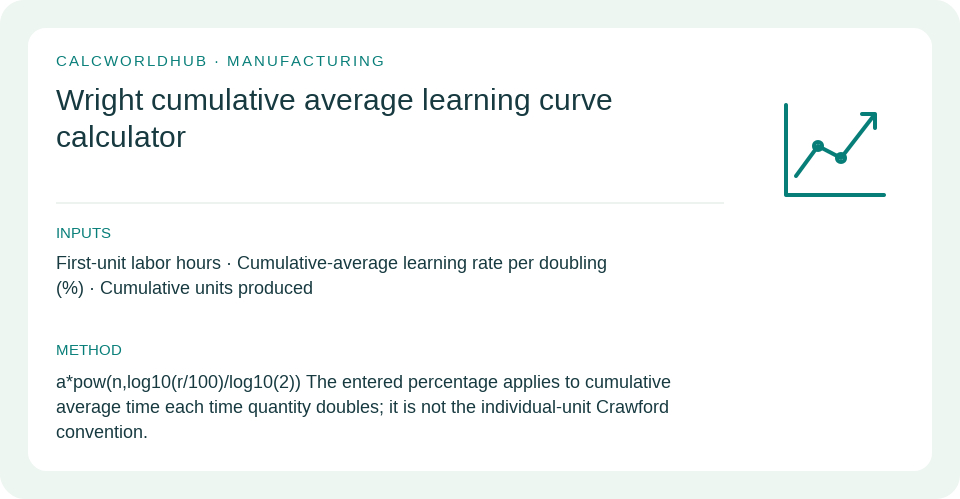
Estimate cumulative average labor and total labor under Wright’s learning-curve convention.
- Enter First-unit labor hours, Cumulative-average learning rate per doubling (%), Cumulative units produced. Match the units shown beside each field and review the result together with the assumptions below.
- Read the worked example below to check the expected input format and result.
- Compare another scenario by changing one input at a time. Use Reset to return to the starting values.
Wright cumulative average learning curve explained
Wright’s cumulative-average model applies the learning percentage to average labor hours per unit whenever cumulative output doubles. The power-law exponent converts that doubling rule into an estimate for any entered cumulative quantity; it is not a unit-by-unit Crawford curve.
Inputs, symbols, and units
a— First-unit labor hours- First-unit labor hours.
r— Cumulative-average learning rate per doubling (%)- Cumulative-average learning rate per doubling (%).
n— Cumulative units produced- Cumulative units produced. Enter a whole number.
Formula and method
a*pow(n,log10(r/100)/log10(2))
The entered percentage applies to cumulative average time each time quantity doubles; it is not the individual-unit Crawford convention.
A worked scenario
First-unit labor hours = 10; Cumulative-average learning rate per doubling (%) = 80; Cumulative units produced = 16.
- Cumulative average labor: 4.096 hours/unit
- Total cumulative labor: 65.536 hours
An 80% rate gives exponent log₂(0.8)≈−0.321928. Sixteen units are four doublings, so average labor is 10×0.8⁴=4.096 hours/unit and total cumulative labor is 16×4.096=65.536 hours.
Assumptions and edge cases
The entered percentage applies to cumulative average time each time quantity doubles; it is not the individual-unit Crawford convention.
Frequently asked questions
What does an 80% rate mean?
Cumulative average time becomes 80% of its previous value after each doubling.
Is the result time for unit n?
No, it is average time through unit n.
Can rate exceed 100%?
This learning-only version does not model deterioration.
How do I use the Wright cumulative average learning curve calculator?
Enter First-unit labor hours, Cumulative-average learning rate per doubling (%), Cumulative units produced. Match the units shown beside each field and review the result together with the assumptions below.
What is a worked example of Wright cumulative average learning curve?
First-unit labor hours = 10; Cumulative-average learning rate per doubling (%) = 80; Cumulative units produced = 16. Cumulative average labor: 4.096 hours/unit Total cumulative labor: 65.536 hours An 80% rate gives exponent log₂(0.8)≈−0.321928. Sixteen units are four doublings, so average labor is 10×0.8⁴=4.096 hours/unit and total cumulative labor is 16×4.096=65.536 hours.
Read our calculation methodology.