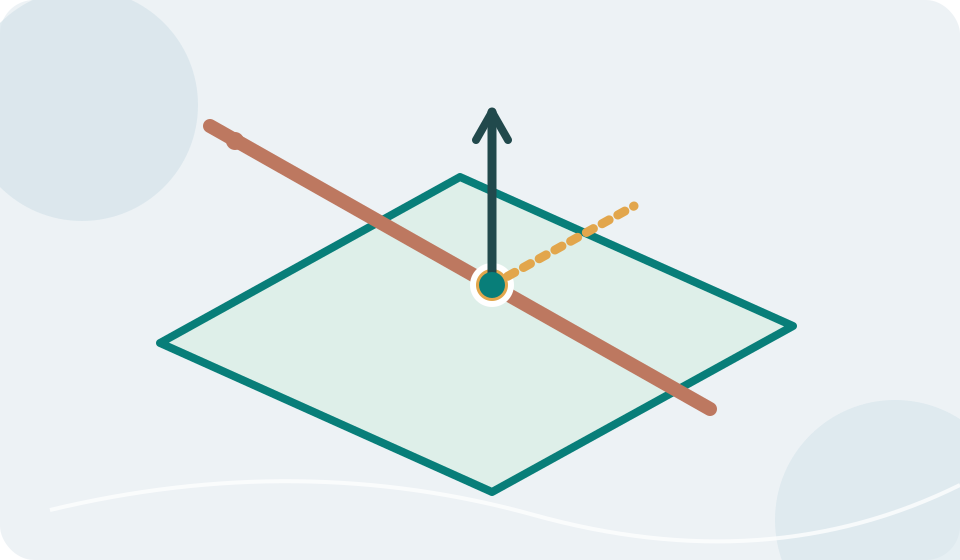

Represent the line and plane
A line through P with direction u is X(t)=P+t u, where t can be any real number for an infinite line. A plane through Q with nonzero normal n contains exactly the points X satisfying n·(X−Q)=0. The dot product is zero because every vector lying within the plane is perpendicular to its normal.
This representation does not require a slope or a special coordinate orientation. It works when a line is vertical in a 2D drawing or when a plane cannot be written conveniently as z=f(x,y). The direction vector must be nonzero, and the normal must be nonzero; their magnitudes can be scaled without changing the geometric line or plane.
Derive the parameter instead of guessing a point
Substitute X(t)=P+t u into the plane equation: n·(P+t u−Q)=0. Distribute the dot product to get n·(P−Q)+t(n·u)=0. If n·u is nonzero, solve t=n·(Q−P)/(n·u), then put that parameter back into P+t u to obtain the intersection coordinates.
The denominator n·u measures how much the line direction points along the plane normal. A large nonzero value gives a clear crossing; a zero value means the line is parallel to the plane. If the parallel line also lies in the plane, every point on it is shared, so there is no unique intersection point to return.
Worked examples
Example 1 · horizontal plane z=6
Inputs: P=(0,0,0), u=(1,2,3), Q=(0,0,6), n=(0,0,1).
Calculation: t=6/3=2; P+2u=(2,4,6); n·(X−Q)=0.
Intersection=(2,4,6), t=2.
Example 2 · shifted starting point
Inputs: P=(1,0,0), u=(1,1,2), Q=(0,0,10), n=(0,0,1).
Calculation: t=10/2=5; P+5u=(6,5,10).
Intersection=(6,5,10), t=5.

Check the first parameter and point
For P=(0,0,0), u=(1,2,3), Q=(0,0,6), and n=(0,0,1), the numerator n·(Q−P) is 6 and the denominator n·u is 3. Therefore t=2 and P+2u=(2,4,6). Substituting that point into z=6 confirms it lies in the plane; subtracting P shows it also lies on the line.
A robust verification checks both representations, not only the rounded displayed point. For the line, each coordinate should equal Pᵢ+t uᵢ using one common t. For the plane, n·(X−Q) should equal zero. If either check fails, revisit vector order, signs, and the chosen point/normal before assuming the tool is wrong.
Understand parallel and nearly parallel cases
A line parallel to a plane has n·u=0 in exact arithmetic. If n·(Q−P) is also zero, the line lies inside the plane; otherwise it never reaches the plane. The calculator reports both situations as having no unique intersection, rather than choosing an arbitrary point or returning an infinite set.
The runtime also treats a small denominator relative to the vector magnitudes as parallel: it rejects when |n·u| is at most 10⁻¹²|n||u|. This scale-aware tolerance avoids unstable intersections from nearly parallel inputs, where a tiny coordinate change could move the calculated point a very large distance. The threshold is a floating-point policy, not a change to the exact geometric definition.
Use the right problem geometry
The calculator models an infinite line. It does not limit t to a segment interval or a ray direction. If the geometry is a segment from P to R, the candidate point belongs only when its line parameter falls in the segment’s allowed range; for a ray, t must respect the ray’s start and direction. Those tests are separate from solving the plane equation.
All point and vector components should use a common Cartesian coordinate system and compatible linear units. Scaling the direction u changes the numerical value of t but not the intersection point; scaling n changes numerator and denominator together, leaving t unchanged. These invariances are useful checks when values are entered in a different but consistent scale.
Verify a computed intersection
After entering P, u, Q, and n in the labeled order, calculate n·u and n·(Q−P) by hand. Their quotient gives t, and each output coordinate should follow Pᵢ+t uᵢ. Then evaluate n·(X−Q); a value close to zero is the plane residual. Keep full precision while checking because the displayed coordinates are rounded to eight decimal places.
If the answer is surprising, first test a simple plane such as z=c with n=(0,0,1), then compare the result with direct substitution for z(t). A positive or negative t is both valid for an infinite line. It only becomes a directional restriction for a ray or segment, which the current inputs do not encode.