
Match the number of payments to periods
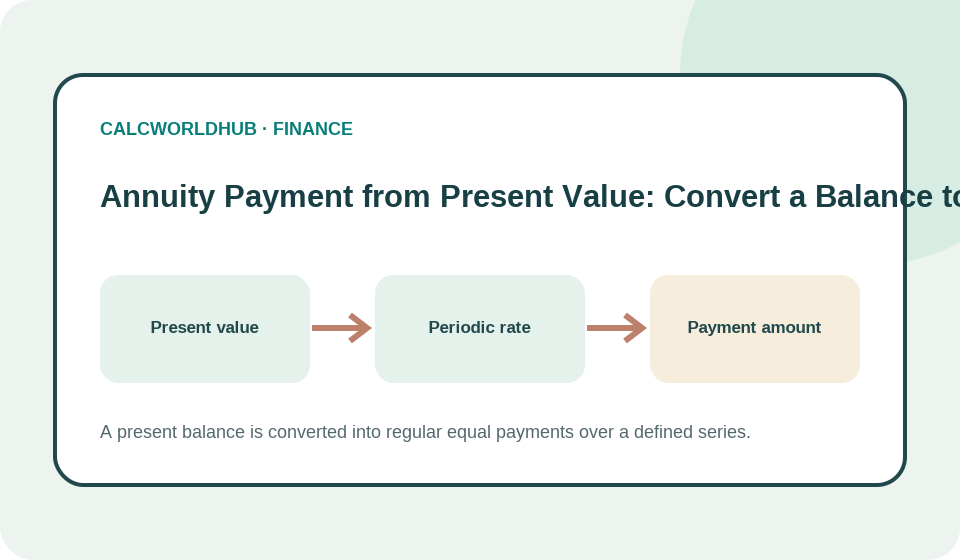
Enter the present value, a positive whole number of payments, and the interest rate per payment period. If payments are monthly, use a monthly periodic rate, not an annual rate copied into the field. The tool does not convert an APR into a monthly rate or determine how compounding is defined.
The field labels number of payments n and interest rate per period. That pairing is essential: 24 monthly payments require 24 monthly periods. If the stated rate is annual, convert it according to the contract or model convention before entering it.
Understand ordinary-annuity timing
The payment formula is PV × r ÷ (1 − (1+r)^−n) for a nonzero periodic rate. It treats payments as occurring at the end of each period, the ordinary-annuity convention. A payment due at the start of each period is an annuity due and would have a different payment relationship.
At a zero periodic rate, present value is divided evenly by the number of payments. The calculator uses that separate case instead of dividing by zero in the annuity factor. Both cases assume equal payments and a constant rate throughout the series.
Read the result as a per-period amount
The output is one equal payment per period in the currency of the present value. It is not automatically monthly: the interval is whatever the inputs define. If n is 36 and the rate is monthly, the output is monthly; if the input rate and payment timing use another interval, interpret it on that interval.
A financial product may include fees, insurance, taxes, variable rates, irregular first periods, or a residual balance. None of those are additional inputs here. Compare the calculator’s assumptions with the contract before using the payment as an estimate of an actual obligation.
See how rate and term affect a payment
For a fixed present value and payment count, a higher positive rate increases the payment needed to represent the same current value. For a fixed rate, spreading repayment over more periods generally lowers each payment but extends the series. These statements follow from the ordinary-annuity model and assume the other inputs are unchanged.
If you compare two scenarios and alter both rate and payment count, explain both changes. A different payment can result from either variable, so attributing it solely to interest would be misleading. Keep the present value constant when isolating the effect of a rate or term change.
Keep present value distinct from total paid
Multiplying the payment by the number of periods gives the nominal sum of the scheduled payments under the model. That total is not the same as present value when the periodic rate is positive, because payments occur at different times. The calculator reports a payment, not a separate total-interest calculation.
For an amortizing loan, an actual schedule also depends on compounding, payment dates, fees, and whether payment rounding changes the last installment. Use the lender’s schedule for contractual totals. The formula here shows the time-value relationship, not a product’s complete cost.
Check precision before comparing offers
Keep the full formula precision until the final display rounding. A result shown to cents may cause small differences when multiplied back by n; that does not mean the underlying annuity equation failed. Record the periodic rate, payment count, and timing convention with the displayed amount.
OpenStax presents present-value annuity formulas with an explicit payment timing convention. When a real cash-flow stream has beginning-of-period payments, unequal amounts, or changing rates, use a model that represents those details rather than adjusting this output informally.
Worked examples
The examples use a periodic rate and matching number of periods, with payments at period end.
A two-year series at 0.5% per period
Inputs: PV = $12,000; rate = 0.5% per period; payments = 24, end of period.
Calculation: Payment = $12,000 × 0.005 ÷ (1 − (1.005)^−24) = $531.8473, or $531.85 per period.
The ordinary-annuity payment is about $531.85 every period for 24 end-of-period payments.
A longer series at a lower periodic rate
Inputs: PV = $25,000; rate = 0.25% per period; payments = 60, end of period.
Calculation: Payment = $25,000 × 0.0025 ÷ (1 − (1.0025)^−60) = $449.2173, or $449.22 per period.
This is a mathematical ordinary-annuity amount; fees and a real contract’s payment rules are outside the model.
