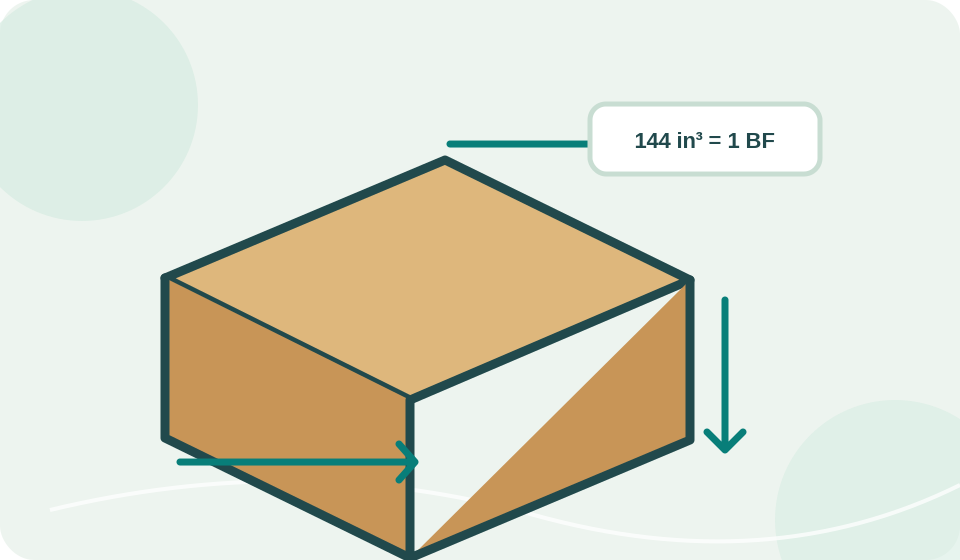

Read the board-foot unit
One board foot is a volume equivalent to a board 12 inches by 12 inches by 1 inch, or 144 cubic inches. In the calculator’s mixed-unit formula, thickness in inches × width in inches × length in feet ÷ 12 produces board feet. The conversion works because one foot contains twelve inches.
The unit describes volume, but lumber trade practice may use nominal dimensions for board-foot measurement. The U.S. Forest Service glossary explains that, for lumber at least one inch thick, board-foot calculations in practice use nominal thickness and width with actual length. Confirm the basis used by the yard or quote before comparing totals.
Enter one-piece dimensions and count
Thickness and width are in inches; length is in feet; pieces must be a positive whole number. Each dimension must be greater than zero. The calculator’s examples and output refer to volume based on the numbers entered, so record whether those figures are nominal board sizes or measured dressed dimensions.
A 2 × 6 × 8-foot piece produces 8 board feet under the nominal-size formula. If you instead enter a dressed width such as 5.5 inches, the result is smaller. The formula does not infer a nominal 6-inch width from the number 5.5 or reverse a supplier’s surfacing process.
Multiply consistently when pieces differ
This tool assumes every counted piece has the same dimensions. For a mixed order, calculate each size group separately and add the resulting board feet. Do not place several thicknesses or lengths into a single field and multiply by one combined count; that would assign the same volume to every piece.
The interface displays total board feet to two decimal places and per-piece volume to two places in the supporting line. Those display values may be rounded; use the original dimensions for a more precise subtotal. The calculator adds no waste factor, price, species density, drying shrinkage, or defect allowance.
Distinguish board feet from other quantity measures
Board feet are not the same as linear feet, piece count, or cubic feet. Two orders with equal board-foot totals can have different sizes and lengths, which affects handling and use. A board-foot total also does not establish structural capacity or tell you whether the lumber has the required grade for a span.
If a project is priced per thousand board feet, multiply the calculated total by the quote’s price basis only after confirming the supplier’s units and rounding. Keep dimensions, count, species, grade, moisture condition, and delivery basis with the estimate. The deck board calculator reports linear feet for parallel deck rows; it answers a different material-planning question.
Check the order basis before comparing quotes
For rough lumber or a lumberyard quotation based on nominal dimensions, use the stated nominal thickness and width. For a geometric volume based on measured dressed dimensions, enter those actual dimensions but describe the result that way. The tool’s “Nominal dimensional volume” note reflects a lumber convention; it does not apply an automatic conversion between nominal and actual size.
For mixed sizes or a contractual order, reconcile the total against the supplier’s tally rather than relying on a single calculator. The board-foot unit can be used in commerce under different grading and rounding practices. This calculator is a transparent dimensional calculation; it does not decide which trade rule controls a quote.
Worked examples
The first example uses standard nominal dimensions. The second intentionally uses the dimensions entered as written; it does not convert actual dressed stock back to nominal size.
Twelve nominal 2-by-6 boards, eight feet long
Inputs: Thickness 2 in; width 6 in; length 8 ft; 12 pieces.
Calculation: Per piece = 2 × 6 × 8 ÷ 12 = 8 BF; total = 8 × 12 = 96 BF.
The calculator displays 96 board feet. This follows the entered nominal 2-by-6 dimensions and the stated eight-foot length.
Twenty pieces entered at 1.5 by 3.5 inches
Inputs: Thickness 1.5 in; width 3.5 in; length 10 ft; 20 pieces.
Calculation: Per piece = 1.5 × 3.5 × 10 ÷ 12 = 4.375 BF; total = 4.375 × 20 = 87.5 BF.
The display rounds the per-piece line to 4.38 BF and shows 87.5 board feet total. No nominal-size adjustment is made to the 1.5-by-3.5 inputs.
