Decking board estimator
Plan board rows and approximate linear footage for a rectangular deck, including the allowance you choose.
inputs.
Calculator
How to use this calculator
Estimate decking board rows and linear footage from deck dimensions, installed board width, spacing, and a waste allowance.
- Enter Deck length along boards (ft), Deck width (ft), Board face width (in), Gap between boards (in), then complete the remaining labeled fields. Match the units shown beside each field and review the result together with the assumptions below.
- Read the worked example below to check the expected input format and result.
- Compare another scenario by changing one input at a time. Use Reset to return to the starting values.
Estimate board rows and linear footage for a rectangular deck
This estimator lays boards along the entered deck length and fills the deck width with board faces plus gaps. It rounds the row count up, then adds the requested extra-length allowance.
Inputs and units
- Deck length along boards (ft): The length of one board run, in feet.
- Deck width (ft): The distance across the rows, in feet.
- Board face width (in): The installed board face, in inches; do not use nominal lumber width if the actual face differs.
- Gap between boards (in): The open spacing between neighboring board faces.
- Extra length allowance (%): A planning allowance applied after the row count, for cuts and waste.
Formula and method
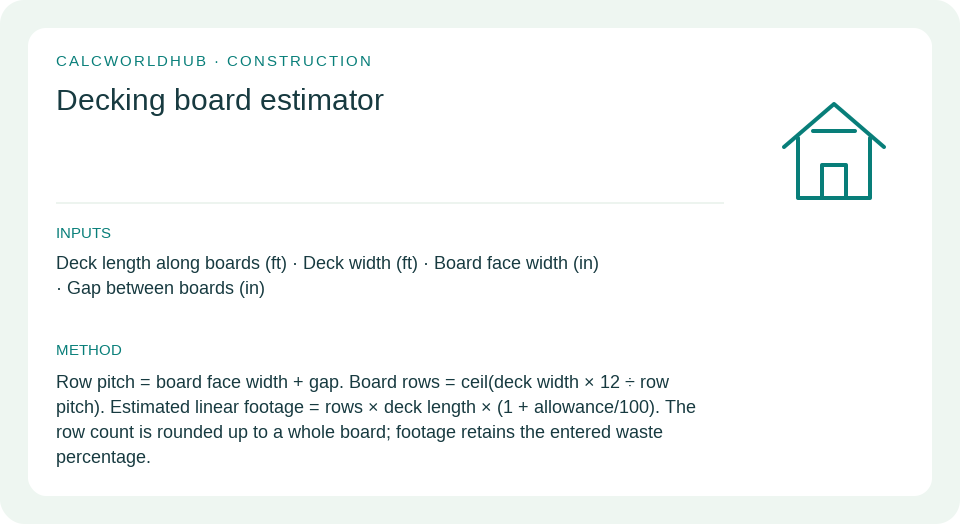
Row pitch = board face width + gap. Board rows = ceil(deck width × 12 ÷ row pitch). Estimated linear footage = rows × deck length × (1 + allowance/100). The row count is rounded up to a whole board; footage retains the entered waste percentage.
Worked example
For a 16 ft × 12 ft deck using a 5.5 in face and 0.125 in gap, the pitch is 5.625 in. The 144 in deck width needs ceil(144 ÷ 5.625) = 26 rows. With 10% extra, footage is 26 × 16 × 1.10 = 457.6 linear ft.
Interpreting the result
Plan for 26 board runs along the 16 ft dimension, or about 458 linear feet including the stated allowance. Convert that total into the lengths sold by your supplier and account for the cutting layout.
Assumptions and limits
The model assumes a flat rectangle with parallel, full-length rows. It does not add stairs, picture-frame borders, diagonal patterns, blocking, seams, or material lost to damaged boards. Confirm actual installed face width and spacing from the chosen product instructions.
Frequently asked questions
Does the allowance include a cutting plan?
No. It adds a percentage to total linear footage. A board-by-board cut layout may use more or less material depending on stock lengths and deck geometry.
How do I use the Decking board estimator?
Enter Deck length along boards (ft), Deck width (ft), Board face width (in), Gap between boards (in), then complete the remaining labeled fields. Match the units shown beside each field and review the result together with the assumptions below.
What is a worked example of Decking board estimator?
For a 16 ft × 12 ft deck using a 5.5 in face and 0.125 in gap, the pitch is 5.625 in. The 144 in deck width needs ceil(144 ÷ 5.625) = 26 rows. With 10% extra, footage is 26 × 16 × 1.10 = 457.6 linear ft.
What does the Decking board estimator calculate?
Estimate decking board rows and linear footage from deck dimensions, installed board width, spacing, and a waste allowance.
What assumptions apply to Decking board estimator?
The model assumes a flat rectangle with parallel, full-length rows. It does not add stairs, picture-frame borders, diagonal patterns, blocking, seams, or material lost to damaged boards. Confirm actual installed face width and spacing from the chosen product instructions.
Good calculators show their work.
CalcWorldHub is built around clear inputs and visible assumptions. Results are estimates for planning; check official sources or your provider’s terms when exact figures matter.