
Measure the joint the sealant will occupy
Start with the total length of the joints that share a similar cross-section. The calculator accepts metres for length and millimetres for width and sealant depth. Width and depth should describe the portion filled with sealant, not the full cavity when a backer rod or other filler occupies part of it. Use consistent measurements for each segment.
Real joints may be triangular, rounded, concave, irregular, or filled over a backer rod. A simple rectangular cross-section is only a volume approximation. If different joint sizes are present, calculate each group separately and add the cartridge requirements after accounting for each product’s package volume.
Separate joint design from quantity arithmetic
The dimensions determine an estimated geometric volume, but they do not establish that the joint is properly designed. Sika’s technical guidance explains that width, depth, movement, and backing affect sealant performance; its recommended profiles depend on the product and application. Do not copy a general width-to-depth ratio into a project without checking the product instructions and applicable specification.
Backer rod can limit sealant depth and help avoid unwanted adhesion to the back of the joint. The calculator has no field for bond breaker, primer, substrate movement, temperature, or product type. Enter the intended sealant depth after the joint detail is settled; this estimate is not a substitute for that design step.
Convert metres and millimetres into millilitres
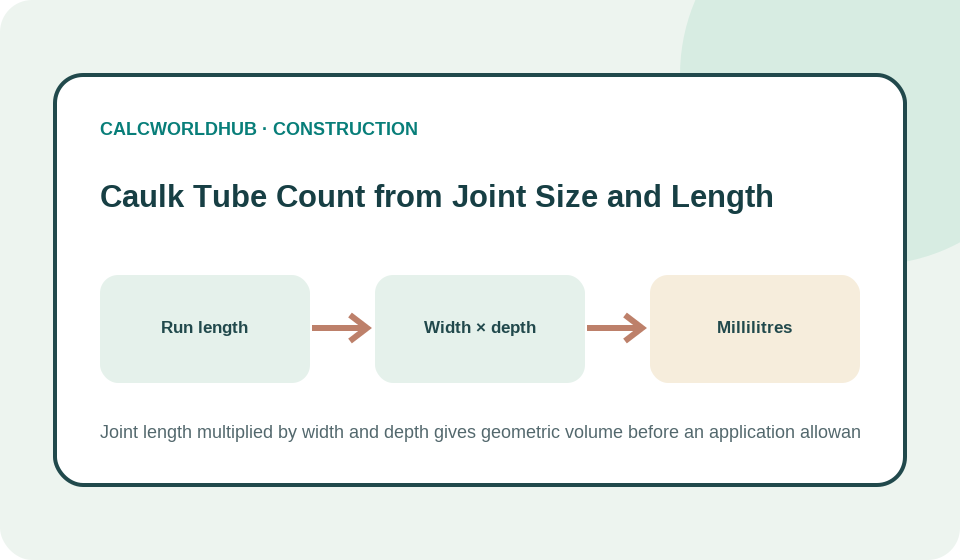
A one-metre run contains 1,000 millimetres. Multiplying that length by a width and depth in millimetres gives cubic millimetres; 1,000 cubic millimetres equal one millilitre. Those factors cancel, so the joint volume in millilitres is numerically length in metres times width in millimetres times depth in millimetres.
The optional application allowance increases the calculated volume by one plus its percentage divided by 100. The adjusted millilitres are divided by the tube volume shown on the cartridge, then rounded upward because the estimate counts complete tubes. Use the net fill volume, not the container’s outside dimensions or a product’s weight, unless the label explicitly converts that weight to usable volume.
Read the tube count as a planning quantity
The geometric joint volume and the volume with allowance are shown separately so the difference stays visible. A small surplus after rounding is normal when a job needs a whole cartridge. It does not mean that the extra sealant can always be used on another joint: cartridge shelf life, color batch, nozzle waste, and interruption between work areas can affect what remains usable.
For one long uniform joint, an application guide may report linear coverage for a specified bead size. That figure is tied to its exact tube size and cross-section. Compare it with this volume estimate only when the dimensions and package volume match; otherwise the two numbers describe different assumptions.
Confirm joint geometry and product instructions
Before purchasing, verify total length and measure several points if the gap varies. Check the cartridge fill volume, the manufacturer’s joint preparation guidance, and whether backer rod or primer is required. Add separate line items for dissimilar joint profiles rather than averaging them into one width and depth that no actual joint uses.
This estimator does not recommend a sealant chemistry, predict movement capability, assess adhesion, or certify a watertight or fire-rated assembly. Exterior exposure, substrate compatibility, and project requirements matter. Use it for the transparent volume-and-tube calculation, then follow the applicable product data and installation specification.
Worked examples
Joint volume is calculated in millilitres before adding the allowance and rounding to a full cartridge.
A uniform joint filled from 300 mL cartridges
Inputs: Total length = 24 m; width = 8 mm; depth = 5 mm; tube volume = 300 mL; allowance = 10%.
Calculation: Joint volume = 24 × 8 × 5 = 960 mL. Volume with allowance = 960 × 1.10 = 1,056 mL. Tubes = ceil(1,056 ÷ 300) = ceil(3.52) = 4 tubes.
Four complete cartridges provide 1,200 mL of nominal fill volume. The calculation estimates a rectangular bead and does not remove volume for a backer rod unless the entered depth already excludes it.
A wider, deeper joint with 600 mL packs
Inputs: Total length = 37 m; width = 10 mm; depth = 8 mm; tube volume = 600 mL; allowance = 12%.
Calculation: Joint volume = 37 × 10 × 8 = 2,960 mL. Volume with allowance = 2,960 × 1.12 = 3,315.2 mL. Tubes = ceil(3,315.2 ÷ 600) = ceil(5.5253…) = 6 tubes.
Six packs are required by the whole-tube rule. The wider and deeper section raises joint volume per metre, while the larger cartridge volume offsets some of the count; the selected allowance is applied only once.
