How to use this calculator
Estimate sealant tubes from joint length, joint width, depth, and tube volume. Free calculator with formula, example, and assumptions.
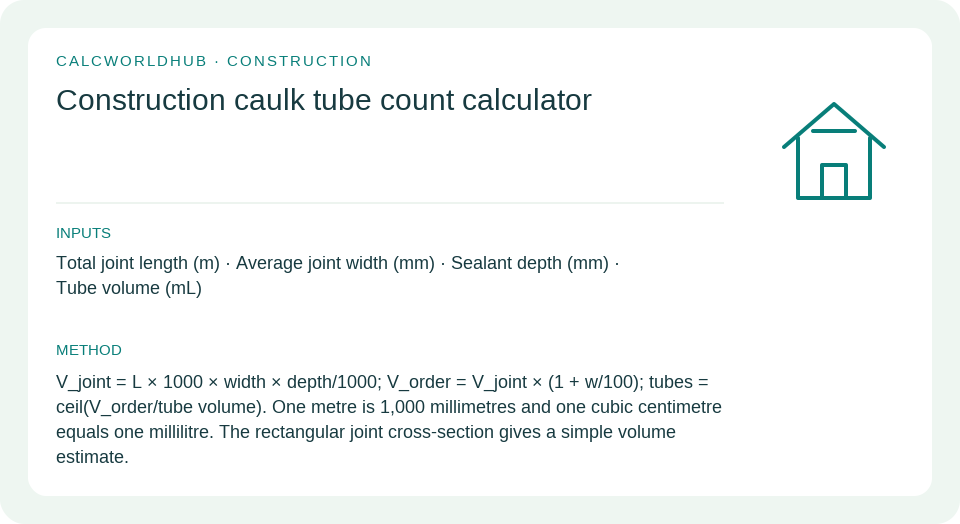
- Enter Total joint length (m), Average joint width (mm), Sealant depth (mm), Tube volume (mL), then complete the remaining labeled fields. Match the units shown beside each field and review the result together with the assumptions below.
- Read the worked example below to check the expected input format and result.
- Compare another scenario by changing one input at a time. Use Reset to return to the starting values.
How the estimate works
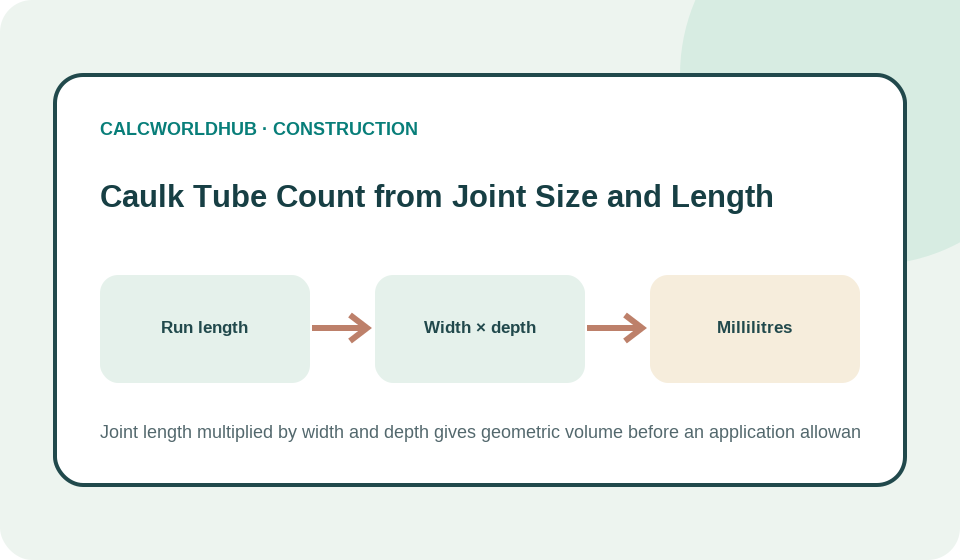
Estimate sealant volume from the length and rectangular cross section of a joint. The model adds the entered allowance to that geometric volume, divides by usable tube volume, and rounds the purchase count upward to whole tubes.
Inputs and units
jointLength— Total joint length (m)- Add the lengths of the joints to be sealed.
jointWidth— Average joint width (mm)- Use the average opening width.
jointDepth— Sealant depth (mm)- Enter the target sealant depth, excluding backer rod.
tubeVolume— Tube volume (mL)- Read the fill volume on the cartridge.
wastePct— Application allowance (%)- Optional allowance for start/stop waste and uneven joints.
Formula and method
V_joint = L × 1000 × width × depth/1000; V_order = V_joint × (1 + w/100); tubes = ceil(V_order/tube volume).
One metre is 1,000 millimetres and one cubic centimetre equals one millilitre. The rectangular joint cross-section gives a simple volume estimate.
Worked example
For 38 m of 8×6 mm joints, geometric volume is 38,000×8×6 = 1,824,000 mm³ = 1,824 mL. With 15% allowance that is 2,097.6 mL; 300 mL cartridges require 7 tubes.
Assumptions and limits
Real bead profiles may be concave, triangular, or backer-rod filled. Use manufacturer guidance for joint design, compatible sealant, and practical coverage.
Frequently asked questions
Should backer rod volume be counted?
No. Enter sealant depth after accounting for backer rod or other joint backing.
Why does the result differ from a label’s linear coverage chart?
Labels may assume a specific bead profile or joint geometry. Use the product chart when it matches your joint.
Does this choose an exterior sealant?
No. Select a sealant compatible with the substrates and exposure conditions.
How do I use the Construction caulk tube count calculator?
Enter Total joint length (m), Average joint width (mm), Sealant depth (mm), Tube volume (mL), then complete the remaining labeled fields. Match the units shown beside each field and review the result together with the assumptions below.
What is a worked example of Construction caulk tube count?
For 38 m of 8×6 mm joints, geometric volume is 38,000×8×6 = 1,824,000 mm³ = 1,824 mL. With 15% allowance that is 2,097.6 mL; 300 mL cartridges require 7 tubes.
Read our calculation methodology.