
What one boundary measurement can tell you
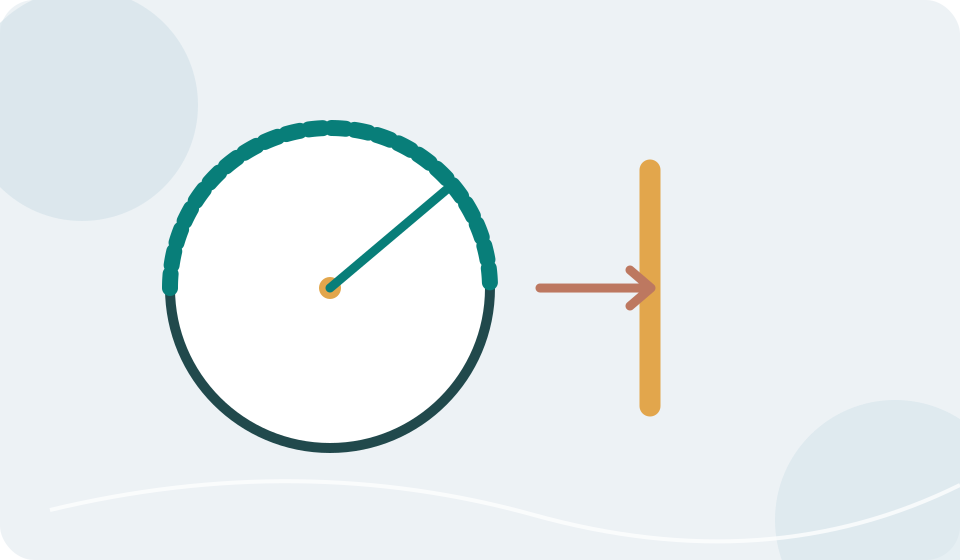
Circumference is the distance around a circle. If a flexible tape, wheel rotation, or drawing gives the full boundary length, the radius and diameter follow because every circle has the same ratio of circumference to diameter, π. The area then follows from the recovered radius. This is useful when the perimeter is easier to measure than a center-to-edge distance, but it assumes the outline is actually circular.
The input is one circumference value C in a chosen length unit. The output radius r and diameter d use that same unit; area A uses its square. Entering 31.4159 centimetres therefore produces centimetres and square centimetres. The calculator does not convert units automatically, so do not mix a circumference in inches with measurements expected in millimetres later in the job.
Formula and dimensional checks
The equations are d = C/π, r = C/(2π), and A = C²/(4π). The radius is half the diameter, so r = d/2. The area expression is the ordinary circle formula πr² after substituting r = C/(2π). These equivalent forms make it possible to verify each reported dimension without relying on the same calculator output twice.
Check units as well as arithmetic. Dividing a length by a dimensionless constant leaves a length, so C/π and C/(2π) remain linear measurements. Squaring C produces a squared length, and division by 4π does not change that dimension. A result labelled as area should never be compared directly with the input circumference because they describe different physical quantities.
Read the outputs for the task at hand
Choose the output that matches the question. A lid or circular panel may need a diameter for sizing and an area for surface coverage. A belt, trim strip, or path around a circular object may need circumference. If the boundary value was measured from a physical object, the derived dimensions inherit the measurement uncertainty; extra decimal places in a result do not make the original tape measurement more precise.
Radius and diameter scale directly with C: doubling circumference doubles both. Area scales with C squared, so doubling the circumference makes the derived area four times as large. That difference is a useful interpretation check. A small percentage error in the perimeter creates about twice that percentage error in the computed area, before accounting for rounding or any departure from a perfect circle.
Measure a full circle and stay within the model
Measure one complete loop along the circle’s boundary, keeping a flexible tape on the intended edge rather than across the circle. For a wheel, a marked full rotation can estimate circumference as distance traveled per revolution. Remove slack and note whether the measurement follows an outside rim, an inside opening, or a centerline; those are different circles and produce different dimensions.
The source runtime requires a positive circumference and supports values up to 1,000,000,000,000 in the chosen unit. A value of zero has no circle to recover. The model also cannot correct for an oval, an uneven rim, tape stretch, or a path that is not planar. When the object is irregular, a perimeter measurement alone is not enough to infer a single radius or circle area.
Verify the result from the recovered dimensions
After obtaining r and d, calculate πd and compare it with the entered C. Separately check that 2r equals d. Then calculate πr² to confirm the area. These checks use the basic definitions of a circle and catch common mistakes such as halving the circumference twice, reporting radius as diameter, or carrying a linear unit into the area field.
For a reusable calculation record, keep the original circumference, its unit, the measurement method, and the number of significant digits. Preserve the unrounded values for downstream work when available, then round only when the task calls for it. If a later drawing provides an independent diameter, compare πd with the measured circumference before deciding which measurement should govern the design.

Worked examples
A circumference of 10π centimetres
Inputs: C = 31.4159265359 cm.
Calculation: r = C/(2π) = 5 cm; d = C/π = 10 cm; A = C²/(4π) = 25π = 78.53981634 cm².
Radius = 5 cm, diameter = 10 cm, and area ≈ 78.5398 cm².
A circumference of 6π metres
Inputs: C = 18.8495559215 m.
Calculation: r = C/(2π) ≈ 3 m; d = C/π ≈ 6 m; A = C²/(4π) ≈ 9π = 28.27433388 m².
Radius ≈ 3 m, diameter ≈ 6 m, and area ≈ 28.2743 m².