
Understand the segment height
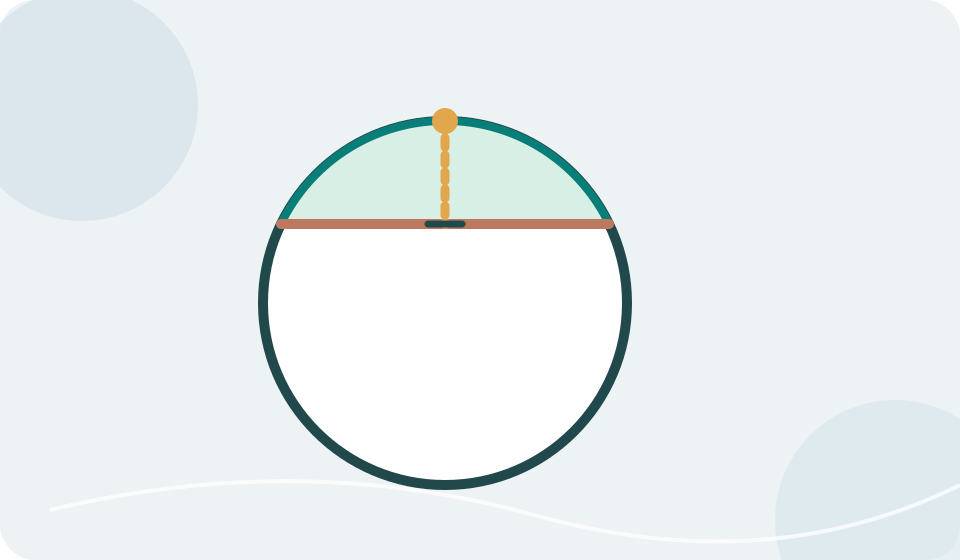
A chord divides a circle into two segments. The minor sagitta is the short perpendicular distance from the chord to the nearer arc. It is not the radius, the arc length, or the distance from the chord to the center. The selected calculator returns the minor-segment height for a radius and chord from the same circle.
For r = 13 and c = 10, half the chord is 5. A right triangle gives the distance from the center to the chord as √(13² − 5²) = √144 = 12. The height is 13 − 12 = 1 unit. When r = 10 and c = 12, that center-to-chord distance is √(100 − 36) = 8, so the sagitta is 2 units.
Formula and geometric derivation
The formula is h = r − √(r² − (c/2)²), where h is sagitta, r is radius, and c is chord length. The perpendicular from the center to a chord bisects the chord, producing a right triangle whose hypotenuse is r and whose half-width is c/2. The square-root term is the center-to-chord distance.
All lengths must use one unit. If r and c are in millimeters, h is in millimeters; if they are in inches, h is in inches. The runtime also reports the central angle 2 asin(c/(2r)) in degrees, which provides an independent geometric interpretation of the same chord. It does not accept an angle as an input.
Validate the chord before calculating
A valid chord ranges from zero to the circle diameter 2r. If c = 0, both endpoints coincide and the sagitta is zero. If c = 2r, the chord is a diameter and the minor sagitta equals r, corresponding to a semicircle. A value above 2r cannot fit on that circle and is rejected by the source runtime.
The radius must be positive. The runtime uses the field registry’s positive-radius minimum and checks the chord against twice the radius. Keep this validation in the explanation: a very large chord value is not fixed by rounding, and it should not be silently capped. Confirm the source measurements and units if the inequality fails.
Use sagitta in measurement and layout
Sagitta is useful when a shallow curve is described by a straight span and a rise: for example, checking the crown above a chord in a circular arch, rim, or template. It helps turn two accessible dimensions into a circle-based height. The result still assumes a perfect circular arc; a flexible spline or parabola can have the same chord and rise but a different radius elsewhere.
For a shallow arc, the sagitta can be small relative to both radius and chord. The subtraction r − √(r² − (c/2)²) may therefore be sensitive to small measurement errors. Do not interpret the final decimal places as field accuracy. Keep the original measurements, compare the computed height with a direct measurement when possible, and round only for the drawing or construction tolerance you actually need.
Compare height and angle
At a fixed radius, increasing chord length increases the minor sagitta and central angle. At a fixed chord, a larger radius makes the arc flatter, so the sagitta decreases. For r = 13, c = 10 gives h = 1 and an angle of about 45.23973°. With the same chord but r = 20, the height is 20 − √975, about 0.7597 units: the wider circle is flatter across that span.
The output angle is the central angle for the minor segment, from 0° through 180°. A diameter gives 180°. The calculator does not describe the major segment’s complementary height across the far side, nor infer a radius from height alone. If a drawing labels the major arc or uses a different reference side, identify which segment the dimension refers to before applying this result.
A repeatable check and common errors
To verify, halve the chord, square that half, subtract from r², take the square root, and subtract the result from r. For r = 10 and c = 12, this gives 10 − √(100 − 36) = 10 − 8 = 2. Then check the reported angle: 2 asin(12/20) is about 73.739795°. The same units must appear in every length term.
Do not put the diameter in the radius field, and do not use half the chord as though it were the full chord. Either error changes both the triangle and the calculated height. Another common mistake is to add the square root to the radius; the center-to-chord distance lies inside the circle, so the minor sagitta is their difference.

Worked examples
A 10-unit chord in a radius-13 circle
Inputs: Radius r = 13 length units; chord c = 10 length units.
Calculation: h = 13 − √(13² − (10/2)²) = 13 − √144 = 1 unit; θ = 2 asin(10/26) = 45.2397298961°.
Sagitta = 1.00000000 unit; central angle = 45.23972990°.
A 12-unit chord in a radius-10 circle
Inputs: Radius r = 10 length units; chord c = 12 length units.
Calculation: h = 10 − √(10² − (12/2)²) = 10 − √64 = 2 units; θ = 2 asin(12/20) = 73.7397952917°.
Sagitta = 2.00000000 units; central angle = 73.73979529°.