
Set one common elevation datum
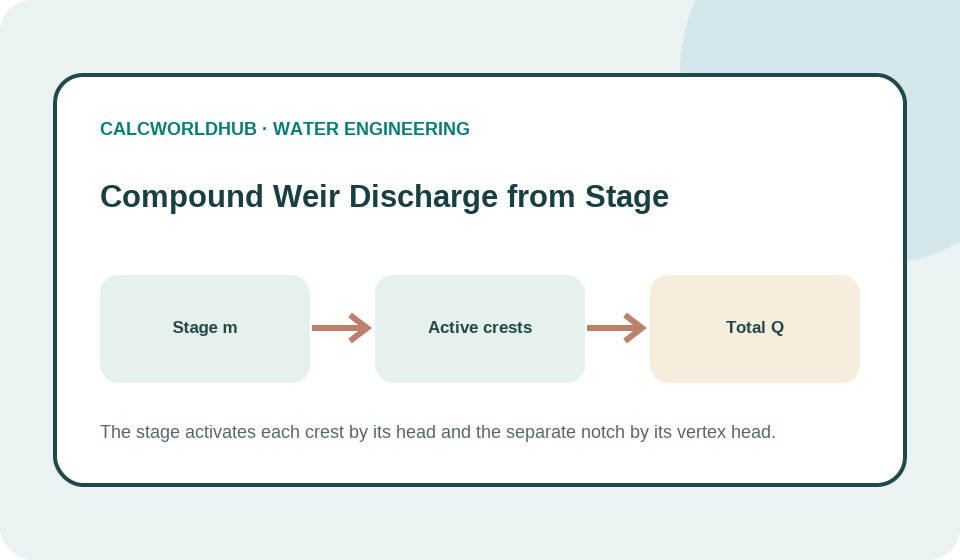
The input stage, each rectangular crest, and the V-notch vertex must use the same elevation datum in metres. A rectangular segment contributes only when stage exceeds its crest; its head is the positive difference between the stage and that crest. The V-notch uses its own vertex elevation and included angle, so it can begin flowing at a different stage.
Widths and crest elevations are entered as matching lists. Each width describes a nonoverlapping rectangular segment, and the corresponding crest value belongs to that width. If a segment is above the water surface its head is zero and it contributes nothing. The calculator expects the arrays to correspond; it does not infer a channel cross-section from a drawing.
Understand the component equations
For each rectangular segment, the model uses Qᵢ = (2/3)Cd√(2g)bᵢHᵢ^(3/2), where bᵢ is width and Hᵢ is head above that segment crest. It sums the active rectangular contributions. For a separate triangular notch it uses Qv = (8/15)Cd√(2g)tan(θ/2)Hv^(5/2), where θ is the included angle in degrees and Hv is stage above the notch vertex.
The coefficient Cd is a single user-specified dimensionless value shared by the calculator’s segments. Gravity is fixed at 9.80665 m/s². Because width and head are in metres, discharge is in cubic metres per second. The calculation adds the theoretical components; it does not apply an independently calibrated coefficient to each opening.
What free sharp-crest flow assumes
The equations assume a sharp crest, a ventilated nappe, free discharge, and negligible approach velocity. USBR measurement guidance stresses that head must be measured upstream at a location appropriate to the structure and that crest geometry and approach conditions affect measurement. A number from the calculator is therefore only as useful as the geometry and coefficient supplied.
Submergence can change the relation between upstream stage and flow. End contractions, side walls, surface tension, nappe ventilation, approach velocity, and interactions between nearby openings are not corrected here. If downstream water contacts the nappe or the segments influence one another, do not interpret the sum as a validated rating curve.
Use the estimate to compare stages
A stage sweep can show which crest becomes active first and how quickly the combined discharge rises. A lower rectangular crest may dominate at modest stages, while a higher segment adds flow only after the surface reaches it. The notch term grows with the 2.5 power of its head, so its contribution can increase rapidly as water rises above the vertex.
This comparison can help check a conceptual layout or prepare candidate rating points. It does not size a channel, establish a safe flood capacity, or determine a design flood level. Those tasks require site geometry, calibrated coefficients, downstream conditions, freeboard, and applicable engineering review.
Read totals and component outputs
The calculator reports rectangular discharge, V-notch discharge, and their sum. Verify that the total equals the components before rounding. If a segment remains dry, its rectangular contribution should be zero; if the stage is at or below the notch vertex, the notch term should also be zero. A sudden nonzero value below a crest is a sign to check the datum or copied elevation.
The displayed precision is not a statement of measurement accuracy. Discharge depends on the coefficient and head to powers greater than one, so small stage or calibration errors can materially change the result. Record the stage datum, crest list, notch angle, coefficient source, and whether the flow was actually free when using the estimate in a field note.
Worked examples
Work through the inputs in the same units used by the calculator, and compare the intermediate terms before interpreting the final value.
Two active crests and one notch
Inputs: Widths = [1.5, 2.0] m; crests = [0, 0.3] m; stage = 0.8 m; Cd = 0.61; notch angle = 90°; vertex = 0.1 m.
Calculation: Qrect = 3.206537 m³/s; Qv = 0.590676 m³/s; Qtotal = 3.206537 + 0.590676 = 3.797212 m³/s.
Both rectangular segments are wet, with heads 0.8 m and 0.5 m; the notch head is 0.7 m. The result is a free-flow theoretical sum using the same Cd for each part.
A lower stage with a shallower notch
Inputs: Widths = [1.0, 1.5] m; crests = [0, 0.25] m; stage = 0.55 m; Cd = 0.62; notch angle = 60°; vertex = 0.1 m.
Calculation: Qrect = 1.197834 m³/s; Qv = 0.114851 m³/s; Qtotal = 1.197834 + 0.114851 = 1.312685 m³/s.
The segment heads are 0.55 m and 0.30 m, and the notch head is 0.45 m. This is a mathematical comparison, not a site-verified discharge measurement.
