
Read the geometry fields
Gate width b is the clear horizontal opening in metres, and opening height a is the vertical opening from sill to gate edge. Upstream depth H and tailwater depth Ht are both measured above that sill, not from the opening centre or a separate elevation datum. The entered coefficient Cd is dimensionless and must be selected or justified for the gate and regime being represented.
The calculator requires H>a, Ht≥a, and H>Ht. These checks define the comparison it supports: the downstream water covers the opening, while upstream head exceeds tailwater. Even though it reports a free-flow approximation, the form uses the same stated inputs and is set up for a comparison with submerged flow; do not treat the validation as a complete regime classifier.
Compare the two discharge formulas
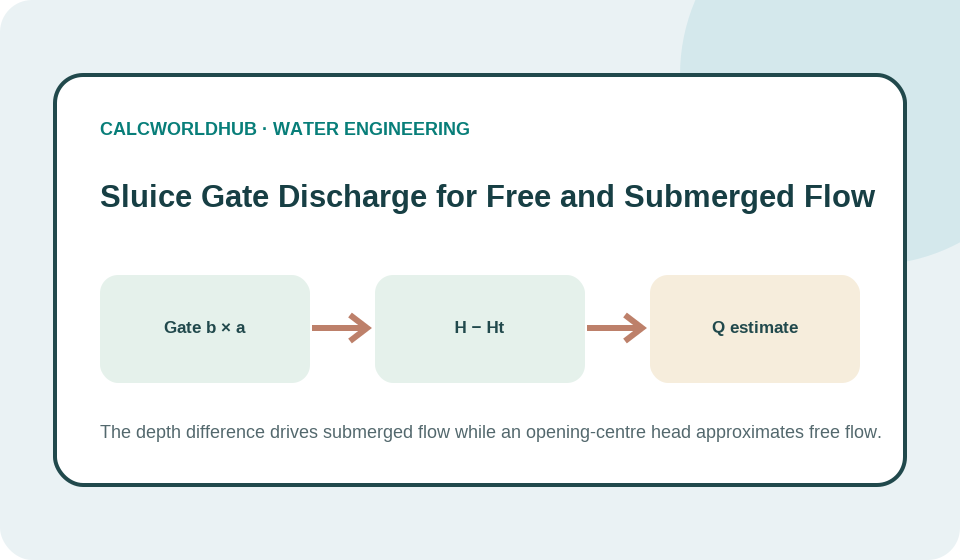
The submerged estimate uses Qsub = Cdba√[2g(H−Ht)]. It is driven by the difference between the upstream and downstream water depths. The free estimate uses Qfree ≈ Cdba√[2g(H−a/2)], an opening-centre head approximation. Gravity is fixed at 9.80665 m/s², so metres and the coefficient produce discharge in cubic metres per second.
Both values share the same width, opening, and coefficient. The free-flow expression is not a claim that every field installation will discharge at that rate; contraction, vena-contracta geometry, approach velocity, gate shape, and coefficient calibration matter. The downstream ratio Ht/H is also reported as a comparison indicator, not a universal boundary between free and submerged regimes.
Why tailwater changes flow
When downstream water rises, the energy difference driving a submerged opening becomes smaller. At fixed b, a, and Cd, Qsub falls with the square root of H−Ht. The free estimate instead uses upstream depth relative to the opening centre and does not subtract tailwater. That difference makes the two outputs useful for illustrating why regime assumptions matter.
Published gate equations use coefficients and head references tied to the particular structure. HEC-RAS documentation describes separate gate-flow cases and transition conditions; other measurement guidance emphasizes calibration. The calculator’s two formulas are simplified comparison branches, not the full HEC-RAS regime interpolation or a field-specific coefficient determination.
Use the comparison responsibly
For an existing gate, measure depth from the sill and keep width, opening, and water levels in consistent units. Use a coefficient supported by the gate geometry, calibration, or an applicable reference. If the actual tailwater does not cover the opening or upstream depth does not exceed tailwater, the current comparison conditions do not apply.
The calculation assumes quasi-steady, incompressible flow. It does not model a gate opening or closing during the observation, changing flow direction, approach-velocity head, hydraulic jumps, downstream channel controls, or a nonuniform contracted jet. A field rating may require discharge measurements across the relevant range and a structure-specific model.
Interpret the output without overclaiming
The reported ratio Ht/H is a compact description of the entered depths. It should not be read as proof that the gate is fully submerged or as a regulatory threshold. The free and submerged values are separate estimates under different idealizations; actual flow can lie outside either estimate if the coefficient or flow assumptions are wrong.
Use the calculator for an educational comparison or equation check. Operational releases, flood control, and irrigation delivery need a qualified hydraulic analysis of the gate, approach and tailwater channels, measurement uncertainty, and applicable requirements.
Worked examples
Work through the inputs in the same units used by the calculator, and compare the intermediate terms before interpreting the final value.
A wide gate under moderate tailwater
Inputs: Width = 3 m; opening = 0.5 m; upstream depth = 3 m; tailwater depth = 1 m; Cd = 0.62.
Calculation: Qsub = 0.62 × 3 × 0.5 × √[2 × 9.80665 × (3 − 1)] = 5.824696 m³/s. Qfree ≈ 0.62 × 3 × 0.5 × √[2 × 9.80665 × (3 − 0.25)] = 6.830062 m³/s; Ht/H = 0.3333.
The model’s free estimate exceeds the submerged estimate because the latter uses the smaller head difference. Both depend on the same assumed coefficient.
A smaller opening and lower depth difference
Inputs: Width = 1.5 m; opening = 0.3 m; upstream depth = 2.4 m; tailwater depth = 0.8 m; Cd = 0.58.
Calculation: Qsub = 0.58 × 1.5 × 0.3 × √[2 × 9.80665 × (2.4 − 0.8)] = 1.462096 m³/s. Qfree ≈ 0.58 × 1.5 × 0.3 × √[2 × 9.80665 × (2.4 − 0.15)] = 1.733832 m³/s.
The entered tailwater covers the 0.3 m opening, and H exceeds Ht. The two outputs remain comparison formulas rather than a site-specific rating.
