How to use this calculator
Build one stage-discharge estimate from separate rectangular crest segments and a V-notch, allowing some segments to remain dry.
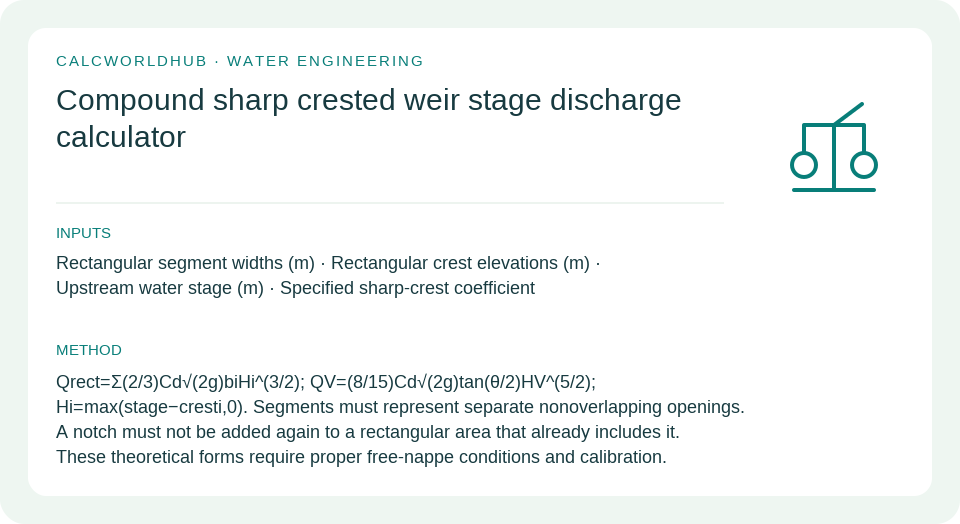
- Enter Rectangular segment widths (m), Rectangular crest elevations (m), Upstream water stage (m), Specified sharp-crest coefficient, then complete the remaining labeled fields. Match the units shown beside each field and review the result together with the assumptions below.
- Read the worked example below to check the expected input format and result.
- Compare another scenario by changing one input at a time. Use Reset to return to the starting values.
Compound sharp crested weir stage discharge explained
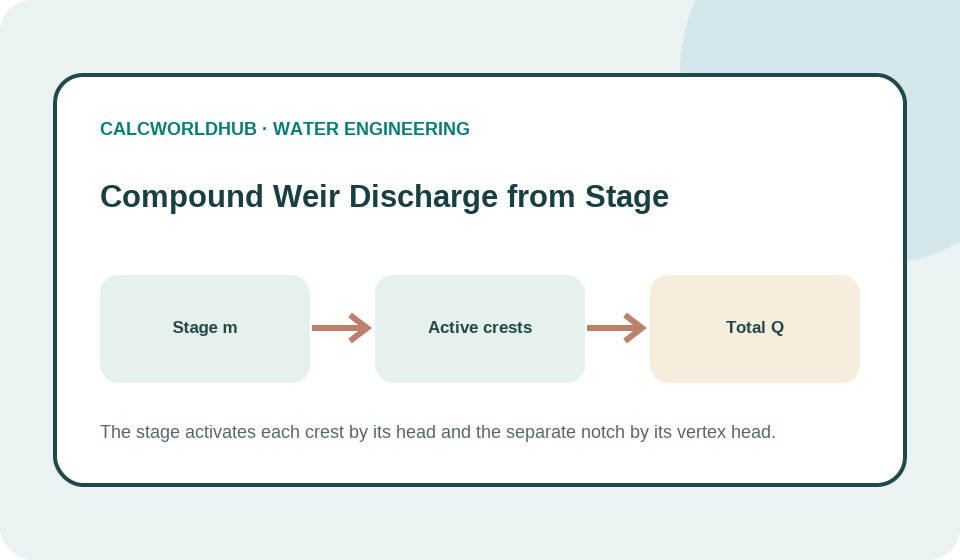
Each rectangular opening uses water depth above its own crest; the separate V-notch uses depth above its vertex. Sum the component discharges only for nonoverlapping openings under free overflow.
Inputs, symbols, and units
width— Rectangular segment widths (m)- Widths of nonoverlapping horizontal crest segments. Use comma-separated values in the stated order.
crest— Rectangular crest elevations (m)- Elevation of each matching crest relative to the common stage datum. Use comma-separated values in the stated order.
head— Upstream water stage (m)- Water surface stage at the measurement section; approach velocity is neglected.
Cd— Specified sharp-crest coefficient- Shared dimensionless coefficient for this theoretical comparison; calibration and contraction corrections must be established separately.
ang— Separate V-notch included angle (degrees)- Included angle of a separate nonoverlapping triangular notch.
ct— V-notch vertex elevation (m)- Vertex elevation on the same datum as stage and rectangular crests.
Formula and method
Qrect=Σ(2/3)Cd√(2g)biHi^(3/2); QV=(8/15)Cd√(2g)tan(θ/2)HV^(5/2); Hi=max(stage−cresti,0).
Segments must represent separate nonoverlapping openings. A notch must not be added again to a rectangular area that already includes it. These theoretical forms require proper free-nappe conditions and calibration.
A worked scenario
Rectangular segment widths (m) = [1.5, 2]; Rectangular crest elevations (m) = [0, 0.3]; Upstream water stage (m) = 0.8; Specified sharp-crest coefficient = 0.61; Separate V-notch included angle (degrees) = 90; V-notch vertex elevation (m) = 0.1.
- Total free-overflow discharge: 3.797212 m³/s
- Rectangular segment discharge: 3.206537 m³/s
- Separate triangular notch discharge: 0.590676 m³/s
Two rectangular segments 1.5 and 2 m wide have crest levels 0 and 0.3 m, plus a separate 90° notch at level 0.1 m. At stage 0.8 m every opening contributes.
Assumptions and edge cases
Sharp crest, ventilated free nappe, negligible approach velocity and specified coefficient. Submergence, end contractions, surface tension and compound interference are not corrected. Educational model; this is not a code-compliant design check.
Reading the outputs
Total and component free discharges are m³/s. A water stage below a crest gives zero flow through that segment.
Frequently asked questions
Can the notch overlap a rectangular segment?
Not in this additive model. Overlapping opening area would be counted twice.
Why does a small stage change alter flow strongly?
Free overflow scales with head to powers 3/2 or 5/2, so the stage datum and measurement accuracy matter.
Can submerged weirs use these results?
No. Tailwater influence invalidates the free-overflow assumption.
How do I use the Compound sharp crested weir stage discharge calculator?
Enter Rectangular segment widths (m), Rectangular crest elevations (m), Upstream water stage (m), Specified sharp-crest coefficient, then complete the remaining labeled fields. Match the units shown beside each field and review the result together with the assumptions below.
What is a worked example of Compound sharp crested weir stage discharge?
Rectangular segment widths (m) = [1.5, 2]; Rectangular crest elevations (m) = [0, 0.3]; Upstream water stage (m) = 0.8; Specified sharp-crest coefficient = 0.61; Separate V-notch included angle (degrees) = 90; V-notch vertex elevation (m) = 0.1. Total free-overflow discharge: 3.797212 m³/s Rectangular segment discharge: 3.206537 m³/s Separate triangular notch discharge: 0.590676 m³/s Two rectangular segments 1.5 and 2 m wide have crest levels 0 and 0.3 m, plus a separate 90° notch at level 0.1 m. At stage 0.8 m every opening contributes.
Background or definition reference: USBR Water Measurement Manual.
Reference access note: The linked USBR Water Measurement Manual was not retrievable during this review. The stated equation and example were checked independently; confirm applicable calibration and approach-flow conditions in the manual.
Read our calculation methodology.