
Read the numerator and denominator
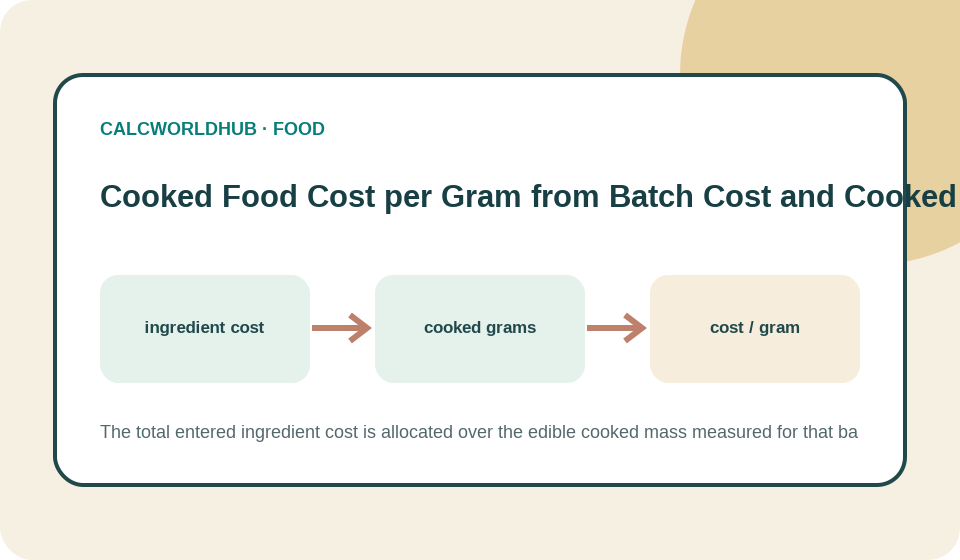
Cost per gram = entered ingredient cost ÷ cooked grams. Dollars divided by grams produces dollars per gram. The denominator is final cooked weight, not raw input weight, because the goal is to spread the entered batch cost over mass available for serving or sale. Weigh using a consistent tare and after the same drain or rest step.
This is an allocation, not a full recipe-costing system. Include the relevant cost items in the numerator before dividing if a broader estimate is needed, and define which ingredients belong to the batch. The selected calculator exposes cooked weight and ingredient cost; it has no fields for labor, utilities, packaging, yield loss, tax, or selling price.
Keep currency and mass units explicit
The calculator labels cost in dollars and cooked mass in grams. If working in another currency, convert the cost to a consistent currency basis before comparing batches; the quotient carries that currency per gram. If weighing in kilograms, convert to grams or convert the final unit cost carefully: one kilogram contains 1,000 grams. A kg value interpreted as g changes the result by a factor of 1,000.
The runtime checks whether the quotient is finite, but the current markup does not set a positive cooked-weight minimum or a nonnegative cost rule. Zero cooked mass with positive cost cannot produce a finite answer and is rejected by the result check; a negative value can still produce a finite quotient. For practical costing, use positive cooked mass and nonnegative batch cost. This is a documented validation limitation, not a claim that the tool enforces those business rules.
Why cooked mass changes unit cost
Water loss can leave the same ingredient spend supporting fewer cooked grams, increasing allocated cost per gram. Added liquid or components can move the denominator the other way, while new ingredients may also add to the numerator. USDA yield references show why cooked weight varies by food and preparation protocol; measure the actual finished batch when available.
For a fair comparison, use the same costing boundary and cooked-weight method in each recipe. If one batch includes sauce or garnish and another does not, the unit rates describe different products. Record batch size, method, cooked mass, and included costs so later portion estimates can be reproduced.
Turn unit cost into a portion estimate
After calculating a per-gram rate, multiply by portion mass to estimate the ingredient cost allocated to that serving. Keep the unrounded quotient for that multiplication outside the calculator; rounding every intermediate can accumulate error across portions. The displayed result is formatted to four decimal places, so the visible rate may not preserve the exact quotient.
A weighed portion matters when pieces vary in size. Dividing by an average count would require a count input that this tool does not request. If cooked yield changes between batches, recompute with the new cooked weight. The calculator does not set a menu price or calculate margin; those decisions require additional costs and commercial assumptions.
Limits of the simple allocation
The output is only as complete as its inputs. Ingredient cost may omit trim loss, purchased-but-unused material, spoilage, labor, energy, rent, packaging, delivery, payment fees, or taxes. Those costs may matter for a selling price but sit outside this quotient. The model assumes one total mass and one total entered cost; it does not allocate different components among portions.
Treat the result as a planning figure, not a quote or accounting record. Keep invoices, recipe quantities, and scale readings separately. Use the same currency, costing policy, and weighing stage when comparing products. If the unit is wrong or the batch is weighed before its final serving state, a precise-looking quotient answers the wrong question.
Worked examples
Examples divide dollars of ingredient cost by final cooked grams. Unit costs are shown to four decimals.
A small batch at about one cent per gram
Inputs: Ingredient cost = $7.50; cooked weight = 760 g.
Calculation: Cost per gram = $7.50 ÷ 760 g = $0.009868421…/g ≈ $0.0099/g.
At the unrounded rate, a 100 g portion represents about $0.9868 of entered ingredient cost; the tool itself reports the unit rate.
A larger batch with a higher rate
Inputs: Ingredient cost = $28.40; cooked weight = 2,260 g.
Calculation: Cost per gram = $28.40 ÷ 2,260 g = $0.01256637168…/g ≈ $0.0126/g.
The entered ingredient cost is allocated at about $0.0126 per cooked gram.
