
Separate yield, coefficient, and area
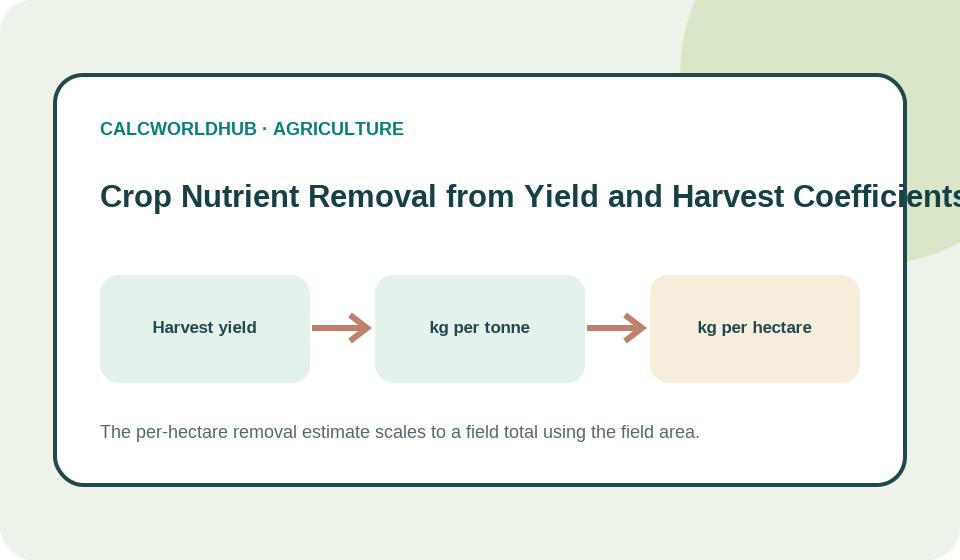
Harvest yield is entered in tonnes per hectare (t/ha). The removal coefficient is kilograms of the selected nutrient per tonne of the harvested product (kg/t). Their product is kilograms per hectare because the tonne units cancel: (t/ha) × (kg/t) = kg/ha. Field area, in hectares, is a separate multiplier for the whole-field mass.
Make sure the coefficient refers to the crop, harvested part, and yield basis you measured. Grain, whole-plant silage, and removed hay do not have interchangeable coefficients. Moisture basis matters too: a coefficient expressed per tonne of dry matter should not be paired with an as-harvested wet yield unless the yield is converted consistently.
The calculation has two levels
Per-hectare removal is yield × coefficient. Multiply that result by field area to estimate total nutrient mass associated with the harvest. The tool also reports crop mass across the field as yield × area. Keep the intermediate kg/ha visible when communicating the estimate; a total field number can look large or small depending on field size and may obscure the underlying rate.
This accounting does not include fertilizer recovery, residual soil nutrient, mineralization, deposition, nutrient held in roots or residues, or losses before harvest. It is not the same as crop uptake: plant uptake includes nutrients in parts that may remain in the field. The estimate follows the coefficient and harvested yield that were entered.
Worked examples
Both examples use yield in tonnes per hectare and a coefficient in kilograms of nutrient per tonne.
A grain harvest across twelve hectares
Inputs: Harvest yield = 6.5 t/ha; nutrient removal coefficient = 22 kg/t; field area = 12 ha.
Calculation: Removal per hectare = 6.5 × 22 = 143 kg/ha. Field removal = 143 × 12 = 1,716 kg. Harvest mass = 6.5 × 12 = 78 t.
The coefficient-based estimate is 143 kg per hectare, or 1,716 kg across this field.
A higher-yield block with a different coefficient
Inputs: Harvest yield = 9.2 t/ha; nutrient removal coefficient = 18 kg/t; field area = 7.5 ha.
Calculation: Removal per hectare = 9.2 × 18 = 165.6 kg/ha. Field removal = 165.6 × 7.5 = 1,242 kg. Harvest mass = 9.2 × 7.5 = 69 t.
The higher field yield does not by itself determine total removal; the coefficient and area also set the result.

Choose a coefficient that matches the question
A nutrient removal coefficient is an empirical or extension-derived amount per unit of harvested yield. Confirm whether it represents elemental nitrogen, phosphorus, potassium, or an oxide convention such as P₂O₅ or K₂O. The same printed percentage or number can represent different chemical reporting bases. A unit label cannot fix a coefficient that was chosen for the wrong nutrient form.
For multi-nutrient planning, calculate each nutrient with its own appropriate coefficient and keep the results in separate columns. Do not add kilograms of nitrogen to kilograms of P₂O₅ and call the sum a single fertilizer requirement. Penn State’s soil-test guidance explains that removal-based maintenance recommendations are used in a specific soil-test context; they do not replace the local recommendation for every field.
Use whole-field totals carefully
Field area should match the boundary from which the entered yield was measured. If yield is reported for only a harvested block, do not multiply by the farm’s full acreage. Likewise, do not multiply a yield already expressed as tonnes for the whole field by hectares a second time; the input field expects t/ha. These denominator checks prevent a common factor-of-area error.
The calculator accepts nonnegative yield, coefficient, and area values. Zero area gives zero total removal while leaving the per-hectare estimate unchanged; zero yield or coefficient gives zero estimated removal. A result with many decimal places is arithmetic precision, not proof that a biological coefficient or yield measurement is exact. Round the reported estimate to a level justified by the source data.
Turn the estimate into a useful field record
Record the crop, harvested product, yield moisture basis, coefficient source, measurement date, and field area alongside the result. If yields differ across zones, one field average can hide a high-removal strip and a low-removal strip. A zone-based calculation may be more useful when the yield map and coefficient are reliable enough to support it.
Treat the result as one line in a nutrient balance. Soil tests, manure or residue credits, crop rotation, nutrient availability, environmental rules, and local agronomic recommendations can change the appropriate nutrient plan. The calculator deliberately does not supply those data. Its role is to make the yield-times-coefficient arithmetic transparent so that the next decision can use the right local evidence.