
Distinguish plants from seeds
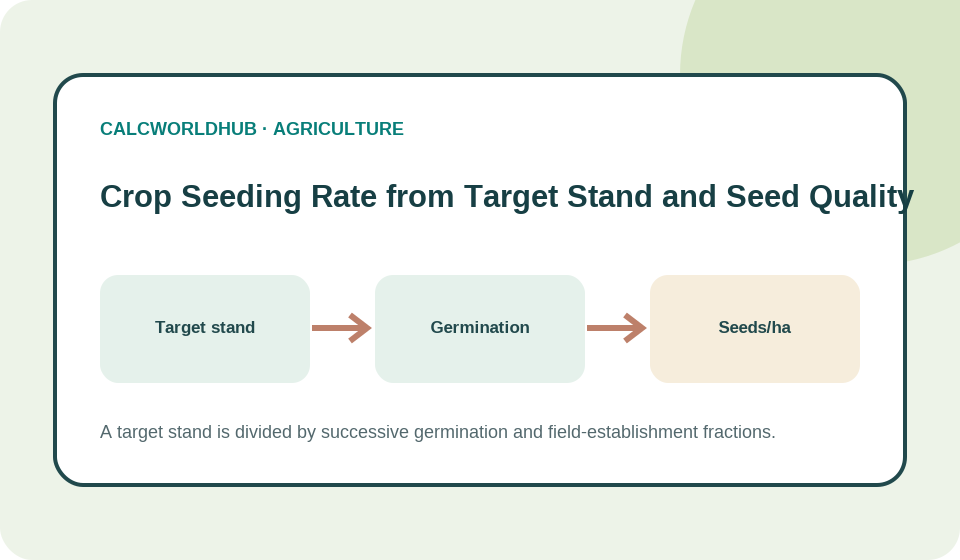
A target plant population states how many established plants you want per hectare. Not every seed germinates, and not every germinated seed becomes an established plant. The calculator accounts for both rates by dividing the target stand by their combined probability. Because each rate is entered as a percentage, both must be converted to fractions before they are multiplied.
This distinction prevents a common planning error: entering the desired plants per hectare as if every seed will produce a plant. If the desired stand is 65,000 plants/ha and the combined probability is below 100%, the required number of seeds is higher than 65,000. The output remains seeds/ha; it is not a mass rate or a guarantee of the final stand.
Enter seed quality and field establishment
The inputs are Target plant population (plants/ha), Seed germination rate (%), and Field establishment rate (%). Use the germination percentage from a representative seed test, and choose an establishment estimate that reflects the crop, seedbed, sowing depth, weather, and management. The two percentages describe different stages and should not be added together.
The target may be zero or positive. Germination and establishment must each be greater than 0% and no more than 100%, because the calculation divides by their product. If either rate is zero, the equation has no finite seed rate. Values outside the percentage range are not meaningful for this model.
Apply the formula without adding losses twice
The equation is seeds/ha = target plants/ha ÷ ((germination % ÷ 100) × (establishment % ÷ 100)). Convert each percentage to a fraction, multiply the two sequential probabilities, then divide the target count by that product. The output is a seed count per hectare before any practical drill-setting decision; rounding should happen only after the full division.
Use the rate definitions consistently. If your field-establishment estimate already includes failed germination, do not multiply it by germination again; instead define the second percentage as survival after germination. The calculator treats the inputs as sequential factors. It cannot determine what losses are included in a percentage you supply.
Convert to seed mass only with another measure
Seed bags and drills are often planned in kilograms, but this calculator does not include thousand-seed weight, seed size, purity, or seeds per kilogram. To convert seeds/ha to kg/ha, use a separately measured seed count per unit mass and the same seed lot. The output alone cannot tell how many kilograms to load.
For a row crop, the hectare rate can be converted to seeds per metre or per row only after row spacing is known. Divide seeds per hectare by the number of row metres per hectare. That layout step is outside this calculator, so retain the units when transferring the result to a drill setting.
Use the estimate as a field-planning input
FAO guidance on crop emergence and establishment treats seed quality and field conditions as factors in achieving a target plant population. A percentage model helps organize that plan, but local recommendations vary by crop, variety, planting window, soil, and production system. Do not treat one calculator output as a universal recommended rate.
After emergence, compare measured plant counts with the intended stand. If actual establishment differs from the assumed rate, update the next planning estimate using the field record rather than silently increasing the target. The result supports transparent arithmetic; it does not predict yield, competition, lodging, or the best population for a particular farm.
Worked examples
Both examples keep laboratory germination separate from the field establishment assumption.
A 65,000 plants/ha target
Inputs: Target = 65,000 plants/ha; germination = 92%; field establishment = 85%.
Calculation: Seeds/ha = 65,000 ÷ ((92/100) × (85/100)) = 65,000 ÷ 0.782 = 83,120.2046 seeds/ha.
The calculation calls for about 83,120.2046 seeds/ha before choosing a practical drill setting. It does not convert that count into kilograms or guarantee the observed stand.
A lower establishment assumption
Inputs: Target = 78,000 plants/ha; germination = 90%; field establishment = 80%.
Calculation: Seeds/ha = 78,000 ÷ (0.90 × 0.80) = 78,000 ÷ 0.72 = 108,333.3333 seeds/ha.
The seed requirement is higher than in the first case for two reasons: the target stand rises from 65,000 to 78,000 plants/ha, while germination falls from 92% to 90% and field establishment falls from 85% to 80%. The target numerator is larger and the combined probability in the denominator is smaller. Keep the two loss stages distinct; if establishment already includes germination failure, do not count that loss twice.
