
Mass-based and volume-based moisture differ
Gravimetric water content compares water mass with oven-dry soil mass. Volumetric water content compares water volume with the total soil volume. The first is a mass ratio; the second is a volume fraction. They describe the same sample from different bases and are not interchangeable unless density information is included.
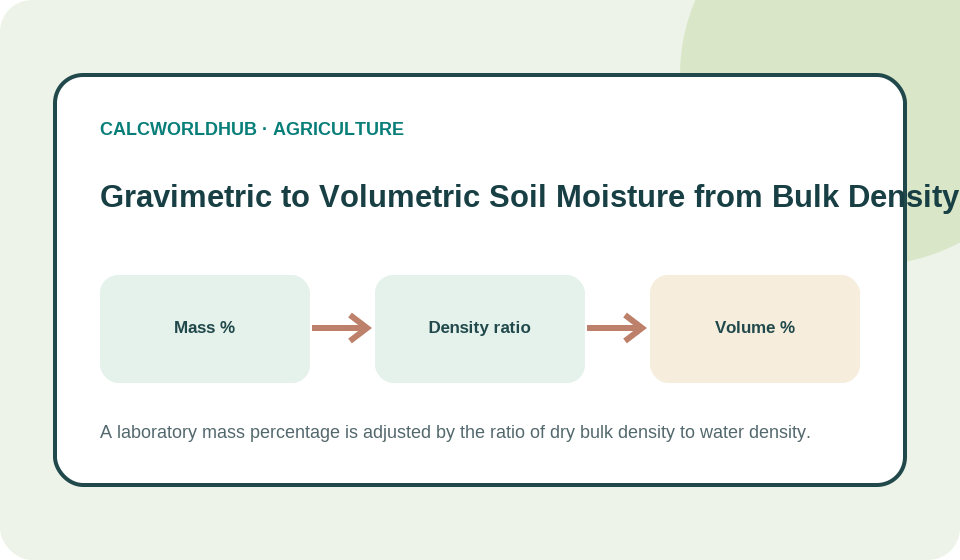
The conversion is volumetric moisture (%) = gravimetric moisture (%) × dry bulk density ÷ water density. Both densities must use the same units, such as g/cm³. Their ratio is unitless, so the percentage remains a percentage. Use dry bulk density for the soil mass per total sample volume; moist bulk density would mix water into the density basis.
Enter a matched soil sample
Gravimetric water content is entered as a percent, for example 18 rather than 0.18. Dry bulk density and water density are each entered in g/cm³. The source fields require nonnegative gravimetric content and positive density values. Use measurements from the same sample or a clearly justified matching depth and condition.
Water density is often close to 1 g/cm³ under ordinary conditions, but the calculator accepts an explicit value. Keep the units consistent and do not enter a density in kg/m³ without converting it. A 1.4 g/cm³ dry bulk density compared with 1 g/cm³ water density multiplies the mass-based percentage by 1.4.
Interpret the converted percentage
This conversion relates a laboratory mass measurement to water occupying part of the soil volume. A volume-based result can support storage calculations when a representative layer depth is known, but it does not establish how much water roots can extract.
If bulk density changes across depths or management zones, the same gravimetric percentage can map to different volumetric percentages. Compaction, organic matter, rock fragments, and sampling methods affect interpretation. The calculation applies the entered densities uniformly; it does not adjust for swelling, shrinkage, coarse fragments, or vertical variation.
Connect percentage to a storage depth
For a uniform layer of depth z, a volumetric fraction can be multiplied by layer depth to estimate water depth. If a 0.20 m layer has 25.2% volumetric content, the water-equivalent depth is 0.252 × 0.20 m = 0.0504 m, or 50.4 mm. This additional step assumes the percentage represents the whole layer.
The calculator stops at volumetric percentage. It does not accept layer depth, field capacity, wilting point, rooting depth, or a soil-water sensor reading. Therefore, it cannot report available storage or an irrigation trigger. Those decisions need the soil profile and locally suitable water-retention information.
Use laboratory context and limits
NRCS soil laboratory materials describe water content on both gravimetric and volumetric bases and define bulk density from dry soil mass relative to bulk volume. That context supports the conversion but does not replace a sampling protocol. Keep the oven-dry mass, sample volume, and density method documented with the result.
Use the output as a unit conversion for the sampled conditions, not as a soil-health score or crop-water recommendation. If a sample contains gravel or its volume changes during drying, check whether the chosen density represents the same soil fraction as the moisture measurement. The equation is simple; the quality of the input definitions determines whether it is useful.
Worked examples
These examples use the same water density basis and show how bulk density affects the converted percentage.
A denser sample at 18% gravimetric content
Inputs: Gravimetric content = 18%; dry bulk density = 1.4 g/cm³; water density = 1.0 g/cm³.
Calculation: Volumetric moisture = 18 × 1.4 ÷ 1.0 = 25.2%.
The mass-based measurement corresponds to 25.2% water by volume under the entered density assumptions. It is not automatically a plant-available-water percentage.
Lower gravimetric content with lower bulk density
Inputs: Gravimetric content = 12%; dry bulk density = 1.25 g/cm³; water density = 1.0 g/cm³.
Calculation: Volumetric moisture = 12 × 1.25 ÷ 1.0 = 15%.
The converted content is 15% by volume. If comparing it with the first sample, keep depth, sample preparation, and the density method aligned.
