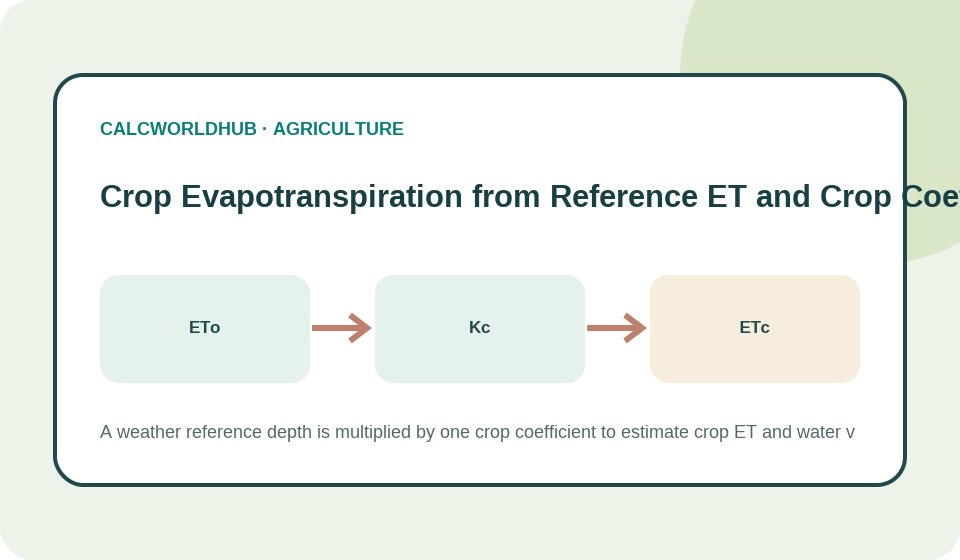

Start with reference evapotranspiration
Reference evapotranspiration, ETo, represents atmospheric demand from a defined reference surface, commonly a well-watered grass surface. It is supplied as a depth per time, such as millimetres per day. Use data for the same location and period as the crop coefficient you plan to apply.
The calculator takes ETo in mm/day and a dimensionless crop coefficient Kc. Both must be nonnegative. Kc reflects differences between the crop and reference surface for a selected stage or condition. A coefficient from another crop stage or averaging period may not match the reference value.
Apply the crop-coefficient method
The equation is ETc = ETo × Kc. The units stay mm/day because Kc is dimensionless. The calculator also reports an area equivalent: 1 mm over 1 hectare is 10 m³, so multiply the depth rate by 10 to express it in m³/ha/day. Keep that equivalent distinct from a whole-farm volume, which also requires the farm area.
Keep the depth and volume outputs distinct. A millimetre is a water depth over area; cubic metres per hectare is the same quantity expressed as volume per area. The second number is not a tank size or a whole-farm total until the area is multiplied in.
Choose a coefficient for stage and method
FAO Irrigation and Drainage Paper 56 presents the single crop-coefficient relationship and explains that Kc varies with crop stage and conditions. Some methods separate crop transpiration and soil evaporation or apply stress corrections. This calculator uses one entered Kc; it does not select a coefficient from a crop database or adjust it for stress.
Document the crop, stage, coefficient source, and ETo method when comparing estimates. If the coefficient is a seasonal average, do not present the result as a precise daily peak. If ETo is a monthly total or a different time unit, convert it to the field’s mm/day basis before using the calculator.
ETc is not irrigation requirement
Crop evapotranspiration describes water leaving the crop-soil system through evaporation and transpiration in the modeled conditions. Irrigation requirement may also account for effective rainfall, stored soil water, application efficiency, salinity, leaching, and management targets. None of those inputs appears here, so ETc must not be equated with water to apply.
A crop with an ETc of 4 mm/day does not necessarily need 4 mm of irrigation that day. Rainfall or stored moisture can supply part of the demand, while distribution losses can increase the gross amount applied. The calculator shows the crop-coefficient product and its area equivalent only.
Use the output with local records
FAO describes the crop-coefficient method as a practical way to estimate crop ET from reference ET and crop-specific conditions. For field decisions, combine that estimate with local weather data, soil moisture, crop stage, rainfall, and an appropriate irrigation plan. A coefficient from guidance should be checked against the crop and climate rather than treated as universal.
Record input dates and units. ETo and Kc need to cover the same period; if a weekly ETo total is paired with a daily Kc interpretation, the output label would be misleading. The result is an arithmetic planning value, not a sensor measurement, yield forecast, or agronomic recommendation.
Worked examples
The calculations keep ETo and Kc tied to one matching daily period.
Reference ET of 5 mm/day
Inputs: ETo = 5 mm/day; Kc = 1.15.
Calculation: ETc = 5 × 1.15 = 5.75 mm/day; volume equivalent = 5.75 × 10 = 57.5 m³/ha/day.
The estimate is 5.75 mm/day of crop ET, equivalent to 57.5 m³/ha/day. Effective rainfall and soil storage are not subtracted.
A lower coefficient for the selected stage
Inputs: ETo = 4.2 mm/day; Kc = 0.75.
Calculation: ETc = 4.2 × 0.75 = 3.15 mm/day; volume equivalent = 3.15 × 10 = 31.5 m³/ha/day.
The modeled ETc is 3.15 mm/day for the entered coefficient and period. The volume equivalent still does not state how much irrigation should be applied.
