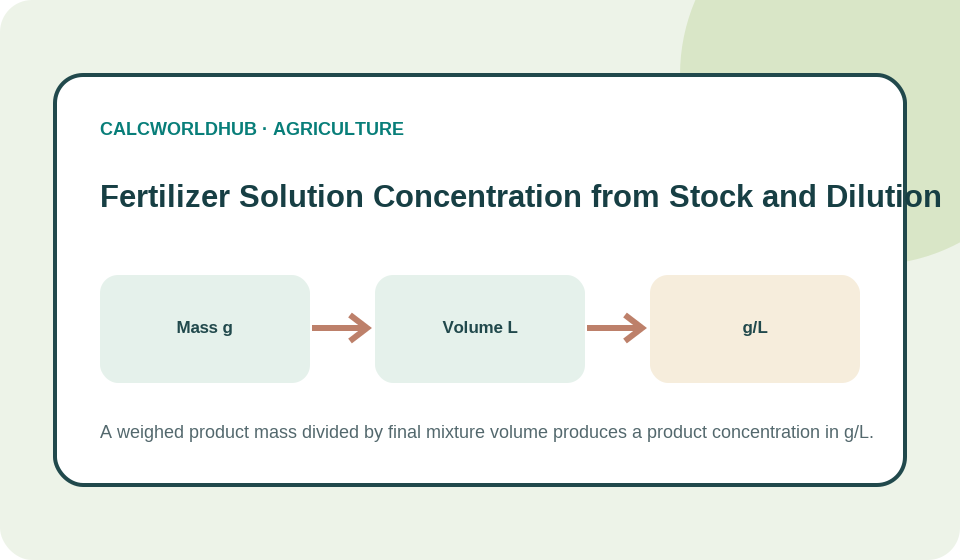

Use final mixture volume
Fertilizer mass is entered in grams and final solution volume in litres. The formula is concentration = mass ÷ volume, so the units reduce to grams per litre. Use the volume after the fertilizer has been mixed to the intended final mark. Starting with 20 L of water and adding a solid may produce a final volume different from 20 L.
The concentration describes total product mass per solution volume. It does not state how much nitrogen, phosphorus, potassium, or another nutrient is present. A fertilizer grade or chemical composition would be needed for nutrient concentration, and the calculator has no field for that information.
Keep stock and diluted solutions separate
If you mix a stock concentrate and later dilute it, this calculator reports only the concentration represented by the entered mass and final volume. It does not model injector ratio, dilution water, solubility limits, temperature, precipitation, or chemical compatibility. For a dilution, a separate concentration-volume relationship is needed and its units must be consistent.
Use a nonnegative fertilizer mass and a positive final volume for a physical result. The form accepts numeric values, so the user must still check whether the entries describe a possible mixture. A negative mass can produce a finite negative number, which is not a usable fertilizer concentration; zero final volume cannot be divided into a meaningful result.
Interpret grams per litre
A mass-per-volume result is useful for recording a mixture or checking a simple preparation calculation. It does not say how many litres to apply per hectare, how much fertilizer a crop needs, or how much nutrient reaches a root zone.
If the same mass is placed in a larger final volume, concentration falls. If the final volume is halved while mass stays fixed, concentration doubles. These changes follow directly from the ratio. Keep concentration separate from application volume because their product, not either number alone, would determine a total mass delivered.
Check product instructions and units
Fertilizer labels and extension guidance may express nutrient targets in ppm, nutrient mass, product mass, or injector dilution ratios. Those are not automatically interchangeable with g/L of total product. Convert the product grade and dilution basis carefully before comparing a label or a stock solution with this output.
Do not infer a safe or effective application from concentration alone. The calculator does not know the crop, growth stage, water chemistry, irrigation flow, fertilizer solubility, or label directions. Follow product instructions and local agronomic guidance, especially before mixing concentrated stock solutions or applying them through irrigation.
Use the estimate as a mixing record
For reproducibility, record the product, weighed mass, final mixture volume, water source, and date. If you need the concentration of one nutrient, multiply the product mass by the nutrient fraction only when the label basis and chemical form support that conversion. The current result remains total fertilizer product mass per litre.
Extension guidance on fertilizer calculations illustrates that nutrient concentration and injection ratio require additional inputs beyond mass per volume. That is why this result is best used as a narrow bookkeeping calculation. It can verify a mixture ratio, but it cannot choose a crop-specific target or confirm compatibility.
Worked examples
The final volume, rather than the starting water amount, is the denominator in both examples.
A 20 L final mix
Inputs: Fertilizer mass = 250 g; final solution volume = 20 L.
Calculation: Concentration = 250 g ÷ 20 L = 12.5 g/L.
The mixture contains 12.5 g of total fertilizer product per litre of final solution. The nutrient concentration depends on the product analysis and is not calculated here.
A larger batch at the same mass per litre
Inputs: Fertilizer mass = 375 g; final solution volume = 25 L.
Calculation: Concentration = 375 g ÷ 25 L = 15 g/L.
The second mixture is 15 g/L of product. Compare it with a target only after confirming that the target uses the same product-mass basis rather than nutrient ppm.
