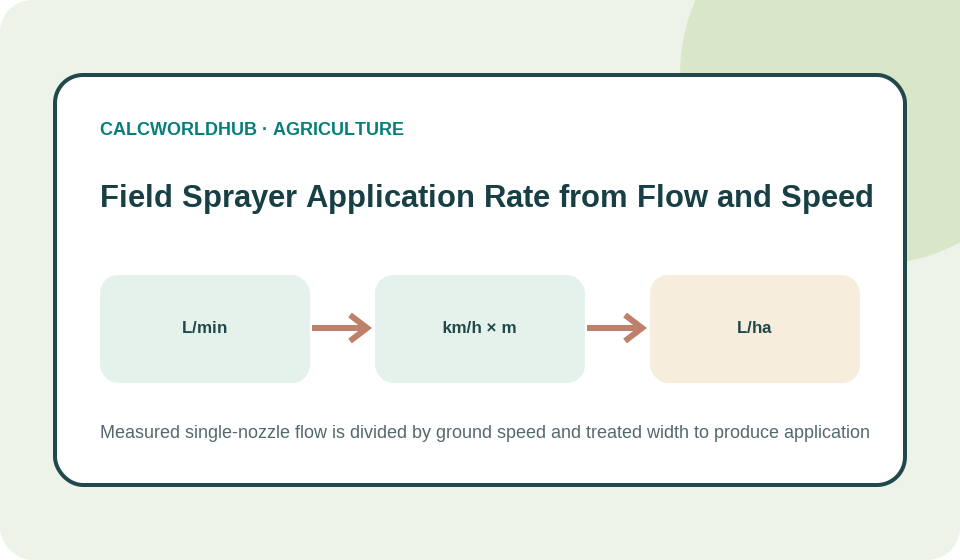

Measure one nozzle at operating conditions
Flow per nozzle is the liquid volume collected from one outlet per minute, in L/min. Measure it at the pressure and nozzle condition used in the field. A worn, clogged, or mismatched nozzle can change the delivered volume, so a catalog value is not necessarily the flow of the installed tip.
Travel speed is the actual ground speed in km/h while spraying, not an assumed tractor speed from another field. Nozzle spacing is the distance between adjacent outlets in metres. For a broadcast boom, that spacing represents the treated width assigned to one nozzle; a different application layout may use another effective width, which this calculator does not accept.
Use the metric conversion factor
The rate equation is L/ha = 600 × q ÷ (v × s), where q is L/min per nozzle, v is km/h, and s is metres. The constant 600 combines the conversions from minutes to hours, kilometres to metres, and square metres to hectares. The units cancel to litres per hectare when nozzle spacing represents the treated width.
For example, q = 1.2 L/min, v = 6 km/h, and s = 0.5 m produce 600 × 1.2 ÷ (6 × 0.5) = 240 L/ha. The calculator also reports an equivalent volume per square metre: divide L/ha by 10,000. It does not calculate how much active ingredient belongs in a tank.
Understand how each field changes the rate
At fixed flow and spacing, faster travel covers more area each minute, so the estimated volume per hectare falls. At fixed speed and spacing, a higher nozzle flow raises the rate. Wider nozzle spacing assigns each nozzle more treated width, reducing the volume per hectare for the same output.
The input fields are numeric and the physical calculation needs a positive speed and positive spacing; zero in either denominator cannot yield a meaningful rate. Use a nonnegative measured flow. Check that every nozzle is operating uniformly before using one value to represent a boom.
Calibrate for the actual field
UGA Cooperative Extension describes sprayer calibration in terms of application rate, nozzle spacing, ground speed, and nozzle output. This calculator performs the volume conversion from those measured quantities; it does not account for turns, overlap, wind, boom height, droplet drift, terrain, or pressure changes as the rig moves.
If the target rate comes from a pesticide or fertilizer label, use that label’s application instructions and confirm the correct units and crop. A computed spray volume is not a recommendation to apply a product. When the mixture does not flow like water, calibrate with the intended material and follow manufacturer safety guidance.
Interpret the output carefully
Use the result to compare calibration scenarios or identify a mismatch between measured nozzle flow and the intended carrier volume. If the rate is too high, possible adjustments include flow, speed, or spacing, but each has equipment and coverage consequences. Recheck all nozzles and pressure after any adjustment rather than relying on arithmetic alone.
Record the date, nozzle type, pressure, measured flow, speed, and spacing with the result. The estimate describes the chosen operating point. It does not ensure uniform coverage, correct chemical concentration, crop safety, or compliance with a label or local rules.
Worked examples
The same formula is used in both cases; changing speed or nozzle flow changes the volume per treated area.
A common boom setup
Inputs: Flow = 1.2 L/min per nozzle; speed = 6 km/h; spacing = 0.5 m.
Calculation: Rate = 600 × 1.2 ÷ (6 × 0.5) = 240 L/ha; equivalent = 240 ÷ 10,000 = 0.024 L/m².
The modeled carrier volume is 240 L/ha, or 0.024 L/m², if each nozzle covers the entered 0.5 m strip at the measured speed and flow.
Faster travel with lower flow
Inputs: Flow = 0.8 L/min per nozzle; speed = 8 km/h; spacing = 0.5 m.
Calculation: Rate = 600 × 0.8 ÷ (8 × 0.5) = 120 L/ha; equivalent = 120 ÷ 10,000 = 0.012 L/m².
The output is 120 L/ha under the second set of measured conditions. It is half the first rate because the flow fell while travel speed rose.
