
Name each distance before using the formula
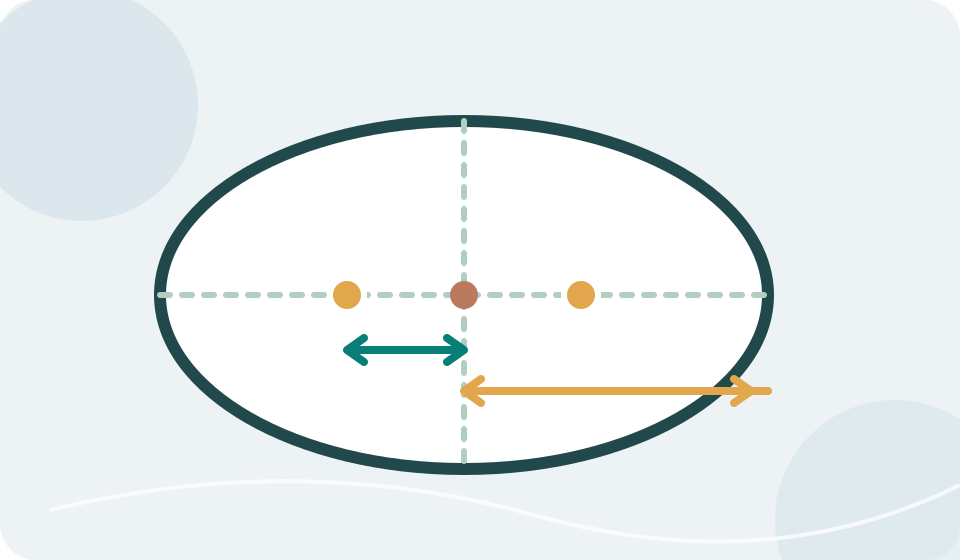
For a standard ellipse, a is the semi-major axis, b is the semi-minor axis, and c is the linear distance from the centre to either focus. The foci sit on the major axis, one on each side of the centre. If the centre is at the origin and the major axis is horizontal, their coordinates are (−c, 0) and (c, 0); rotation or translation changes those coordinates but not the distance c.
The calculator fields request the semi-major and semi-minor axes, not the full diameters. Both should be positive lengths in the same unit, with a ≥ b for the usual horizontal-axis convention. If a specification lists full diameters 16 cm and 10 cm, convert them to a = 8 cm and b = 5 cm before calculating. The center-to-focus distance is a length, not an eccentricity.
Worked examples
Foci for an 8-by-5 ellipse
Inputs: a = 8 cm; b = 5 cm.
Calculation: c = √(8² − 5²) = √(64 − 25) = √39 ≈ 6.244998 cm.
Each focus is about 6.245 cm from the centre; on a horizontal axis through the origin the coordinates are approximately (−6.245, 0) and (6.245, 0).
Foci for a 10-by-6 ellipse
Inputs: a = 10 m; b = 6 m.
Calculation: c = √(10² − 6²) = √(100 − 36) = √64 = 8 m.
The two foci lie 8 m from the centre along the major axis.

Derive the focus distance from the right triangle
Draw a right triangle from the centre to a focus and from that focus to the endpoint of the major axis. The hypotenuse is a, the vertical leg is b, and the horizontal leg is c. By the Pythagorean theorem, a² = b² + c², so c = √(a² − b²). This is equivalent to c = ae when eccentricity e is known.
Subtract the squared semi-minor axis from the squared semi-major axis before taking the square root. Because both squared terms use the same squared unit, the result under the root has squared length units, and c returns to the original length unit. If the arithmetic produces a negative radicand, the entered values are not in the expected a ≥ b order for this formula.
Interpret how far the foci sit from the centre
For a circle, a and b are equal, so c = 0 and both foci coincide at the centre. As b becomes smaller while a stays fixed, c increases and the foci move outward along the major axis. The focus distance is still less than a for a non-degenerate ellipse because b remains positive. It does not mean the foci lie on the ellipse boundary.
The distance also scales with the ellipse. If both semi-axes double, c doubles. For a = 8 and b = 5, c = √39 ≈ 6.245. For a = 16 and b = 10, c = √156 = 2√39 ≈ 12.490. The two shapes have identical eccentricity, while their focus distances differ by a factor of two.
Use the result in a coordinate model
When placing an axis-aligned ellipse at the origin, write its foci as (−c, 0) and (c, 0) for a horizontal major axis. If the major axis is vertical, use (0, −c) and (0, c). For a translated ellipse centred at (h, k), add the centre coordinates: (h − c, k) and (h + c, k) for the horizontal case. These positions make it possible to check a conic equation or plot without guessing.
The calculator returns the scalar distance c; it does not infer orientation, centre coordinates, focus signs, or a full ellipse equation. Add those pieces separately from the drawing or model. If you also compute eccentricity, check that e = c/a. A disagreement usually points to a unit mismatch, a full diameter entered as a semi-axis, or an incorrectly ordered pair.
Keep the geometry and precision in view
The mathematical domain assumes positive semi-axes and a ≥ b. The runtime evaluates the square root of a² − b² and rejects non-finite output, but readers should still enter positive geometric lengths even if a user-interface field accepts a wider numeric range. Inputs of opposite sign or reversed axis labels are not meaningful axis lengths merely because the expression may return a finite number.
A result rounded to four decimal places is suitable for a compact explanation, but coordinate work may require retaining more digits until later steps are complete. If a and b are measured values, their uncertainty affects c, especially near a circle where a² − b² is small. In that case a small input change can be large relative to c, so treat the calculated focus position as sensitive rather than exact.