
Enter the major axis first
The calculator uses a for the semi-major axis and b for the semi-minor axis. Both are positive centre-to-edge lengths in the same unit, with 0 < b ≤ a. They need not be measured in metres; millimetres, centimetres, or another consistent unit give the same eccentricity because only a ratio enters the formula.
If a drawing gives full diameters, halve them first. A 16 cm major diameter and 10 cm minor diameter correspond to a = 8 cm and b = 5 cm. Reversing these inputs would violate the major/minor convention and can make an otherwise clear comparison confusing. The implementation checks that the entered b does not exceed a.
Worked examples
A moderate elongation
Inputs: a = 8 cm; b = 5 cm.
Calculation: e = √(1 − b²/a²) = √(1 − 25/64) = √(39/64) = √39/8 ≈ 0.78062475.
Eccentricity ≈ 0.7806; the number has no unit.
Compare a narrower ellipse
Inputs: a = 10 m; b = 6 m.
Calculation: e = √(1 − 36/100) = √0.64 = 0.8. The axis ratio is b/a = 0.6.
Eccentricity = 0.8000, higher than the first example because the minor axis is smaller relative to the major axis.

Formula and geometric meaning
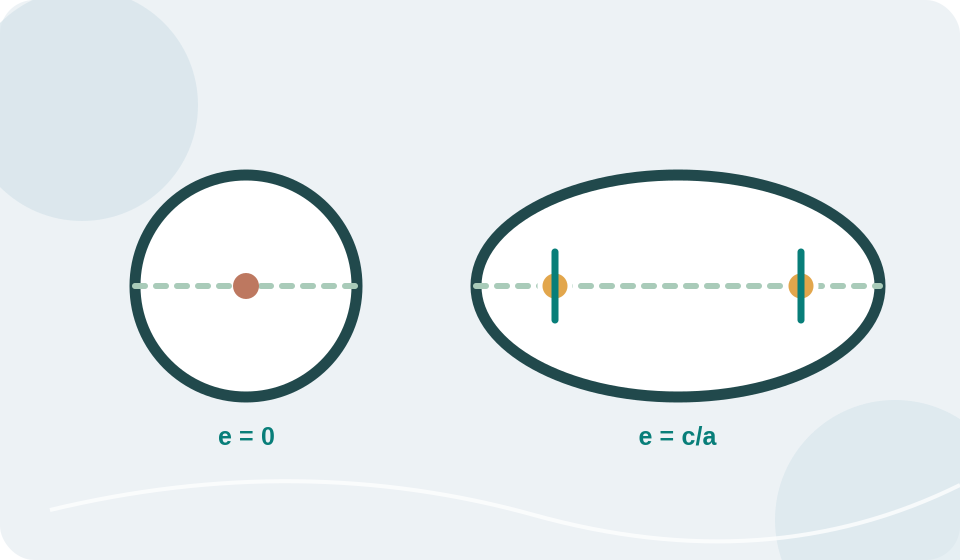
The eccentricity is e = √(1 − b²/a²). The focus distance from the centre is c = √(a² − b²), so the same quantity can be written e = c/a. Because c and a have the same length unit, their ratio is dimensionless. For a circle, a = b, which makes c = 0 and e = 0. As b becomes small relative to a, c/a increases toward 1.
This is a shape measure, not a direct “percent stretched” scale. A value of 0.8 does not mean the ellipse is 80% longer or that its area is reduced by 20%. The axis ratio b/a is related to eccentricity by b/a = √(1 − e²). That relation makes the geometry easier to interpret when a reader knows either the axis proportions or the eccentricity.
Compare shapes without mixing scale
Eccentricity stays unchanged when both axes are scaled by the same factor. An ellipse with a = 8 cm and b = 5 cm has the same e as one with a = 16 m and b = 10 m. The physical sizes differ, but the proportion b/a is identical. This makes eccentricity useful for comparing the shape of a small drawing with a much larger object or orbit.
If a is fixed while b decreases, the ellipse becomes more elongated and eccentricity rises. For a = 10, changing b from 8 to 6 changes e from 0.6 to 0.8. This gives a straightforward scenario comparison: the major span stays the same while the minor span narrows, so the foci move farther from the centre relative to a.
Use the number alongside the axes
A practical record should keep e together with a and b. The pair of axes tells the actual dimensions; eccentricity summarizes their shape. Two ellipses can share e while having very different areas, and two ellipses can share the same semi-major axis but have different e. For design, astronomy, or an image, do not discard the original axis measurements after calculating the ratio.
Round only for presentation. The calculator displays four decimal places, so 0.780624… appears as 0.7806. When comparing close cases, use the same displayed precision and be cautious if the input measurements themselves are approximate. The underlying result is calculated from the entered values, but more displayed digits cannot recover accuracy absent from those measurements.
Check the domain and avoid common mistakes
The formula assumes a real ellipse with positive semi-axes and b no greater than a. A zero axis collapses the shape and is outside the intended input domain; a negative length has no geometric meaning. If a and b come from a rotated ellipse, use its principal semi-axes rather than arbitrary horizontal and vertical spans on the page.
A common mistake is to use a full diameter for one input and a semi-axis for the other. That changes b/a and therefore the reported shape, even though each number may look plausible. Another is to interpret eccentricity as a measure of size. Verify the ratio b/a separately, then substitute it into √(1 − (b/a)²); the result should lie from 0 inclusive to less than 1 for a non-degenerate ellipse.