Ellipse eccentricity calculator
Measure an ellipse’s shape from its semi-major and semi-minor axes.
Calculator
How to use this calculator
Measure an ellipse’s shape from its semi-major and semi-minor axes.
- Enter Ellipse semi-major axis a, Ellipse semi-minor axis b. Match the units shown beside each field and review the result together with the assumptions below.
- Read the worked example below to check the expected input format and result.
- Compare another scenario by changing one input at a time. Use Reset to return to the starting values.
Ellipse eccentricity calculator
Measure an ellipse’s shape from its semi-major and semi-minor axes.
Inputs and units
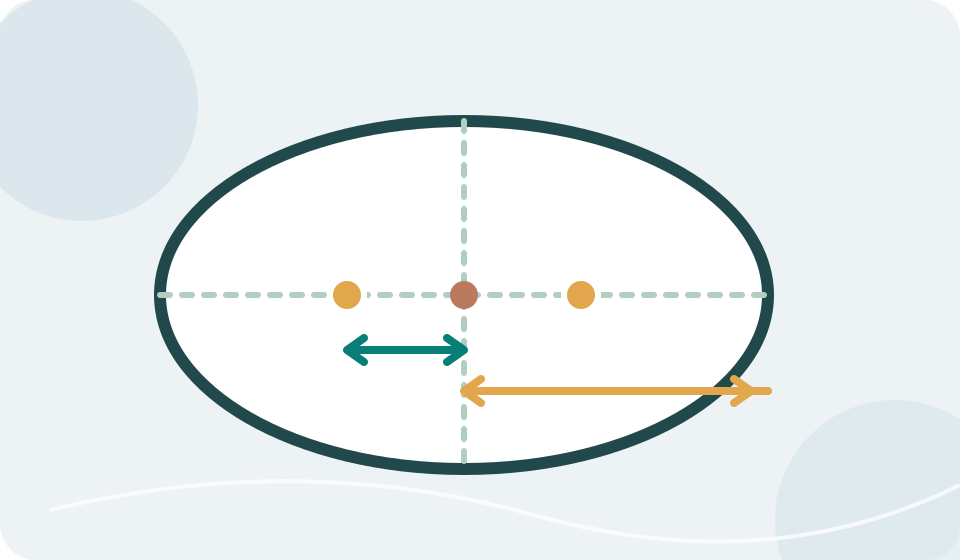
- Ellipse semi-major axis a: Longer ellipse semi-axis a; it must be positive and at least as large as the semi-minor axis.
- Ellipse semi-minor axis b: Shorter ellipse semi-axis b; it must be positive and no greater than a.
Formula and method
e=√(1−b²/a²), 0≤b≤a
Worked example
For a=8 and b=5, e=√(1−25/64)=0.7806.
Interpreting the result
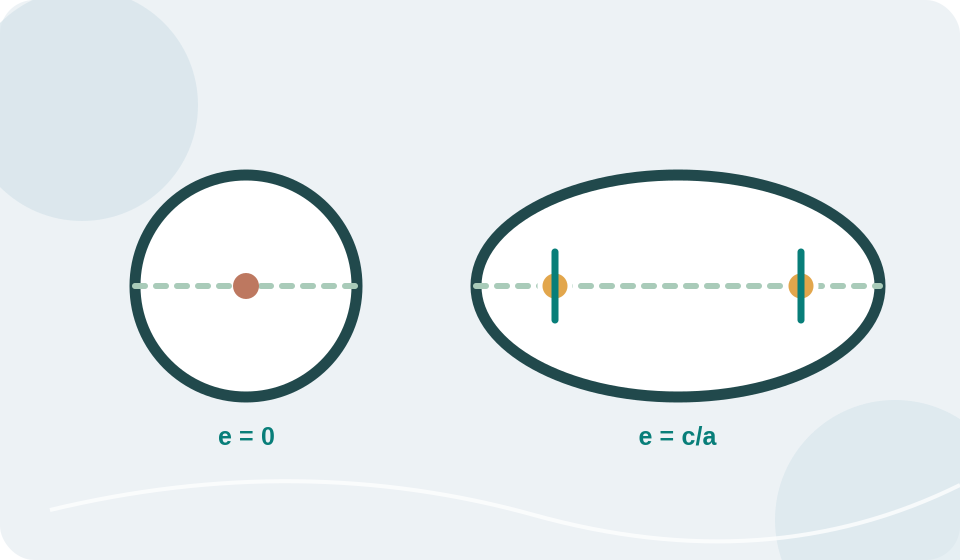
e=0 is a circle; values nearer 1 indicate a more elongated ellipse. Eccentricity has no units.
Assumptions and limits
Semi-axes must be positive and b≤a; swap the axes if the inputs are reversed.
Frequently asked questions
Which inputs determine this result?
The visible inputs are Ellipse semi-major axis a, Ellipse semi-minor axis b. Each is used by the displayed formula; the calculator does not use any other hidden measurement.
When does this method apply?
Semi-axes must be positive and b≤a; swap the axes if the inputs are reversed.
How do I use the Ellipse eccentricity calculator?
Enter Ellipse semi-major axis a, Ellipse semi-minor axis b. Match the units shown beside each field and review the result together with the assumptions below.
What is a worked example of Ellipse eccentricity?
For a=8 and b=5, e=√(1−25/64)=0.7806.
What does the Ellipse eccentricity calculator calculate?
Measure an ellipse’s shape from its semi-major and semi-minor axes.
See the calculation methodology.
Good calculators show their work.
CalcWorldHub is built around clear inputs and visible assumptions. Results are estimates for planning; check official sources or your provider’s terms when exact figures matter.