
Separate perimeter from area and diameter
The inputs are the two semi-axis lengths of one ellipse. They must be positive and use the same length unit; this calculator accepts them in either order because the formula is symmetric. A semi-axis runs from the centre to the boundary. If a drawing lists full axis lengths of 16 and 10 cm, the inputs should be 8 cm and 5 cm, not the full diameters.
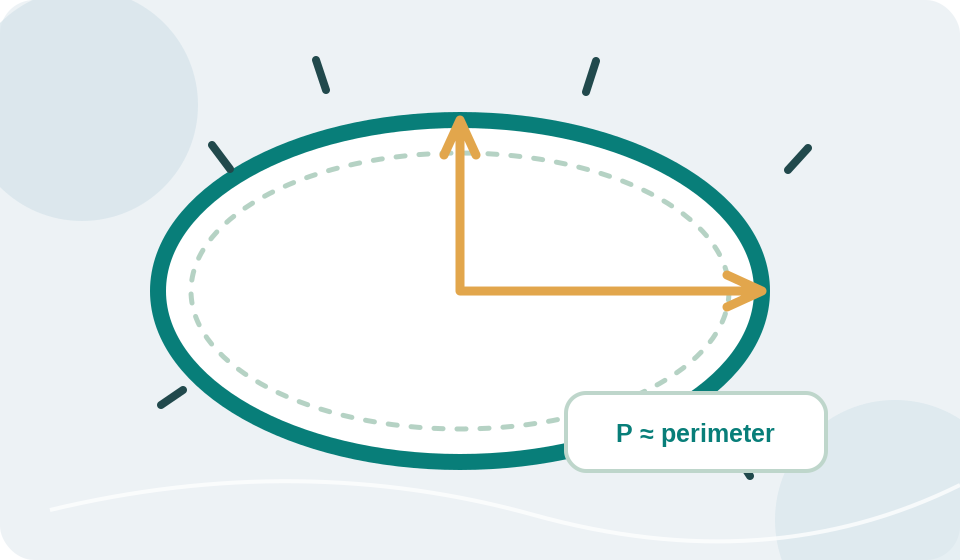
Perimeter is the distance around the ellipse boundary. It is not the ellipse area πab and it is not simply 2π times either axis. For a circle where a = b = r, the familiar circumference 2πr is exact. For a stretched ellipse, the boundary curvature varies, which is why a concise approximation replaces an elementary exact expression.
Worked examples
Estimate for an 8-by-5 ellipse
Inputs: a = 8 m; b = 5 m.
Calculation: P ≈ π[3(8 + 5) − √((24 + 5)(8 + 15))] = π[39 − √667] ≈ 41.38626361 m.
Ramanujan perimeter estimate ≈ 41.3863 m.
Compare a circle with a flatter ellipse
Inputs: a = 10 cm; b = 6 cm.
Calculation: P ≈ π[3(10 + 6) − √((30 + 6)(10 + 18))] = π[48 − √1008] ≈ 51.05397279 cm.
The estimate is about 51.0540 cm. For comparison, a 10 cm radius circle has exact circumference 20π ≈ 62.8319 cm.

Use the Ramanujan expression
The displayed model is P ≈ π[3(a + b) − √((3a + b)(a + 3b))]. It takes only the two positive semi-axis lengths and returns a length. The expression is unchanged if a and b are swapped, so the order does not affect the perimeter estimate. It is commonly associated with Ramanujan’s work on ellipse perimeter approximations.
An independent arithmetic check should substitute the same axes into the whole expression and retain the square-root term until the final rounding. The result has the same unit as a and b because the terms within the square root multiply lengths to create a squared length, then the square root returns a length. Multiplying by π does not change that dimension.
Interpret the estimate for a task
This estimate can help compare trim length, boundary material, or a first-pass path length when the outline is elliptical and the input axes are known. It does not include cutting allowance, joint overlap, waste, installation slack, or a manufacturing tolerance. Add those quantities separately when the real task requires them instead of quietly treating the mathematical perimeter as a purchase quantity.
For the same semi-major axis, making the minor axis smaller reduces the ellipse perimeter, although not in a simple linear proportion. For example, with a = 10 units, compare b = 10 with b = 6. The first shape is a circle with perimeter 20π ≈ 62.8319; the approximation for the second is about 51.0540. Both axes are measured from the centre, and both outputs remain in the chosen length unit.
Use units and measurements consistently
If a = 8 m and b = 5 m, the result is in metres. If those measurements are recorded in millimetres, the answer is in millimetres; convert only once at a clearly chosen point in the workflow. Entering one axis in centimetres and the other in millimetres distorts the shape as well as the scale, so convert before calculating.
The perimeter inherits uncertainty from both measured axes. If the axes come from a survey with limited precision, round the result consistently with that survey rather than reporting extra digits as if they were measured. For repeated physical work, note whether the axes describe the inside edge, outside edge, or centreline, because the required boundary can differ even when the geometric outline looks similar.
Know when a more exact method is needed
Ramanujan’s formula is an approximation, not an exact elementary identity for arbitrary ellipse axes. It is useful because it is compact and accurate for many practical comparisons, but the required accuracy depends on the task. A high-precision engineering analysis, formal numerical benchmark, or tolerance decision should use an elliptic integral or a validated numerical method and document the desired error bound.
A useful sanity check is to compare with simple limiting shapes. When a and b are equal, the result should agree with 2πa. When b is much smaller than a, the shape approaches a narrow oval and the perimeter remains around twice the long-axis length plus the contribution of the ends; it does not collapse to zero. Large disagreement with these checks usually signals a diameter/semi-axis mix-up or an inconsistent unit.