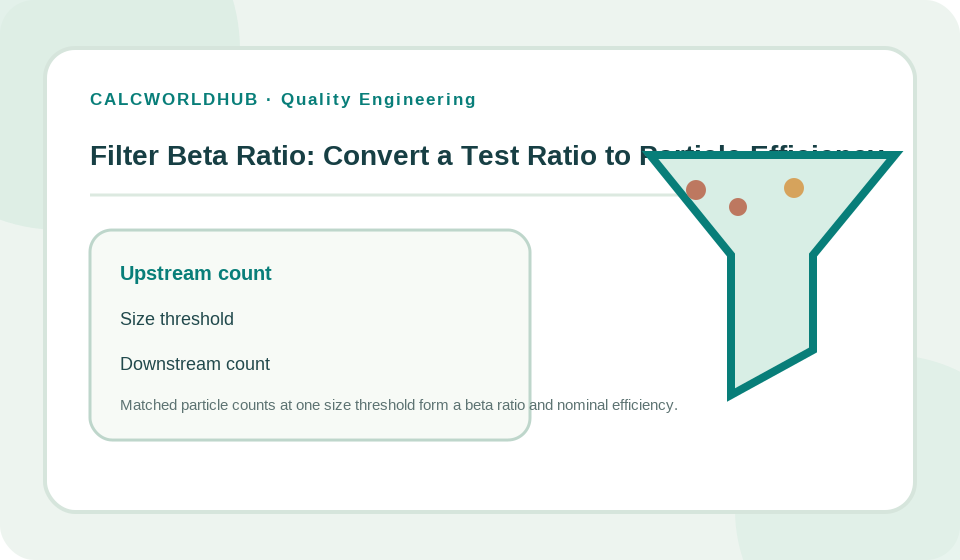

Keep the particle size threshold attached
The size threshold specifies which particles are included in the comparison. Upstream and downstream counts must refer to the same threshold, fluid, test conditions, and sampling interval. If one side is counted at a different threshold or from a different volume, the ratio does not describe a like-for-like comparison.
A threshold is not a guarantee that every particle of that physical diameter behaves identically. Counting methods, calibration, particle shape, concentration, flow, and test conditions affect what is observed. Record the procedure and the threshold with the result so another reader can interpret the comparison.
Calculate beta and nominal efficiency
The beta ratio is βₓ = Cᵤₚ ÷ Cdown for the chosen size threshold x. Nominal particle-count efficiency is ηₓ = (1 − 1/βₓ) × 100%. For example, β = 20 corresponds to 95% because one in twenty upstream-counted particles is represented downstream in this simplified ratio.
If the downstream count is zero, the ratio would require division by zero and cannot be treated as an infinite measured efficiency. A finite test has a detection limit and sampled volume. The calculator requires a positive downstream count so the reported ratio remains a finite calculation rather than an unsupported claim of perfect removal.
Enter comparable counts and units
Enter a size threshold in micrometres and particle counts per millilitre for upstream and downstream samples. Counts should be nonnegative and use the same concentration unit. The calculator’s ratio cancels that unit only when both measurements genuinely share it; mixing total counts with counts per volume changes the meaning.
The form accepts the threshold as a numeric input, but the arithmetic is determined by the two entered counts. The underlying filter test may evaluate several thresholds or report a beta curve. This single-value result does not interpolate to other particle sizes or characterize every contaminant class.
Read efficiency as a test ratio
An efficiency of 96% from β = 25 is a mathematical transformation of the paired counts. It is not a universal probability that a filter will remove every particle in service. It does not account for bypass, loading, media damage, pressure changes, or particles generated downstream after the test.
When comparing products, use the same recognized test procedure, particle-size basis, fluid, and operating conditions. A ratio from one test setup should not be compared directly with a ratio from a materially different procedure unless the specifications explain the relationship.
Use the result within the filter specification
The beta ratio is useful when a specification or test report asks for a count-based comparison at a defined threshold. Keep the original upstream and downstream counts, the sample volumes, and any uncertainty or repeatability information. If counts are small, sampling variation can make the computed ratio unstable even when the displayed efficiency looks precise.
Use the applicable hydraulic or process-filter standard and supplier documentation for performance claims. This calculator does not size a filter, estimate service life, calculate pressure drop, certify a test, or decide whether a fluid system is protected. It only transforms the two concentrations entered for one threshold.
Worked examples
Counts are entered per millilitre at one stated size threshold; the efficiency is calculated from beta, not measured separately.
A 5-micrometre threshold
Inputs: Threshold = 5 μm; upstream = 12,500 particles/mL; downstream = 500 particles/mL.
Calculation: β₅ = 12,500 ÷ 500 = 25; η₅ = (1 − 1/25) × 100% = 96.00%.
The measured downstream concentration is one twenty-fifth of the upstream concentration at this threshold under the matched test conditions.
A different threshold and count pair
Inputs: Threshold = 10 μm; upstream = 18,000 particles/mL; downstream = 1,200 particles/mL.
Calculation: β₁₀ = 18,000 ÷ 1,200 = 15; η₁₀ = (1 − 1/15) × 100% = 93.33%.
The ratio is lower than in the first example, but the threshold also differs. Compare the values only with the test method and specification that define the particle-size basis.
