How to use this calculator
Calculate a filter’s particle beta ratio and count-based efficiency from upstream and downstream concentrations at one size threshold.
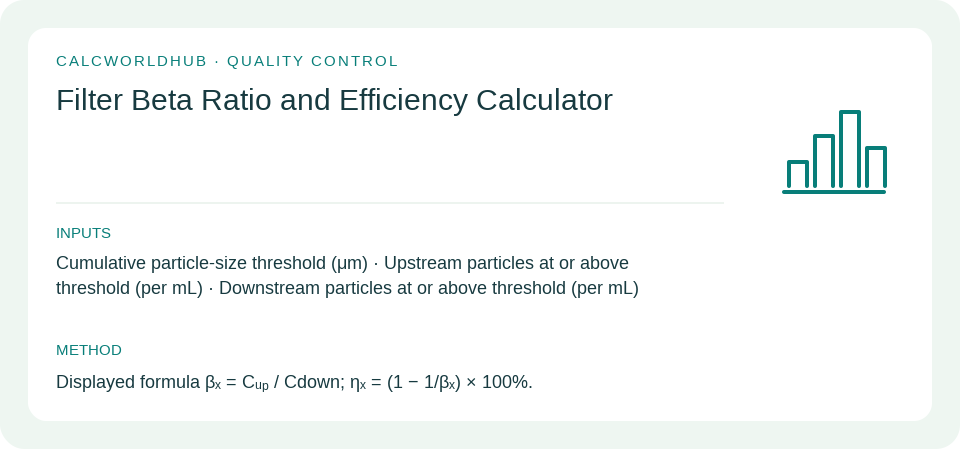
- Enter Cumulative particle-size threshold (μm), Upstream particles at or above threshold (per mL), Downstream particles at or above threshold (per mL). Match the units shown beside each field and review the result together with the assumptions below.
- Read the worked example below to check the expected input format and result.
- Compare another scenario by changing one input at a time. Use Reset to return to the starting values.
How this calculation works
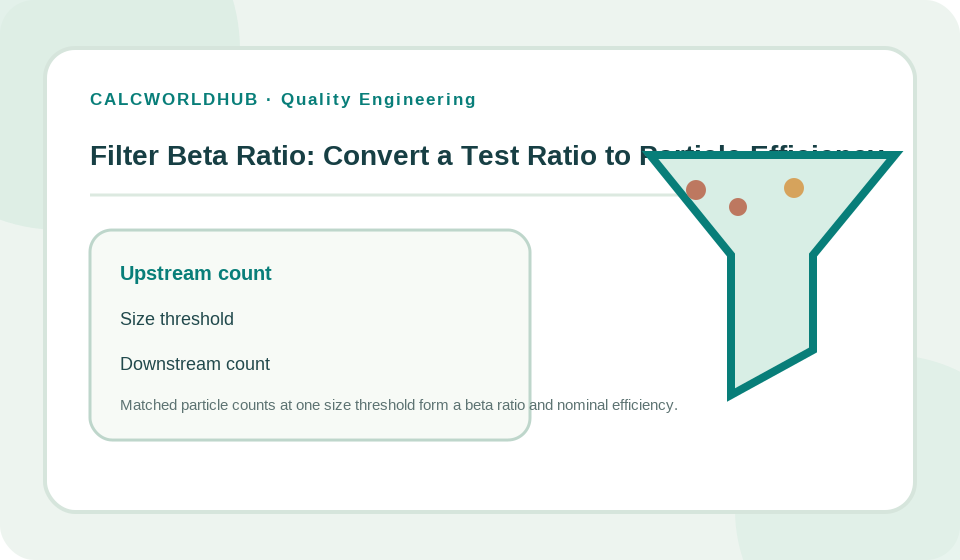
A beta ratio compares the upstream and downstream particle concentrations at the same cumulative particle-size threshold. It expresses how many measured particles enter the filter for each one measured downstream and can be translated into an observed count-based removal percentage.
Inputs and units
sizeThresholdUm— Cumulative particle-size threshold (μm)- Both upstream and downstream concentrations must use this same threshold and counting convention.
upstreamPerMl— Upstream particles at or above threshold (per mL)- Particle concentration entering the filter at the selected cumulative size threshold.
downstreamPerMl— Downstream particles at or above threshold (per mL)- Particle concentration after the filter at the same size threshold.
Formula
βₓ = Cᵤₚ / Cdown; ηₓ = (1 − 1/βₓ) × 100%.
Method
Enter upstream and downstream particle concentrations measured at the same particle-size threshold, along with that threshold. The beta ratio is their quotient; the reported count-based efficiency is the upstream-to-downstream reduction as a percentage.
Worked example
At a 10 μm threshold, 20,000 particles/mL upstream and 100 particles/mL downstream give β₁₀ = 200 and η₁₀ = 99.5%.
Assumptions and limits
Standard beta-ratio ratings are tied to a specified multi-pass test method, calibrated particle counting, and stated size threshold. This calculator performs the ratio arithmetic on supplied concentrations; it does not certify a filter or correct counting uncertainty, background counts, or non-matched samples.
Frequently asked questions
What does a beta ratio of 200 mean?
At the stated size threshold, the measured upstream concentration is 200 times the downstream concentration, corresponding to 99.5% count-based removal.
Must both counts use the same size threshold?
Yes. Compare concentrations counted with the same cumulative particle-size threshold and compatible calibration method.
Does this calculator certify an ISO filter rating?
No. It calculates ratio arithmetic from entered measurements; certification depends on the applicable ISO 16889 test and ISO 11171 particle-counter calibration.
How do I use the Filter Beta Ratio and Efficiency Calculator?
Enter Cumulative particle-size threshold (μm), Upstream particles at or above threshold (per mL), Downstream particles at or above threshold (per mL). Match the units shown beside each field and review the result together with the assumptions below.
What is a worked example of Filter Beta Ratio and Efficiency?
At a 10 μm threshold, 20,000 particles/mL upstream and 100 particles/mL downstream give β₁₀ = 200 and η₁₀ = 99.5%.
Reference: Filter engineering reference for ISO 16889 beta ratio and particle-count efficiency. See our calculation methodology.