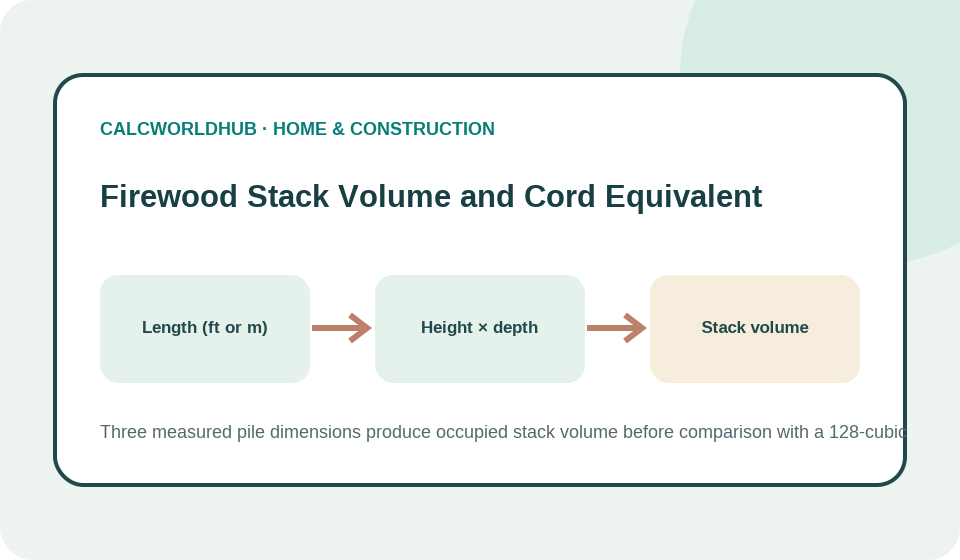

Measure the stack as a rectangular space
Measure across the front of the pile for stack length, from its base to a representative top for height, and from front to back for piece length. That last dimension is the stack depth in this model. Keep feet with feet or metres with metres; mixing units changes the product before any conversion can correct it.
A tidy row makes the rectangular approximation easier. If the pile has a sloped top, irregular ends, or a deep recess, use a representative height and note that the result is an estimate. You can divide a complicated pile into simple sections and calculate each one separately, then add the volumes, rather than forcing a poor single rectangle.
Understand what a cord measures
The U.S. cord convention is a stacked volume of 128 cubic feet. A familiar example is a stack four feet high, four feet deep, and eight feet long. The reference describes the outside space occupied by the stack, including the gaps between pieces; it is not 128 cubic feet of solid timber after every air space has been removed.
This distinction matters when comparing a delivery, a storage bay, or two piles. A cord equivalent of 0.5 means the measured rectangular stack occupies half of that reference volume. It does not prove the wood species, moisture content, piece size, heating value, or whether a particular sale complies with local labeling and measurement rules.
Convert dimensions and interpret the outputs
For feet, multiply length by height by piece length to obtain cubic feet. For metres, the same product first gives cubic metres; the calculator converts that value to cubic feet using approximately 35.3147 cubic feet per cubic metre. It then divides cubic feet by 128. The conversion changes units, not the geometry or the definition of a cord.
Compare the displayed stacked volume and cord equivalent with the measurements you took. Small differences in how tightly logs are arranged can change the pile’s outside dimensions without changing the same quantity of solid wood in a simple way. Use the fraction for scale, not as a precision claim about the contents of an uneven stack.
Worked examples
These examples use the calculator’s rectangular-stack assumption and show the cord conversion after measuring the pile.
A half-cord-sized rectangular stack
Inputs: Stack length = 8 ft; height = 4 ft; piece length / depth = 2 ft.
Calculation: Stacked volume = 8 × 4 × 2 = 64 ft³; cord equivalent = 64 ÷ 128 = 0.5000 cord.
The measured stack occupies 64 ft³, equal to one-half of the 128-ft³ cord reference.
A metric stack compared with the same cord reference
Inputs: Stack length = 2.4 m; height = 1.2 m; piece length / depth = 0.4 m.
Calculation: Stacked volume = 2.4 × 1.2 × 0.4 = 1.152 m³; equivalent volume = 1.152 × 35.31466672148859 ≈ 40.682 ft³; cord equivalent = 40.682496 ÷ 128 ≈ 0.3178 cord.
The pile occupies about 40.682 ft³, or 0.3178 of the cord reference. The cord fraction is not a solid-wood measurement.

Plan storage and ordering with a margin
A volume estimate can help you check whether a planned wood rack will hold a load or whether a stack appears broadly consistent with a stated quantity. Measure the available bay before delivery and allow room for access, airflow, and safe handling. A cord equivalent is useful for comparing volumes, but a seller’s legal unit or invoice may use local rules that require separate verification.
Do not turn the calculator into a weight estimate by assuming every cord weighs the same. Wood density varies by species and moisture, and the stack’s air gaps affect bulk density. If transport capacity or structural loading matters, use a verified weight or an appropriate material-specific method instead of multiplying this volume by a generic number.
Keep uncertainty visible
The rectangular model is most useful when the pile has fairly even faces and known dimensions. A few extra inches of measured height or depth can affect the volume product, especially across a long stack. Measure at more than one point when the pile is uneven, record the method, and round the final comparison to a level justified by those measurements.
The calculation cannot inspect the delivery, identify species, assess seasoning, determine usable heat, or enforce state and local firewood-sale requirements. If an amount is disputed, retain measurements and the seller’s unit description, then consult the relevant weights-and-measures authority. Treat the result as a transparent geometric estimate, not a certification.