
Start with a measured or defensible flow
The flow input is gallons per hour, not gallons per minute. If a meter or monitoring device reports another unit, convert it before entering the value. For a one-time container test, measure collected gallons and elapsed hours, then divide volume by time. Avoid estimating a slow leak from a brief observation if the flow varies or the measurement is too small for the container.
The calculator assumes that the selected rate continues at a constant level for the hours and days entered. A toilet that cycles, an irrigation line that runs only on a schedule, and a leak that has already been repaired do not share the same exposure pattern. Use a representative rate and duration, or calculate separate intervals instead of presenting a variable event as continuous.
Read the rate from the bill
Enter the combined water-and-sewer charge per 1,000 gallons that you want to apply. Bills may show water and wastewater separately, so add only the volumetric components you intend to estimate. Keep fixed service fees, taxes, stormwater charges, and unrelated fees out of this rate unless they genuinely change with each additional 1,000 gallons.
Utilities may use tiers, seasonal prices, minimum charges, or different sewer rules, so one rate is only a planning approximation. Use the relevant marginal rate for the expected consumption range, and compare the estimate with the utility’s published tariff or a bill breakdown. EPA WaterSense explains that variable charges are priced by volume and distinguishes them from other bill components.
Follow the calculation from flow to cost
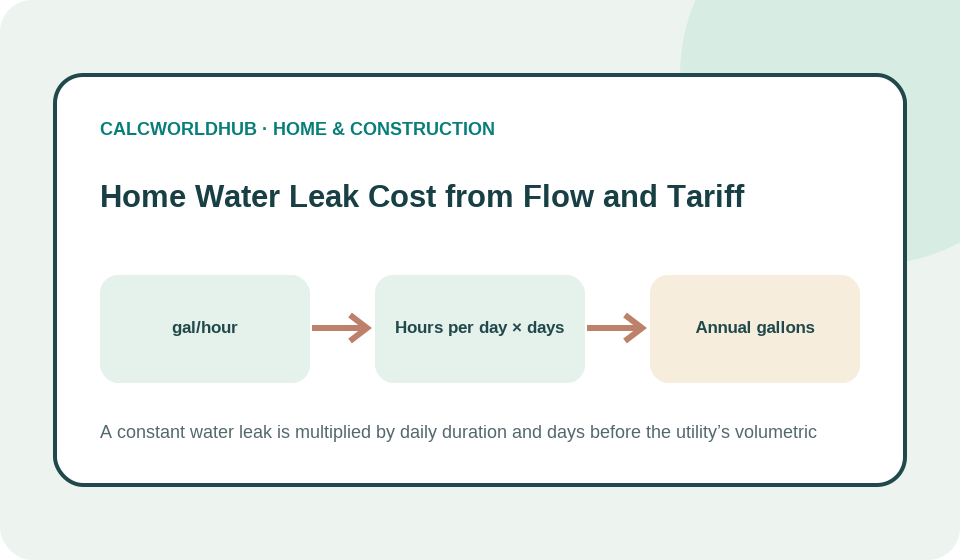
Annual gallons = gallons per hour × hours per day × days at that rate per year. Estimated variable cost = annual gallons ÷ 1,000 × dollars per 1,000 gallons. The division by 1,000 is a unit conversion for the entered tariff, not a discount. A daily-hours value of 24 represents an uninterrupted flow; fewer hours describe a leak or fixture that runs only part of each day.
The calculator also reports daily water loss from the hourly flow and daily duration. Check that output against the scale of the leak before interpreting the annual figure. If the flow is entered as zero, the volume and variable cost are zero by arithmetic, but that does not establish that the home has no other leaks or unusual consumption.
Worked examples
The examples hold the entered leak rate constant for the stated hours and days, then apply a rate per 1,000 gallons.
A leak that runs all day for 30 days of the year
Inputs: Flow = 2.5 gal/hour; duration = 24 hours/day; days = 30; rate = $12.00 per 1,000 gallons.
Calculation: Annual volume for 30 leaking days = 2.5 × 24 × 30 = 1,800 US gallons; variable charge = 1,800 ÷ 1,000 × $12.00 = $21.60.
If this flow lasts for 30 days in the year, the estimated annual variable charge is $21.60 at the entered rate.
A smaller flow that runs ten hours each day
Inputs: Flow = 0.25 gal/hour; duration = 10 hours/day; days = 365; rate = $8.40 per 1,000 gallons.
Calculation: Annual volume = 0.25 × 10 × 365 = 912.5 US gallons; unrounded charge = 912.5 ÷ 1,000 × $8.40 = $7.665, displayed to cents as $7.67.
The model estimates 912.5 gallons for the year and about $7.67 in variable charges at the entered rate.

Use the estimate to prioritize investigation
A rising water bill can be a useful reason to inspect fixtures, irrigation controls, meters, and visible plumbing. EPA WaterSense recommends paying attention to usage changes and provides leak detection information for homes. The calculator is most useful after you have isolated a likely flow and want to compare the possible annual use with the rate on your own bill.
If the flow measurement is uncertain, test more than once under similar conditions and record the meter reading, time, and household uses that were off. Do not assume all overnight meter movement is a leak: appliances, softeners, toilets, irrigation, and meter resolution can affect readings. Shutoff tests and repairs should follow equipment instructions or be handled by a qualified plumber when needed.
Know what the dollar result leaves out
This estimate includes only volume multiplied by one entered rate. It cannot calculate tier changes, fixed monthly fees, sewer billing caps, taxes, rebates, repair costs, or future rate changes. If a utility charges wastewater using a seasonal average or another basis, the water saved and the bill reduction may differ from the simple combined rate entered here.
Use the result as a comparison tool: a lower assumed rate, shorter daily duration, or fewer days reduces the estimate in direct proportion. Keep the assumptions visible when sharing the number. A large estimated loss can justify prompt investigation, but the output is not a diagnosis of the pipe, a guaranteed savings amount, or a substitute for an actual tariff calculation.