
Separate the repeated set from the outer phases
Enter a whole number of repeats, work duration per repeat in seconds, rest between repeats in seconds, and combined warm-up plus cool-down time in minutes. This calculator counts rest only between work intervals. It does not add a recovery period after the last repeat unless that time is included in the combined warm-up and cool-down field.
Use the same planned session structure for every comparison. A session with two different interval lengths or rests cannot be represented by one repeated pattern without approximation. Split a ladder or mixed workout into blocks and sum each block separately if you need a more faithful schedule.
Count the spaces between intervals
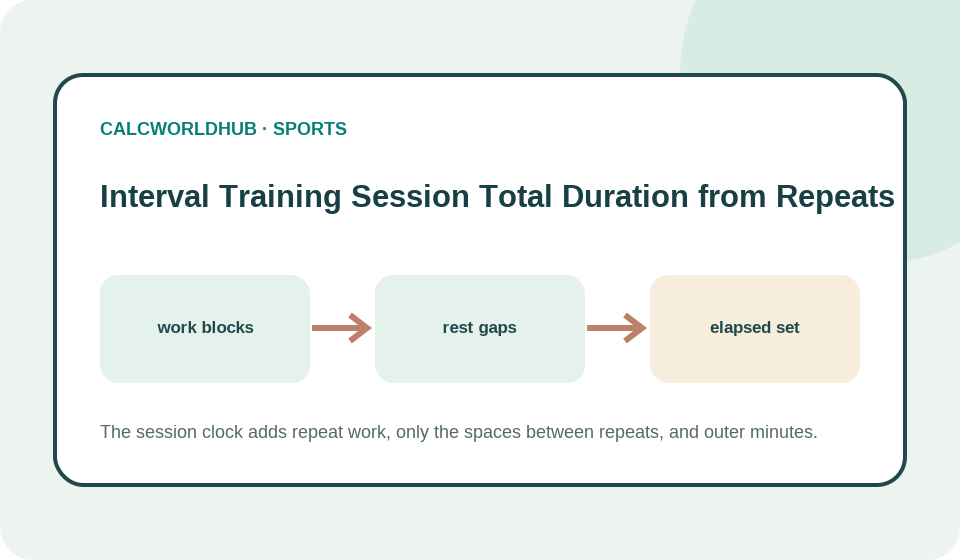
Total work seconds = repeats × work seconds. Between-repeat rest seconds = (repeats − 1) × rest seconds, with no negative rest count when there are no repeats. Divide those totals by 60 to convert them to minutes, then add the entered combined warm-up and cool-down minutes.
Use at least one whole-number repeat and nonnegative time values. Although the repeat field may appear to accept decimal steps, a fractional repeat produces a message asking for a whole-number count. A completed interval is a whole event, so use an integer count when estimating a real session.
Keep the units visible
Work and between-repeat recovery are entered in seconds, while the outer phases are in minutes. Convert seconds to minutes only after multiplying by the repeat count and the number of rest gaps. Converting each interval after rounding can create a small difference in the total.
The result is a duration in minutes and may be fractional. It represents the entered schedule only. It excludes travel to the track or gym, equipment setup, water breaks, coaching instructions, and any extra recovery that is not entered.
Use the total to schedule, not prescribe
A total duration can help reserve calendar time, compare two written session structures, or check whether a workout fits a planned window. It does not judge whether the work intensity, rest, or total training load is suitable for a person. ACSM’s information on high-intensity interval training emphasizes that interval work varies by individual and context; use qualified guidance for training decisions.
Do not treat the calculator’s arithmetic as a readiness or safety assessment. If fatigue, injury, health conditions, or a return to exercise changes what is appropriate, consult a qualified professional. The model knows only the four time inputs and has no health, age, fitness, or recovery information.
Document what the duration includes
Label the repeat count and work/rest conventions whenever you share a total. In this tool, the rest count is one less than the repeat count because rests occur between intervals, not after every interval. If your written workout includes a final cooldown walk or jog, include it in the combined outer-phase field.
USATF describes sprinting and pacing as distinct across event lengths, while the calculator makes no claim about pace or adaptation. Keep the duration estimate separate from any workout plan. A revised number of repeats, changed recovery, or longer warm-up should be entered explicitly so the total is reproducible.
Worked examples
Eight repeats with seven rests
Inputs: Repeats = 8; work = 100 s each; rest between repeats = 60 s; warm-up plus cool-down = 20 min.
Calculation: Work = 8 × 100 ÷ 60 = 13.3333… min. Between-repeat rest = (8 − 1) × 60 ÷ 60 = 7 min. Total = 13.3333… + 7 + 20 = 40.3333… min ≈ 40.33 min.
The programmed blocks total about 40.33 minutes, before setup or any unentered pauses.
Six longer work periods and five recovery gaps
Inputs: Repeats = 6; work = 120 s; rest = 90 s; warm-up plus cool-down = 15 min.
Calculation: Work = 6 × 120 ÷ 60 = 12 min. Between-repeat rest = (6 − 1) × 90 ÷ 60 = 7.5 min. Total = 12 + 7.5 + 15 = 34.5 min.
This schedule is 34.5 minutes by the entered timings; no recovery after the sixth repeat is included.
