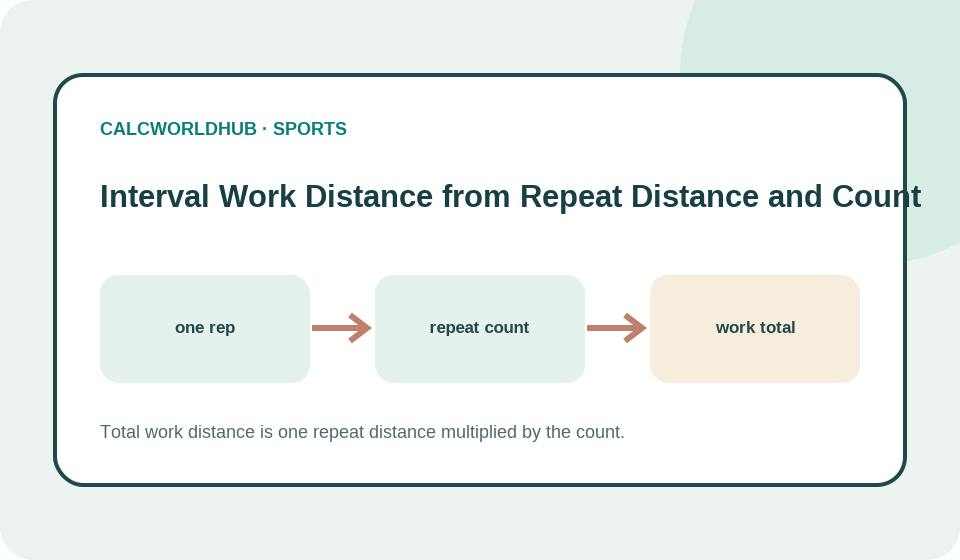

Enter the distance of one work interval
The calculator asks for one interval distance in metres and the number of repeats. Use the distance assigned to the work portion of one repetition, not the total distance of a complete workout. The repeat count describes how many times that same work segment is completed.
The current calculation has no time or pace field. If a plan gives only work duration and pace, convert that pair into distance separately with consistent units before entering the interval distance. Do not assume this tool performs that conversion because its route or a general search phrase mentions interval pace.
Multiply the work segment by the repeats
Total work distance = interval distance × repeats. If the set contains several different distances, calculate each block and add the resulting subtotals. This calculator represents one repeated distance only, so it does not model a ladder, mixed set, or progressive workout structure.
A practical repeat count is a whole number. Although the entry can accept a decimal count, a fractional value does not describe a physical number of completed intervals. Use an integer repeat count when planning or recording a workout; the input limitation is documented separately.
For a workout with several blocks, keep a small block-by-block record: the distance assigned to each work repetition, how many were completed, and the resulting subtotal. The general extension is the sum of each block’s distance multiplied by its completed repetitions, but this calculator accepts only one distance and one count at a time. Calculate each uniform block separately before combining the subtotals. If an athlete stops early, use completed repetitions for an after-session total; use planned repetitions only when the question is the prescribed workload. State which basis you used, because the two totals answer different questions.
Keep work distance separate from total session distance
The result covers only the repeated work segments. It excludes warm-up jogging, walk-back recovery, easy running between sets, cool-down, and travel. Those phases may make total distance much larger than the work-only number, so label the result clearly when tracking mileage.
A work-distance subtotal can be useful for comparing two sets with the same kind of interval or recording training volume. It does not tell you how long the session takes or how fast each interval is. A full session estimate needs distances or times for every phase and a rule for how to account for recovery.
Use compatible units and a consistent definition
The distance field is metres. Convert kilometres by multiplying by 1,000 and convert miles with an explicit conversion factor before entering the value. Keep precision in the conversion until the final display; rounded distance per interval multiplied many times can accumulate visible difference.
Define whether the interval means a lap, a measured route, or a distance from a training plan. A track lap, GPS estimate, and measured road segment can differ. Use one measurement source within a comparison and note whether the repeat count includes only completed work or planned repeats that were later skipped.
Interpret the subtotal without making a training claim
A larger work-distance total means more distance is included in the repeated work blocks; it does not automatically mean a session is harder, safer, or more effective. Recovery, pace, surface, elevation, athlete experience, and the surrounding program all matter, none of which is assessed here.
Use the calculator for arithmetic after deciding the session structure. It is not a readiness test or personalized training recommendation. If you compare sets with different interval lengths, report both the repeat structure and total work distance so the number does not hide the way the session was built.
Worked examples
Twelve 400-metre work intervals
Inputs: Distance per work interval = 400 m; repeats = 12.
Calculation: Total work distance = 400 m × 12 = 4,800 m = 4.8 km.
The repeated work adds up to 4.8 km; warm-up, recovery, and cooldown are not included.
Five one-kilometre work intervals
Inputs: Distance per work interval = 1,000 m; repeats = 5.
Calculation: Total work distance = 1,000 m × 5 = 5,000 m = 5 km.
The work-only total is 5 km; the complete session distance is higher if other phases are covered on foot.
