
What the most-likely weight means
Three-point estimating separates the task’s central scenario from its optimistic and pessimistic bounds. The central value often reflects the most common or ordinary case, but its meaning depends on the estimator and the task definition. Keep the estimate tied to the same scope and unit as the two endpoints that will later be used in the complete PERT calculation.
Use the central estimate as a duration
Enter M as a duration. Use days with days, hours with hours, and the same convention for elapsed versus working time. The calculator does not need O or P because this focused calculation returns only the central term’s weight. That makes it useful for checking a formula component, but insufficient to calculate a full task expectation on its own.
Calculate its weighted contribution
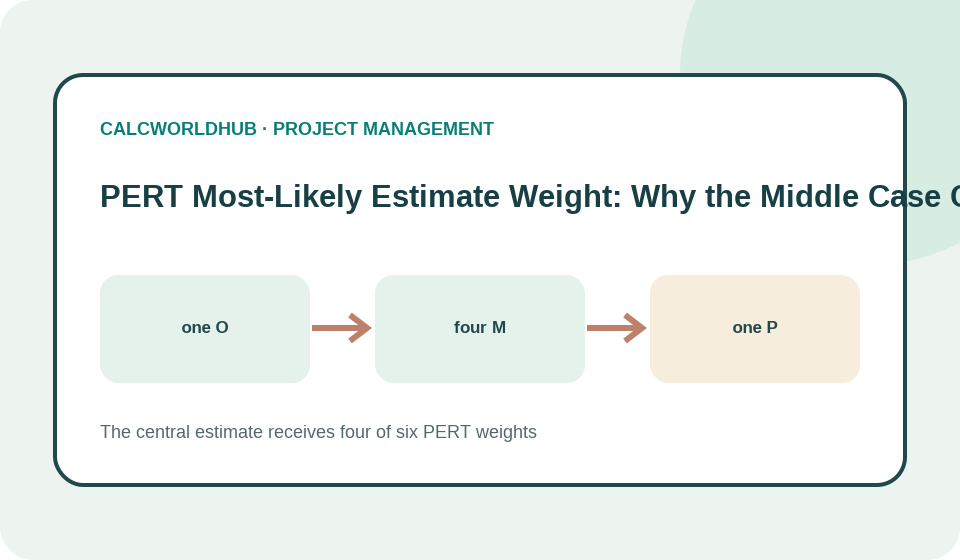
In TE=(O+4M+P)/6, the most-likely contribution is 4M/6, which simplifies to 2M/3. The denominator remains six because the complete expression includes six total weight units. The calculator’s output can therefore be compared with the central portion of a hand calculation before adding the endpoint contributions.
Do not confuse a contribution with a forecast
A weighted contribution is not a probability and not a complete duration forecast. It can be smaller than M because the six-part average distributes the combined estimates across the full weight. When writing the result in a schedule note, name it as a component of the PERT mean so nobody mistakes it for the activity’s full expected time.
Use weights in the full PERT sum
The component is most useful as a transparent check in a spreadsheet or teaching example. If the full formula is being assembled by hand, calculate the optimistic term O/6, central term 4M/6, and pessimistic term P/6, then add them. Comparing the three parts can reveal a misplaced factor or a mismatch in units before the estimate reaches the schedule.
A common error is to multiply M by four and stop there, or to divide by three after simplifying the numerator. The correct contribution remains 4M/6; after simplification it is 2M/3. Keep the unreduced expression visible when teaching or auditing a worksheet, because it connects the part to the six total weights in the complete PERT equation.
If M is revised after a team review, recompute the contribution from the revised duration and keep the earlier estimate in the decision record. The weighted term is transparent enough to audit by hand, which is why it can help locate mistakes in a larger worksheet. It cannot tell whether the estimate itself is unbiased; that is a judgment about the evidence and forecasting process, not the arithmetic.
Worked examples
These outputs show only the central weighted term; neither is the complete PERT expected duration.
Central estimate of five days
Inputs: Most-likely duration M = 5 days.
Calculation: Weighted contribution = 4M ÷ 6 = (4 × 5) ÷ 6 = 20 ÷ 6 ≈ 3.3333 days.
The most-likely term contributes about 3.33 days to the full PERT mean.
Central estimate of nine hours
Inputs: Most-likely duration M = 9 hours.
Calculation: Weighted contribution = 4 × 9 ÷ 6 = 36 ÷ 6 = 6 hours.
The central term contributes six hours; endpoint terms must still be added for the full mean.

Scope of this component calculation
Changing M changes this component linearly: a proportional increase in the most-likely duration produces the same proportional increase in the contribution. That does not mean total expected duration changes by the same absolute amount as M; only four of the six weights are attached to it. The endpoints also affect the complete result and can shift uncertainty independently.
This calculation contains no statistical fitting and does not test whether M is actually the mode of a duration distribution. PERT’s conventional weighting is a planning approximation. If the activity has multiple modes, strong dependencies, resource conflicts, or a skewed duration pattern, this one component cannot describe those risks.