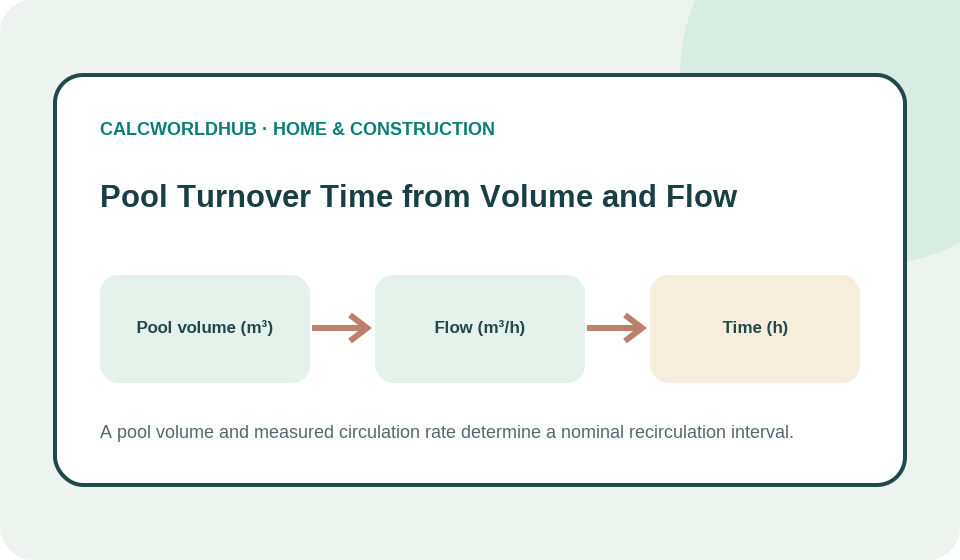

Measure the water volume and operating flow
Use the pool's water volume in cubic metres, not the outside dimensions of the shell. A rectangular pool can be estimated from its water length, width, and average depth, but steps, slopes, benches, and irregular shapes make the geometric estimate less exact. If the pool or installer has a documented water capacity, use that figure and note whether it is a nominal or measured volume.
The flow input is the circulation rate in cubic metres per hour under the condition you want to assess. A pump label or a pump's maximum free-discharge rating is not automatically the flow delivered through an installed filter, heater, valves, and piping. Where available, use a properly installed flow meter or a measured system value with the filter in its normal operating condition.
What the turnover quotient means
The calculator divides volume by flow: turnover time in hours = pool volume in m³ ÷ circulation flow in m³/hour. Cubic metres cancel, leaving hours. It also divides the same volume by your target hours to show the flow rate that would correspond to that nominal interval. For example, doubling flow at the same volume halves the quotient; doubling volume at the same flow doubles it.
A turnover is a volume-equivalent calculation, not a claim that each water parcel passes through the filter exactly once. Real pools mix imperfectly. Return-jet direction, suction locations, water features, obstructions, filter condition, and pump operating point affect circulation patterns. The number is best read as a planning comparison based on the flow actually entered.
Use the target-flow output carefully
The target-hours field lets you ask a narrow question: what average flow would make the pool-volume quotient equal this many hours? It does not select a pump, verify pipe velocity, account for total dynamic head, or establish that the filter can handle that rate. Compare the result with the equipment manufacturer's flow limits and the system's measured operating point before making a change.
The calculator accepts positive pool volume, flow, and target duration. A zero flow cannot produce a finite turnover time, and a zero target cannot be used as a denominator. The inputs are not a treatment recipe: chemical concentration, contact time, water temperature, bather load, and sanitation equipment are outside this arithmetic.
Turnover time is not a water-quality guarantee
The CDC Model Aquatic Health Code defines turnover using pool volume and flow through filtration, while also treating aquatic-facility safety as a broader operating matter. A short quotient by itself cannot show that the filtration system removes a particular contaminant or that disinfection is adequate. Follow the rules adopted by the local authority for a public or commercial facility and the operating instructions for the installed equipment.
For a residential pool, keep the calculation alongside routine circulation and water-care records rather than using it as a substitute for testing. If measured flow is uncertain, a repeat measurement under stable conditions can be more informative than a highly precise calculation from a guessed pump rating. Record filter cleanliness, valve position, and the date so later comparisons use a similar system state.
Worked examples
Each example reports both the time implied by measured flow and the flow needed for the entered target duration.
A 72 m³ pool with 12 m³/hour measured flow
Inputs: Pool volume = 72 m³; measured flow = 12 m³/hour; target duration = 4 hours.
Calculation: Turnover = 72 ÷ 12 = 6 h; target flow = 72 ÷ 4 = 18 m³/h; measured flow conversion = 12 × 1,000 ÷ 60 = 200 L/min.
The theoretical turnover time is 6 hours. A 4-hour volume-to-flow interval would require 18 m³/hour under the same simple model.
A 55 m³ pool at a lower measured flow
Inputs: Pool volume = 55 m³; measured flow = 7.5 m³/hour; target duration = 5 hours.
Calculation: Turnover = 55 ÷ 7.5 = 7.33 h; target flow = 55 ÷ 5 = 11 m³/h; measured flow conversion = 7.5 × 1,000 ÷ 60 = 125 L/min.
The measured-flow quotient is about 7.33 hours. For a five-hour quotient, the arithmetic requires 11 m³/hour; equipment and local requirements still need separate review.
