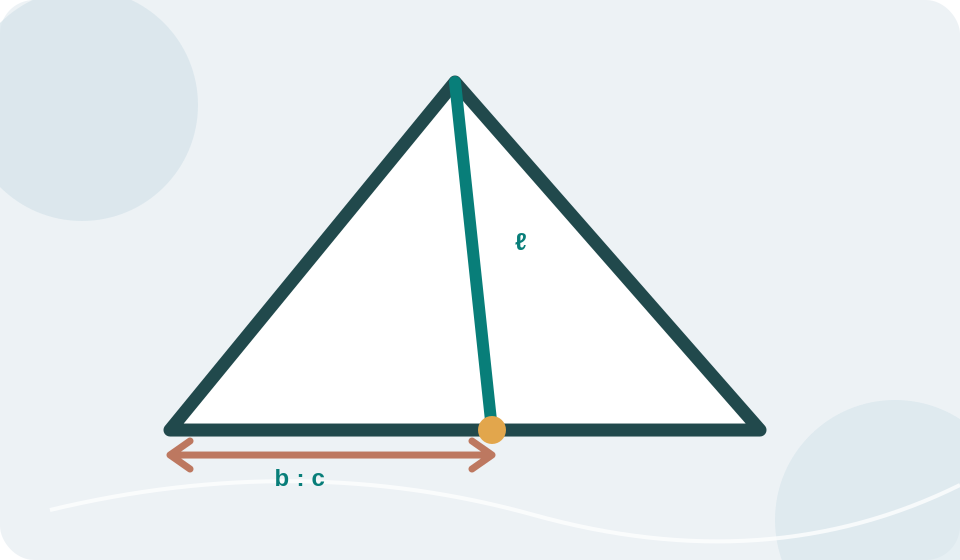

Enter the two adjacent sides and the opposite side
At the selected vertex, call the two sides that meet there b and c. The side across from that angle is a. The calculator labels its three inputs “Adjacent side b,” “Adjacent side c,” and “Opposite side a,” in that order. Keep all three measurements in the same unit; the returned bisector length uses that unit.
A real triangle must satisfy b+c>a, b+a>c, and c+a>b. These strict inequalities rule out flat or impossible side sets. If you are measuring a drawing, use the lengths rather than angle values: this tool infers the included angle from the three sides. The result is the internal bisector from the selected vertex to the opposite side, not an external bisector or a median.
Worked examples
A scalene triangle with a 7:9 side ratio
Inputs: Adjacent sides b=7 units and c=9 units; opposite side a=8 units.
Calculation: ℓ=√[7·9·((7+9)²−8²)]/(7+9)=√(63·192)/16=√756/4≈6.8739.
The internal angle bisector is approximately 6.8739 units. The opposite side is divided in the ratio 7:9.
An isosceles triangle with equal adjacent sides
Inputs: Adjacent sides b=5 units and c=5 units; opposite side a=6 units.
Calculation: ℓ=√[5·5·((5+5)²−6²)]/(5+5)=√(25·64)/10=40/10=4.
The angle bisector is 4 units. Because b=c, it also meets the opposite side at its midpoint.

Use the side-length formula
The length ℓ of the internal angle bisector is ℓ = √[bc((b+c)²−a²)]/(b+c). The sum b+c forms the denominator; the squared opposite side a² reduces the radicand. Every term is a length squared inside the square root, so ℓ has the same length unit as the inputs.
The relation follows by splitting the triangle into two smaller triangles with a common altitude to side a. Their areas are proportional to the two pieces of the opposite side. The angle-bisector theorem says those pieces have ratio b:c, which lets the length be connected to the side lengths without separately entering an angle.
A useful rearrangement is ℓ² = bc[1−a²/(b+c)²]. It makes the scale clear: multiplying every side by a factor t multiplies ℓ by t. The bracket is nonnegative for a valid triangle because a<b+c. It also shows why a long opposite side, close to b+c in a very thin triangle, can make the bisector comparatively short.
Read the result as a segment
The displayed value measures the straight segment from the selected vertex to the point where its angle bisector meets side a. It is not the length of either of the two pieces on side a. The point divides side a into lengths in the ratio b:c, with b opposite the endpoint adjacent to the c-side and c opposite the endpoint adjacent to the b-side.
If b=c, the two pieces are equal and the angle bisector also acts as a median and a perpendicular altitude in an isosceles triangle. When b and c differ, those three lines generally do not coincide. For example, side lengths 7 and 9 create a 7:9 division of the opposite side; treating the bisector as a midpoint line would answer a different question.
Check the geometry independently
A quick manual check is to reconstruct the included angle using the cosine rule, cos A=(b²+c²−a²)/(2bc). For the 7, 9, 8 triangle, cos A=(49+81−64)/(2·7·9)=66/126=11/21. This lies between −1 and 1, as a genuine included angle should.
Worked examples and common mistakes
The worked examples use the same side convention in both cases: b and c meet at the angle being bisected, while a is opposite it. They verify the length formula directly and use the side-ratio theorem as a separate geometry check.
Do not enter an angle in degrees into a side field, even if the value seems plausible. A second common error is to use a as one of the adjacent sides because many textbooks use a,b,c in a different order. Here the labels in the calculator control: read the field captions and identify which two sides touch the chosen vertex.
The model assumes a plane Euclidean triangle and exact straight side lengths. It does not account for measurement uncertainty, rounded construction drawings, a curved boundary, or a three-dimensional angle between surfaces. If dimensions are measured, retain their precision and avoid reporting more digits than the source measurements support.
When another triangle tool is a better fit
Use the median-length calculator when you need the vertex-to-midpoint segment; use the altitude calculator when the question concerns perpendicular height. For an angle bisector, the target is instead the equal-angle line and its side-ratio division. These lengths can coincide in a symmetric triangle, but that special case should not be assumed for a general shape.