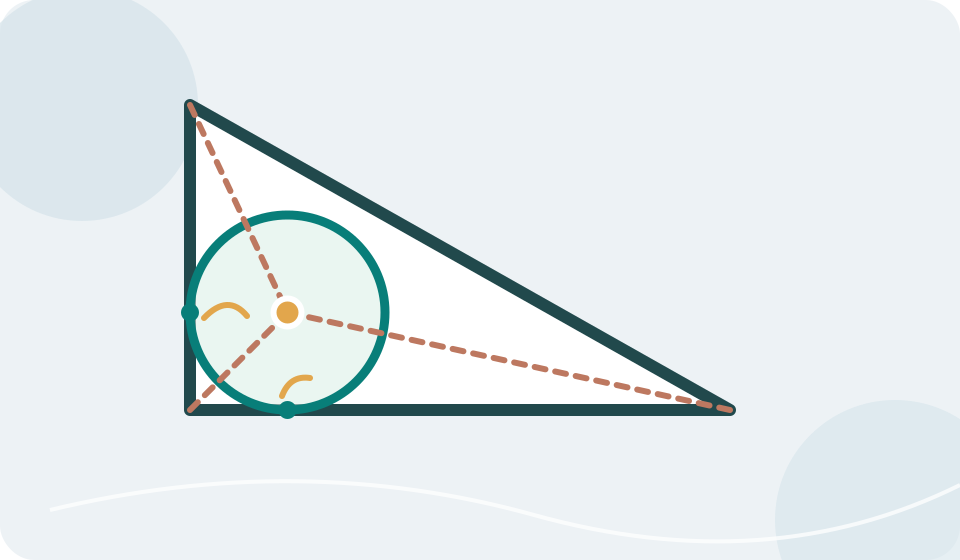

Weight each vertex by its opposite side
Name the vertices A=(x₁,y₁), B=(x₂,y₂), and C=(x₃,y₃). Let a be the length BC, b the length CA, and c the length AB. Then I=((ax₁+bx₂+cx₃)/(a+b+c), (ay₁+by₂+cy₃)/(a+b+c)). In the calculator, enter the six coordinates in the displayed A, B, C order; it derives the three side lengths from those points.
The weights are opposite-side lengths, not the x-values, angles, or side labels in an arbitrary drawing. Longer opposite sides pull the weighted average more strongly toward their corresponding vertex. The perimeter normalizes the weights. Coordinates of the result remain in the same linear unit and coordinate frame as the inputs.
Worked examples
A 3-4-5 right triangle
Inputs: A=(0, 0), B=(4, 0), C=(0, 3); opposite side lengths a=5, b=3, c=4.
Calculation: xI=(5·0+3·4+4·0)/12=1; yI=(5·0+3·0+4·3)/12=1.
The incenter is I=(1, 1), one unit from each side.
A translated right triangle with longer legs
Inputs: A=(1, 1), B=(7, 1), C=(1, 9); opposite side lengths a=10, b=8, c=6.
Calculation: xI=(10·1+8·7+6·1)/24=3; yI=(10·1+8·1+6·9)/24=3.
The incenter is I=(3, 3), the same distance from each side line.

Worked examples and equal-distance meaning
Check an answer by measuring its perpendicular distance to each of the three side lines. For an interior point to be the incenter, these distances must agree. In the right-triangle example, the point is one unit from both legs and one unit from the hypotenuse, making it the center of the largest circle that fits inside the triangle. The calculator returns the point and perimeter, not an inradius output.
Why the weighted average finds the angle-bisector intersection
The incenter is the intersection of the internal angle bisectors and is equidistant from the three side lines. In barycentric coordinates its weights are proportional to the opposite side lengths, which produces the Cartesian formula above. This is why taking a plain arithmetic mean of the vertices is generally wrong: that gives the centroid, a different point defined by the medians.
The incenter is always inside a nondegenerate triangle. That gives a quick visual check, but a narrow triangle can place it close to one side. If the computed point appears outside, first verify the A/B/C coordinate order and recompute the distances to the side lines. Do not compare to vertex-to-point distances; those are not expected to be equal.
Coordinate and measurement discipline
All coordinates must use the same origin, axis directions, and linear unit. If one point is entered in millimetres and another in metres, the derived side lengths and weighted coordinates have no coherent scale. Convert the full drawing first. A shifted origin is harmless if applied to every vertex: the incenter shifts by the same amount. Rotation or uniform scale likewise preserves the geometric construction.
The order of vertices does not change the geometric point when each x,y pair stays together, because the formula’s weighted terms are simply reordered. But swapping only one coordinate breaks a vertex pair and changes the shape. Keep a sketch with A, B, and C labels, then enter each point in the matching fields. Decimal values are valid; use enough precision for the source drawing without implying greater accuracy than the measurements provide.
Applications and what this result does not provide
The incenter is useful when locating the center of an inscribed circle, checking an angle-bisector construction, or comparing the clearance from a point to all three boundaries. For a template or fabrication drawing, it can identify a candidate circle center once the triangle’s coordinate frame is fixed. The radius must still be found separately as the perpendicular distance from the center to a side.
The result is a two-dimensional point, not a side length, area, or circle specification. It does not account for line thickness, rounded corners, a non-triangular outline, or manufacturing clearance. If the task is to draw a circle that must fit within a physical part, use the measured interior boundaries and allow for tolerances after locating the ideal geometric center.
Degenerate cases and common mistakes
Three collinear or indistinguishable points do not enclose a triangle and have no unique incenter. The runtime rejects a degenerate shape and non-finite coordinates. Nearly collinear coordinates can also be sensitive: a small measurement error may noticeably alter the narrow angle and the resulting weighted point. Use a better-conditioned drawing or more precise measurements rather than reading many decimals as certainty.
A common error is assigning each weight to the side that touches that vertex rather than the side opposite it. Another is mixing the incenter with the circumcenter, whose point is equal-distance from the three vertices, or with the centroid, whose vertex weights are equal. State the construction you need, verify the point-to-side distances, and only then use it in a downstream drawing or estimate.