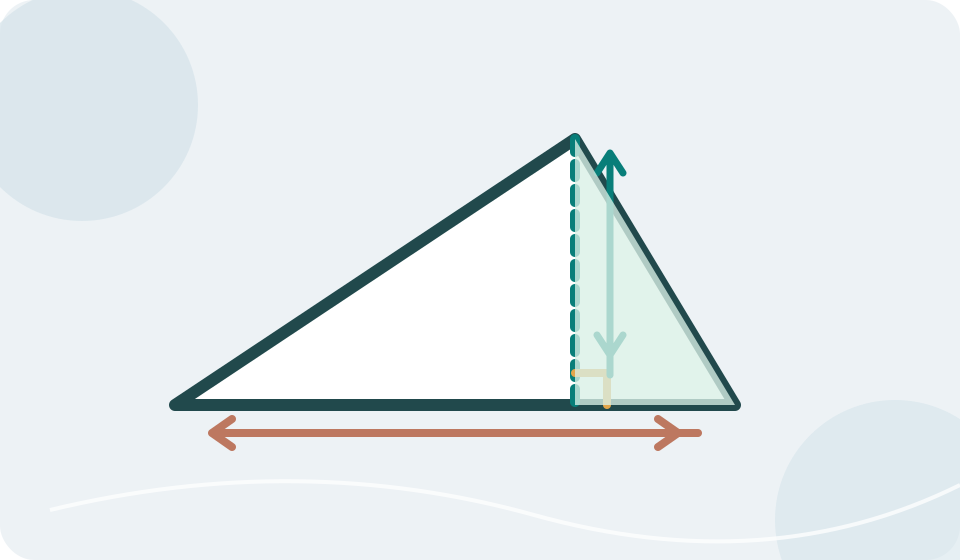

Use the perpendicular height for the chosen base
The calculator applies A = bh ÷ 2. Here b is one side chosen as the base, h is the perpendicular distance from the opposite vertex to the straight line containing that base, and A is the enclosed planar area. The inputs may use any length unit, but b and h must be expressed in the same unit before multiplication.
A perpendicular is measured at 90°. In a right triangle, one leg can be the base and the other leg its height. In an acute triangle the altitude falls inside the shape. In an obtuse triangle it can meet the extension of the base beyond an endpoint, so the relevant height may not be a drawn side. Changing which side is called the base changes its matching height, while the area stays the same.
Worked examples
A 12 cm base with a 7 cm perpendicular height
Inputs: b = 12 cm; h = 7 cm.
Calculation: A = bh/2 = 12 × 7 / 2 = 42 cm².
The triangle’s area is 42 cm².
A larger triangular panel measured in metres
Inputs: b = 9 m; h = 4 m.
Calculation: A = 9 × 4 / 2 = 18 m².
The panel covers 18 m² in the triangular model.

Worked examples and unit checks
The first example uses centimetres throughout. Multiply the measured base by the perpendicular height, then divide by two. The output unit is a square unit because it comes from multiplying two lengths; it is not centimetres or a perimeter.
For a second check, use a base in metres and a height in metres. Convert any millimetre or centimetre measurement before multiplying. If the result differs by a factor of 100 or 10,000 from a hand check, inspect whether a length or area conversion was applied twice or not at all.
For field measurements, record which side was selected and how the perpendicular was obtained. A drawing may show a sloped edge that looks like a height, but a sloped distance is not interchangeable with its vertical or normal projection. If the drawing gives a base and an angle instead, a trigonometric method can recover the perpendicular component first.
Use the result for the question you have
The area is useful for a flat triangular sheet, sign, fabric panel, garden bed, or section of a plan when the outline is reasonably straight and the dimensions describe its plane. It does not estimate the amount of three-dimensional material without a thickness or depth, and it does not determine the triangle’s perimeter or side lengths.
The equation gives simple sensitivity checks. If b stays fixed and h doubles, the area doubles. If both lengths double, the area becomes four times larger. Halving either input halves the result. These comparisons help identify a misplaced decimal and explain why a modest dimensional change can materially alter a cutting or coverage estimate.
A practical cross-check is to compare the triangle with the parallelogram that has the same base and height. Its area must be twice the triangle’s result. You can also split a larger outline into triangles, calculate each piece with a suitable base-height pair, and add the pieces, taking care not to count shared boundaries as extra area.
Common measurement errors
The most common mistake is entering the sloping side opposite the base as h. That side may be longer than the altitude, especially in an acute triangle, and using it makes the calculated area too large. Drop or project a perpendicular to the base line, mark the right angle, and measure that segment instead.
Another error is mixing units. A base of 40 cm and a height of 0.3 m correspond to 0.4 m and 0.3 m, giving 0.06 m²; entering 40 and 0.3 together would combine unlike units. The number returned has no automatic physical unit because the inputs accept generic lengths, so label the output yourself from the measurement units.
Do not treat a curved edge as a straight base unless the shape is being approximated intentionally. For an irregular or curved boundary, this single triangle formula covers only the triangular model. Divide the outline into measured pieces or use a geometry method suited to the actual boundary.
Precision and model limits
Keep more digits during multiplication than you plan to report. The measurements usually limit meaningful precision: if a field measurement is only reliable to the nearest centimetre, a long decimal result is a calculation detail, not evidence that the true area is known to that precision. Round once, after the arithmetic, using a convention appropriate to the task.
The tool accepts finite nonnegative base and height values, so a zero input returns zero area. A physical triangle with zero area is degenerate, however; it has collapsed to a line or a point. For real material planning, confirm that both measurements are positive and refer to the same planar outline. The calculator does not validate that the pair came from a constructible triangle.