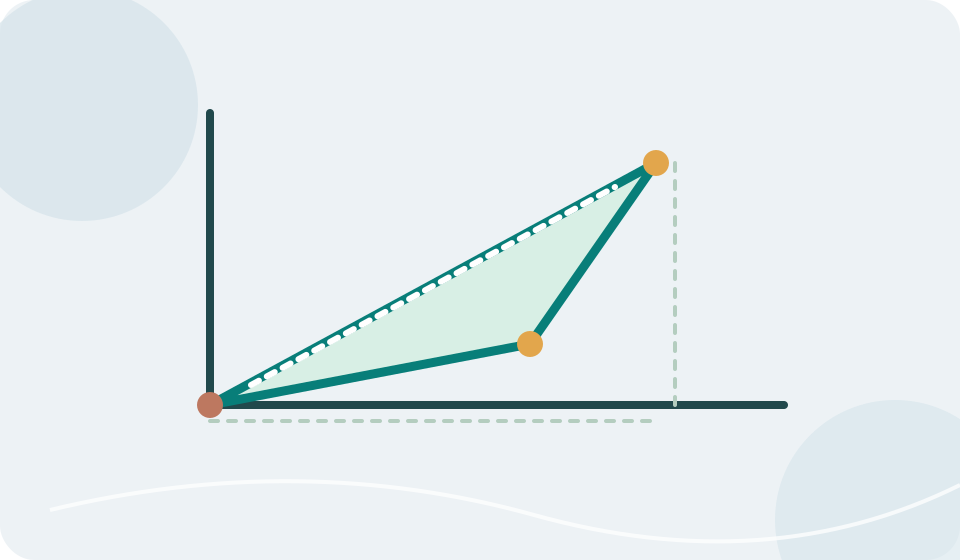

Enter the three vertices in a common coordinate plane
The inputs are x and y for vertex 1, x and y for vertex 2, and x and y for vertex 3. All six values must be finite and use the same Cartesian coordinate system and scale. Coordinates may be positive, negative, or zero; they are locations, not lengths that must each be positive.
The calculation translates the second and third vertices relative to the first. If the points are (x₁,y₁), (x₂,y₂), and (x₃,y₃), then A = ½ |(x₂ − x₁)(y₃ − y₁) − (y₂ − y₁)(x₃ − x₁)|. This is half the absolute two-dimensional determinant, or half the magnitude of the corresponding cross product.
Translation leaves the edge vectors unchanged. Reversing the vertex order changes the sign of the oriented determinant, but the calculator takes its absolute value, so clockwise and counterclockwise listings return the same nonnegative area.
Worked examples
A right triangle plotted from its vertices
Inputs: P₁ = (0,0); P₂ = (4,0); P₃ = (0,3).
Calculation: A = ½ |4×3 − 0×0| = 6 square coordinate units.
The three points enclose area 6; reversing their order leaves the area unchanged.
A triangle with negative and positive coordinates
Inputs: P₁ = (−2,1); P₂ = (3,4); P₃ = (5,−1).
Calculation: Edge vectors (5,3) and (7,−2) give determinant −31; A = |−31|/2 = 15.5 square coordinate units.
The area is 15.5 square coordinate units; the negative determinant records clockwise orientation.

Worked coordinate checks
For (0,0), (4,0), and (0,3), the two edge vectors from the first point are (4,0) and (0,3). Their determinant is 4 × 3 − 0 × 0 = 12, and half its magnitude is 6. The right-angle base-height calculation gives the same area, providing an independent geometric check.
For the second set, use P₁ = (−2,1), P₂ = (3,4), and P₃ = (5,−1). The edge vectors from P₁ are (5,3) and (7,−2). Their determinant is 5 × (−2) − 3 × 7 = −31, so the area is |−31|/2 = 15.5 square coordinate units. The negative sign only records orientation.
Coordinate values measured in metres produce square metres; values in feet produce square feet. For longitude and latitude, raw degrees are angular coordinates, not planar lengths. Project geographic positions into a suitable local coordinate system before interpreting the result as a physical area.
Check the point order and geometry
The three points need not be entered clockwise or in a particular starting position. Because the formula uses an absolute value, any permutation describes the same triangle area. Still, keep a consistent vertex order in your notes when the sign is useful for a separate orientation or boundary calculation.
If the points lie on one straight line, their edge vectors are parallel and the determinant is zero. That is a valid mathematical output for a degenerate triangle, not an error message. If a real triangle was expected, check for swapped coordinates, copied points, or rounding that made distinct vertices collinear.
Collinear vertices return zero. Narrow triangles can be sensitive to rounded coordinates, so preserve source precision and treat a near-zero result as an estimate.
Manual cross-checks and common mistakes
A hand check can use the shoelace form: take the absolute value of x₁y₂ + x₂y₃ + x₃y₁ − y₁x₂ − y₂x₃ − y₃x₁, then divide by two. It is equivalent to the translated determinant, so it checks arithmetic but cannot catch a wrong point copied into both methods.
Keep each x paired with its own y. Swapping one coordinate or shifting a row can produce a plausible-looking number for a different triangle. A quick plot or sketch catches many such errors. Also distinguish a point location from a side length: negative coordinates are allowed, but a coordinate axis or origin is not automatically the triangle’s base.
Do not multiply by one-half twice. The determinant is a signed double-area; divide its absolute value by two exactly once. The base-height formula already includes that factor.
Interpretation and limits
The result applies to a flat triangle in a two-dimensional Cartesian plane. It is not the surface area of a triangular face tilted in three-dimensional space unless the coordinates are expressed in a compatible plane. For three-dimensional points, a full vector cross-product calculation is required instead of selecting two coordinates without justification.
If the three coordinates are approximate, the area is approximate too. Report the coordinate unit and precision, and preserve whether the source is a plan, survey, image trace, or model. The arithmetic is exact for the entered points, but that does not make the points themselves exact or guarantee that they represent a curved boundary well.
These three vertices define only the straight edges between the listed points. Curved boundaries, holes, or outlines with more corners require a method for that boundary; partition a polygon into triangles only when its vertices and diagonals are known.