
Start with the triangle side lengths
The calculator uses side lengths a, b, and c in one common unit. The output is the circumradius R: the distance from the circumcenter to any vertex. It is not the diameter, not the inradius, and not the distance from the center to a side. Every valid triangle has exactly one circumcircle through its three vertices.
Check that all sides are positive and satisfy the strict triangle inequality. A zero side or a set such as 2, 3, 5 is degenerate; no finite circle passes through three distinct noncollinear triangle vertices in that limiting arrangement. A nearly degenerate triangle is valid in principle but can produce a very large circumradius.
The initial measurement scale carries through unchanged. If the sides are entered in centimetres, R is in centimetres; if all are in metres, R is in metres. A mixed-unit set can yield a plausible numerical result but has no geometric meaning, so convert before entering values.
Worked examples
A right triangle whose hypotenuse is the diameter
Inputs: a=3 units, b=4 units, c=5 units.
Calculation: s=6; A=√(6·3·2·1)=6. R=3·4·5/(4·6)=60/24=2.5.
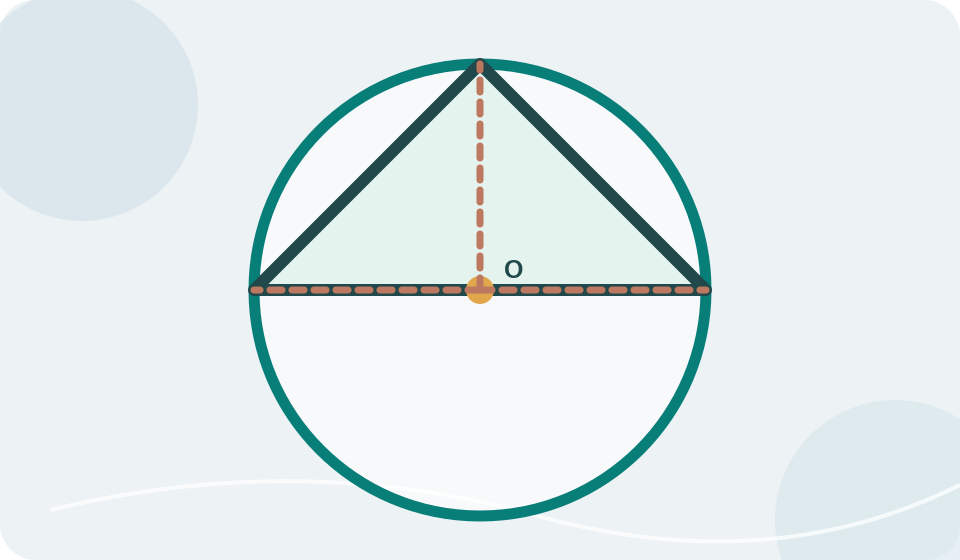
The circumradius is 2.5 units, exactly half the 5-unit hypotenuse.
A scalene triangle with sides 5, 5, and 6
Inputs: a=5 units, b=5 units, c=6 units.
Calculation: s=8; A=√(8·3·3·2)=12. R=(5·5·6)/(4·12)=150/48=3.125.
The circumradius is 3.125 units.

Find area, then use the circumradius relation
For a triangle with area A, R=abc/(4A). With side-only inputs, first find s=(a+b+c)/2 and A=√[s(s−a)(s−b)(s−c)] using Heron’s formula. Substituting this area gives the radius directly from the three side lengths. The area has square units, so abc divided by 4A has length units.
Heron’s formula is useful because it needs no angle or height. It is numerically well behaved for ordinary triangles, although a very thin triangle approaches zero area and can make R sensitive to small side changes. The calculator’s finite output is a computed estimate from the entered values, not a measurement of a physical circle.
For a right triangle, the hypotenuse is a diameter of the circumcircle, so R equals half the hypotenuse. For an equilateral triangle of side x, the height is x√3/2 and the circumcenter lies two thirds of the way from a vertex down the altitude; this gives R=x/√3. These special cases are strong independent checks.
Interpret the circle and its position
The circumcenter is the point equally distant from the three vertices. It lies inside an acute triangle, on the midpoint of the hypotenuse in a right triangle, and outside an obtuse triangle. The radius itself remains positive in every nondegenerate case; the center’s position changes with the shape.
A common visual mistake is to assume the center must be inside the triangle. In an obtuse triangle it is outside, but the same three equal vertex-to-center distances define the circle. The formula uses the triangle’s area and sides, so it does not require locating the center first.
The circumcircle is the unique circle through the three vertices, not the smallest circle containing every point of a filled triangle under arbitrary measurement noise. If the vertices come from a survey or image, uncertainty in those positions can change both the fitted center and radius. This calculator treats the three side lengths as exact inputs.
Worked examples and checks
A convenient verification route is to calculate the semiperimeter and Heron area, then evaluate abc/(4A). When a triangle is right, compare with half the longest side as a separate check. When it is equilateral, compare with side divided by √3. Keep extra precision until the final display rounding.
If two calculations disagree, check that the same side lengths and units were used in both. Do not use the diameter where the formula expects a radius or use an area from a different triangle. For a thin triangle, compare input precision with the size of the area before trusting several decimal places.
Common mistakes and practical use
Use this radius when you need a circle passing through all three measured vertices, such as a circumcircle in a construction or a geometric check. Use an inradius tool for a circle tangent to the sides. The two circles answer different questions, and their radii can differ substantially.
A frequent error is substituting perimeter for area or omitting the factor of four. Calculate s once, then use s−a, s−b, and s−c in the matching side order. For this calculator there is an additional source-contract limitation: its current handler computes Heron’s expression and checks whether the result is finite, but it does not explicitly reject each nonpositive side or test all three triangle inequalities first. The input controls permit negative values. Check the mathematical preconditions yourself; a finite display from an invalid set is not a valid circumradius. The formula and runtime are unchanged.