
Use equal distances to check the circle center
Write the vertices as A=(x₁,y₁), B=(x₂,y₂), and C=(x₃,y₃). The circumcenter O is the intersection of the perpendicular bisectors of the sides. Equivalently, it is the point for which OA=OB=OC. The six calculator inputs are x and y coordinates for the three vertices in one common Cartesian frame; its output is a coordinate pair in that same frame.
A convenient hand check compares squared distances so square roots are unnecessary: (Ox−x₁)²+(Oy−y₁)² should equal the corresponding expressions for B and C. The common distance is the circumradius. The calculator displays that radius as well as the center, giving a second check against a drawing or a known circle.
Worked examples
A right triangle with a 3-4-5 hypotenuse
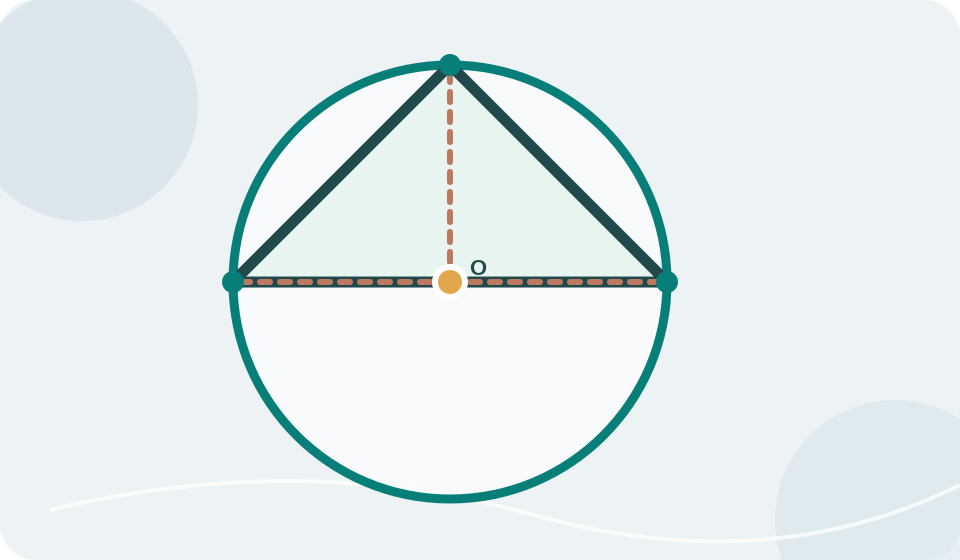
Inputs: A=(0, 0), B=(4, 0), C=(0, 3).
Calculation: The hypotenuse BC runs from B to C; its midpoint is ((4+0)/2, (0+3)/2).
O=(2, 1.5); each vertex is 2.5 units from O.
An acute triangle centered above its base
Inputs: A=(0, 0), B=(6, 0), C=(2, 4).
Calculation: The point O=(3, 1) gives OA²=10, OB²=10, and OC²=10.
O=(3, 1), with circumradius √10 ≈ 3.1623 coordinate units.

Worked examples and the right-triangle shortcut
In a right triangle, the circumcenter lies at the midpoint of the hypotenuse, so all three vertices sit on a circle whose diameter is that hypotenuse. This provides an especially clear coordinate check. For a general triangle, construct two perpendicular bisectors and verify that their intersection is also equally distant from the third vertex; the third bisector must pass through the same point.
How the coordinate calculation is formed
Translate the coordinate origin to A and define u=B−A and v=C−A. Any circumcenter has equal squared distance to A and B, and to A and C. Subtracting those equations cancels the unknown squared coordinates and leaves two linear equations for the center’s offset from A. Solving that pair yields the coordinate result without needing side angles or a preselected circle radius.
This construction is translation-invariant: adding the same offset to all vertices adds it to the circumcenter. Rotating or uniformly scaling the drawing transforms the answer in the same way. These properties are useful checks when the coordinates come from a CAD drawing, map projection, or a local measurement grid. A nonuniform axis scale, however, distorts circles and does not preserve the ordinary Euclidean circumcenter.
Read the center relative to the triangle
For an acute triangle, the circumcenter is inside. For a right triangle it is on the hypotenuse midpoint, and for an obtuse triangle it lies outside the triangle. An outside result is therefore not automatically an error. Compare the angles or side geometry before rejecting a point beyond one edge.
Do not confuse the circumcenter with the centroid, which averages the vertices and meets the medians, or the incenter, which is equally distant from the side lines. The circumcenter is defined by equal distances to the vertices and centers the circumscribed circle. If you need a circle that touches all three sides from within, the incenter is the relevant point instead.
When a unique circumcenter does not exist
Three distinct non-collinear points determine one circle. Collinear points do not: no finite circle passes through three different points on one straight line. Repeated points or near-collinearity also make the solution ambiguous or numerically sensitive. The runtime rejects points that are collinear or indistinguishable at its precision threshold, and it rejects results outside the supported numeric range.
Nearly collinear measurements can produce a center very far from the triangle. This is geometrically possible: a shallow arc has a large radius. Small errors in the input points can cause a large relative change in that remote center, so report the input precision and avoid treating extra calculator decimals as measurement accuracy. If points were sampled from a circle, fit many points with an appropriate least-squares method rather than forcing an unstable exact three-point construction.
Units and practical workflow
Coordinates may be positive or negative, but every point must use the same axes and linear unit. The radius uses that linear unit too; it is not squared. Before entering survey or drawing coordinates, subtract a common local origin if large absolute values reduce clarity, while retaining enough digits to preserve the small differences between points.
A reliable workflow is to label the three measured vertices, calculate the center, recompute all three distances, and compare them at the precision of the source. If the result supports a layout, draw the circle through one vertex and confirm the other two lie on it. The model assumes a flat Euclidean plane and exact points; it does not include line thickness, projection curvature, or fabrication tolerances.