
Map the side inputs and validate the triangle
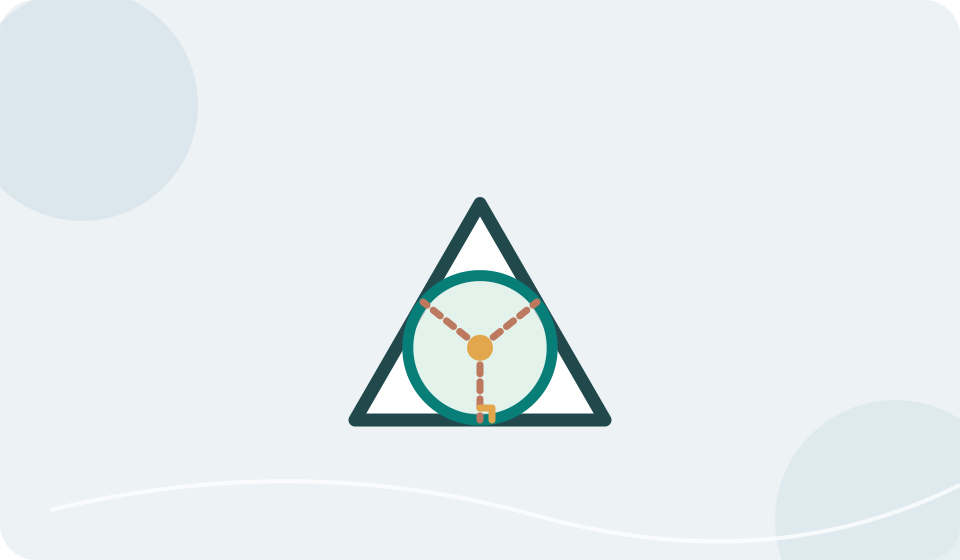
Enter the three positive side lengths a, b, and c in one unit. The inradius r is the radius of the largest circle contained within the triangle and tangent to all three side lines. It is also called the radius of the incircle. The calculator returns a length in the same unit as the entered sides.
The sides must satisfy a+b>c, a+c>b, and b+c>a. Equality gives a flat limiting shape with zero area, so there is no positive-radius incircle. If a measurement set fails the strict inequalities, first verify unit conversions and which segment each measurement describes.
Worked examples
A 3-4-5 right triangle
Inputs: Legs 3 and 4 units; hypotenuse 5 units.
Calculation: s=(3+4+5)/2=6; A=√(6·3·2·1)=6. Thus r=A/s=6/6=1. The shortcut gives (3+4−5)/2=1.
The incircle radius is 1 unit.
An isosceles triangle with sides 5, 5, and 6
Inputs: a=5 units, b=5 units, c=6 units.
Calculation: s=8; A=√(8·3·3·2)=12. Therefore r=12/8=1.5.
The inradius is 1.5 units.

Use the area-to-semiperimeter relationship
The radius is r=A/s, where s=(a+b+c)/2 is the semiperimeter and A is the area. With sides only, Heron’s formula gives A=√[s(s−a)(s−b)(s−c)]. Therefore r=√[(s−a)(s−b)(s−c)/s]. The square root has units of length because the product divided by s has units of length squared.
The relationship comes from splitting the triangle into three triangles whose common height is the inradius. Their total area is (a·r+b·r+c·r)/2=sr, so A=sr and r=A/s. The three tangent lengths along a pair of sides are equal from the same vertex, which is why the incircle touches each side at a right angle from its center.
Interpret the incircle
The incenter is the intersection of the internal angle bisectors. Its perpendicular distance to each side is the same, and that common distance is r. This is why a single circle can touch all three sides. The center is inside every nondegenerate triangle, including obtuse triangles.
Do not confuse the inradius with the circumradius. The circumcircle passes through the vertices and normally has a larger radius; its center can lie outside an obtuse triangle. The incircle instead fits inside and touches the side lines. For a right triangle with legs p and q and hypotenuse c, a convenient check is r=(p+q−c)/2.
The formula measures the ideal Euclidean incircle of exact straight sides. It does not model rounded corners, finite material thickness, or a manufactured tangent circle affected by tolerance. If the side lengths are estimates, the displayed radius is only as reliable as those inputs.
Worked examples and independent checks
For each side set, compute s and Heron area first, then divide A by s. Because both area and semiperimeter are positive, the result must be positive. Keep more digits through the square root and round the final radius only after checking the intermediate area.
The right-triangle shortcut is useful when the side set is 3-4-5 or another known right triangle. The inradius should match half the sum of the legs minus the hypotenuse. For an isosceles triangle, symmetry places the incenter on the altitude from the apex, so the resulting circle should be centered on that axis.
A numerical answer larger than the shortest altitude is not geometrically plausible because the circle must fit under every side. If the radius appears too large, inspect the semiperimeter, the Heron factors, and whether a diameter was reported in place of a radius.
Input and rounding errors to avoid
Do not use a perimeter in place of a semiperimeter, and do not omit the outer square root in Heron’s expression. The expression for r can also be written as a square root of a product divided by s; placing s outside the radical changes the result. A manual calculation should retain parentheses exactly as shown.
A second mistake is mixing a length in centimetres with lengths in metres. Since area scales with the square of the unit while s scales linearly, the ratio A/s still has length units—but only when the side inputs share a unit. Convert the full set first rather than trying to fix the final number afterward.
When the inradius is the right measure
Use the inradius for inscribed-clearance questions: the largest circle that fits within the triangular region, the equal distance from the incenter to a side, or a geometry exercise involving tangent sides. If the task instead asks for a circle through the triangle’s corners, use the circumradius calculation.
For a construction that needs the actual center, combine the radius calculation with the incenter coordinate tool when vertices are known. The radius alone does not specify a center in a coordinate plane, although the side lengths do determine the shape up to rigid motion and reflection.
Before sharing the result, record the three sides, their common unit, and the rounding precision. That note lets a reader reproduce the Heron area and distinguish an inradius from a radius associated with an external circle.