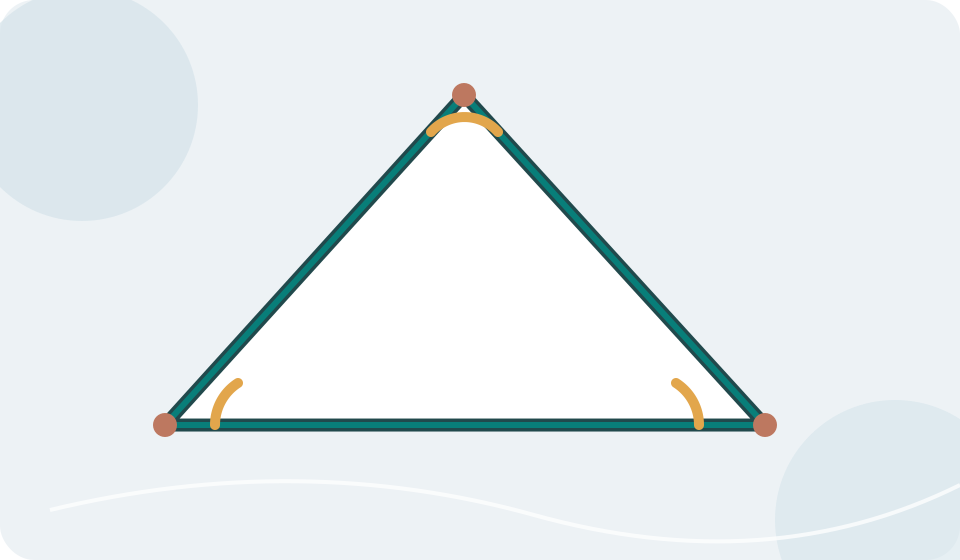

Pair each side with its opposite angle
The calculator asks for side a opposite angle A, side b opposite angle B, and side c opposite angle C. Each side length must use the same unit. A side of 5 centimetres cannot be combined with sides of 4 and 3 metres until they are converted to one common scale, even though the final angles themselves are unitless.
Before calculating, check the strict triangle inequalities: a+b>c, a+c>b, and b+c>a. A set that only equals one of these limits is a straight line rather than a triangle. The inputs must also be positive and finite. The tool returns three interior angles in degrees, not side estimates, bearings, or radians.
Worked examples
A 3-4-5 right triangle
Inputs: a=3, b=4, c=5, with each side opposite A, B, and C respectively.
Calculation: A=arccos((4²+5²−3²)/(2·4·5))≈36.8699°; B≈53.1301°; C=arccos((3²+4²−5²)/(2·3·4))=90°.
The angles are approximately A=36.8699°, B=53.1301°, and C=90°; they sum to 180°.
An isosceles triangle with a longer third side
Inputs: a=5, b=5, c=6.
Calculation: cos C=(5²+5²−6²)/(2·5·5)=0.28, so C≈73.7398°. A=B=(180°−C)/2≈53.1301°.
A≈53.1301°, B≈53.1301°, C≈73.7398°. The equal sides a and b face equal angles.

Apply the law of cosines
For angle A, cos A=(b²+c²−a²)/(2bc), so A=arccos((b²+c²−a²)/(2bc)). Obtain B and C by cycling the letters: cos B=(a²+c²−b²)/(2ac) and cos C=(a²+b²−c²)/(2ab). Convert each inverse-cosine result to degrees.
The side lengths are enough because the cosine rule encodes the included angle between two sides and their opposite side. Unlike a sine-rule calculation from an angle and side, this side-side-side setup has no ambiguous second triangle: any three valid side lengths determine one shape up to rotation, reflection, and scale.
Interpret the three results
Angles A, B, and C are interior angles, each greater than 0° and less than 180°, and their sum is 180°. The side opposite a right angle is the hypotenuse and is the longest side. An acute triangle has three angles below 90°; an obtuse triangle has one above 90° and two below it.
Angles describe shape while lengths describe size. Scaling all three sides by the same positive factor leaves every angle unchanged. This is useful when measurements are available in a scaled drawing or when a design is resized: a proportional side set represents a similar triangle and therefore has the same three angles.
Worked examples and independent checks
For each example, calculate the angles against the side-opposite labels before rounding. Then check the ordering by side size and add the displayed angles as a final consistency test. These checks catch swapped labels and transcription errors without requiring a drawing.
The 3-4-5 case is especially easy to verify: 3²+4²=5², so the angle opposite 5 is exactly 90°. For the other example, two equal sides must face equal angles. If the equal sides are a and b, then A and B must match even when the third side differs.
Use cases, limits, and common errors
This calculation is useful when a survey, drawing, or specification gives all three edges but omits the corner angles. It can help check a triangular brace, a roof detail, or a plotted triangle. It cannot infer which real-world corner a named angle refers to unless the input labels retain their vertex correspondence.
The plane-triangle model assumes straight segments and Euclidean geometry. For very large survey areas on a curved surface, spherical geometry may be more suitable. Measurement uncertainty can also dominate the last displayed decimal, especially for nearly flat triangles where a small side error causes a large change in an angle close to 0° or 180°.
Do not substitute three rounded measurements when the original instrument values are available, and do not mix interior and exterior angles. An exterior turning angle is not one of the outputs; it is supplementary to the adjacent interior angle. Preserve the original measurement units in your notes so another person can reproduce the input set.
Choose a related triangle calculation
If you know two sides and their included angle, the SAS area tool is more direct than first deriving a third side. If you know three sides and need area, Heron’s formula is a useful companion. The current tool solves only the three interior angles; it does not return a coordinate placement or a diagram scale.
The angle sum is a robust independent check, but it does not catch every error: some side permutations produce the same set of angles with the vertex labels rearranged. Check both the sum and the side-opposite ordering. When sharing a result, include the labeled side set and the units so the angle triplet is reproducible.