
Use the adjacent sides and the opposite side consistently
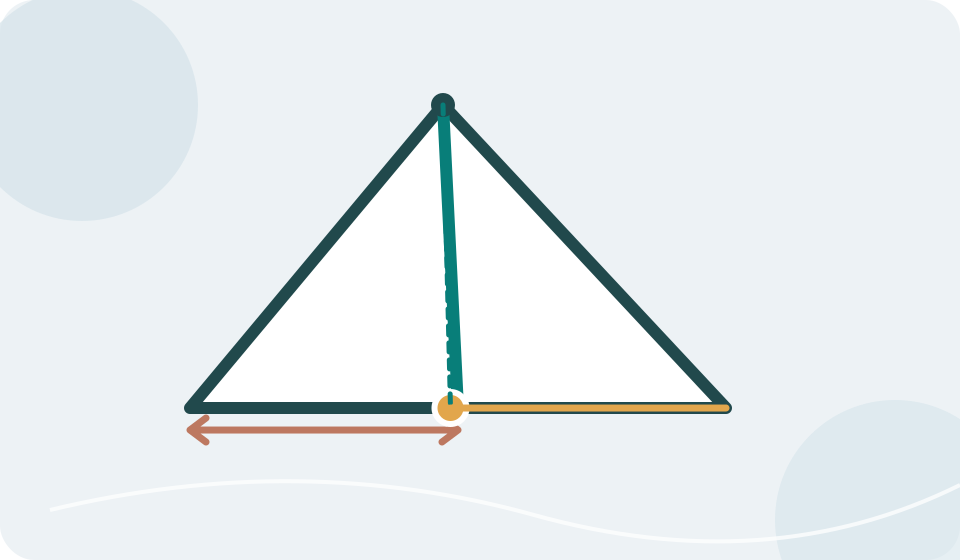
A median joins a triangle vertex to the midpoint of the opposite side. The calculator’s field contract names a and b as the two sides adjacent to that vertex and c as the side opposite it. With that convention, the median length is m=½√(2a²+2b²−c²). All three lengths must use the same unit and satisfy the strict triangle inequalities.
The label is easy to misread because many geometry references call the side opposite angle A simply a. Here the calculator calls the two sides around the selected vertex a and b and the opposite side c. Use the displayed field labels when entering values rather than relying on a separate diagram’s naming convention. The output is a length in the input unit, not a squared quantity.
Worked examples
Median to the hypotenuse of a 6-8-10 triangle
Inputs: Adjacent sides a=6, b=8; opposite side c=10.
Calculation: m=½√(2·6²+2·8²−10²)=½√(72+128−100)=½√100.
The median is 5 units, half the hypotenuse as expected for a right triangle.
Median in a 5-6-7 triangle
Inputs: Adjacent sides a=5 and b=6; opposite side c=7.
Calculation: m=½√(2·5²+2·6²−7²)=½√73≈4.2720019.
The median to the 7-unit side is 4.2720 units to the calculator’s display precision.

Worked examples and midpoint verification
For an independent check, find the midpoint of the side c using coordinates, then compute the distance from the common vertex of sides a and b to that midpoint. This direct coordinate-distance method should match the formula. If coordinates are not available, Apollonius’ theorem gives the squared median length, which rearranges to the calculator’s equation.
A median splits a triangle into two equal-area regions, but need not be perpendicular to the opposite side. An altitude is perpendicular; an angle bisector splits the vertex angle. These lines coincide only in special symmetric cases, so use the construction the task requires.
What the formula measures and how it scales
The equation is a side-length version of the midpoint distance theorem. Squaring the lengths prevents radicals during the derivation: for a vertex at the origin, place the adjacent side endpoints at vectors p and q with lengths a and b, while their separation is c. The midpoint vector is (p+q)/2; expanding its squared magnitude and using c²=|p−q|² produces m²=(2a²+2b²−c²)/4.
If every side is multiplied by a positive scale factor s, the median is multiplied by s. This is a useful unit and proportion check. A result that scales with the square of the inputs or stays unchanged after all lengths double indicates a formula or conversion error. The median is bounded by the triangle’s geometry; it is not an arbitrary independent dimension.
Check whether the three sides form a triangle
Before calculating, confirm a+b>c, a+c>b, and b+c>a, with positive side lengths. These tests reject impossible triples such as two short sides whose sum cannot reach the third. The runtime performs these checks and also requires the median radicand to be nonnegative. Equality in a triangle inequality is a collapsed, zero-area limit rather than a proper triangle.
The calculator returns the median to four decimal places. Keep full precision for the square-root calculation and round only when reporting. If measurements are rounded to the nearest millimetre, four decimal places in metres may be more detail than the inputs justify. Preserve the unrounded value for subsequent calculations where appropriate, while making the final precision match the measurement process.
A practical use and a reliable cross-check
A median length can help with a symmetric layout, splitting a triangular panel into equal-area sections, or checking a centroid construction. The three medians meet at the centroid, which divides each one two-to-one from the vertex. If a design question asks for a central brace that is perpendicular to an edge, however, it is asking for an altitude or another structural line, not automatically for a median.
To check by construction, join the selected vertex to the midpoint of the opposite side, using one unit for all lengths. This catches a common labeling error: c is opposite the vertex, not one of the adjacent sides. Coordinate endpoints also give a direct distance check.
Limits of side-length-only inputs
Three valid side lengths determine a triangle up to rigid motion and reflection, so the median’s length can be calculated without coordinates or orientation. But side lengths alone do not reveal where the triangle sits on a drawing, which direction the median points, or the coordinates of its midpoint. Use a coordinate method if those location details matter.
Real measurements have uncertainty, and the formula treats inputs as exact values. Near a degenerate triangle, small side measurement errors can change the geometry substantially. Record the measurement precision, confirm the three sides belong to the same triangle, and do not interpret the tool’s numerical output as a certified construction or structural assessment.