
Estimate ideal tank reheating time
Use the model to estimate how long a tank would take to heat a known quantity of water under a stated power input. It is useful for a first-pass comparison or a rough planning calculation. The result does not account for a particular heater’s burner modulation, element staging, thermostat dead band, tank losses, or simultaneous hot-water draw.
Enter volume and temperature change
Enter tank water volume in litres, inlet temperature and target temperature in degrees Celsius, rated heating power in kilowatts, and efficiency as a percentage. The temperature rise is target minus inlet. The formula assumes the target exceeds the inlet and that the entered power and efficiency apply throughout the heating period.
Calculate the heat required
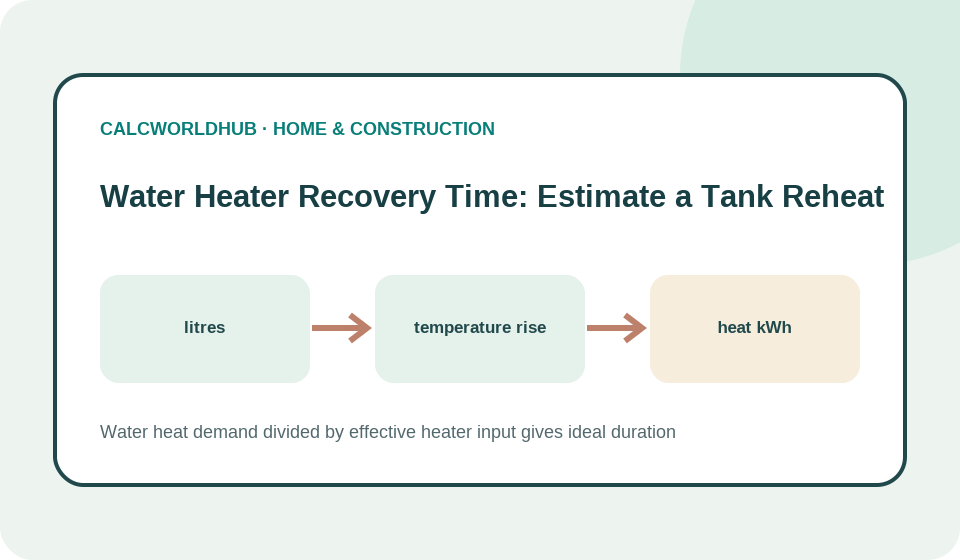
Water’s approximate specific heat is 4,186 joules per kilogram per degree Celsius, and one litre of water is treated as about one kilogram. Multiplying litres × 4,186 × temperature rise gives joules; divide by 3.6 million to convert to kilowatt-hours. The value is the ideal heat transferred to the water, not the entire appliance’s electrical or fuel consumption.
Relate heat to power and efficiency
Effective input power is rated kilowatts multiplied by the efficiency fraction. Divide the required heat in kWh by that effective kW to obtain hours. For example, a lower efficiency lengthens the modeled time for the same water and temperature change. If the user interface displays minutes as well, convert hours by multiplying by 60 without rounding the intermediate hours first.
Use the estimate for planning
The result is most useful when inputs reflect the same system and a clear recovery definition. Some manufacturers report recovery under a standardized draw or temperature-rise test rather than a complete cold-to-setpoint tank reheat. Do not compare a standardized rating directly with this ideal full-volume estimate unless the measurement conditions match.
If the heater is supplying a fixture while reheating, the tank may never follow a single uninterrupted temperature rise. Incoming cold water, stratification, thermostat cycling, and mixing can change what a sensor reports. Compare like-for-like conditions: the same tank volume, starting temperature, set point, power rating, and definition of recovery before using estimates to compare equipment or schedule hot-water demand.
Worked examples
Heat is calculated first in kWh; recovery time is then divided by power multiplied by efficiency.
A 190-litre tank warming from 12°C to 55°C
Inputs: Volume = 190 L; inlet = 12°C; target = 55°C; power = 4.5 kW; efficiency = 95%.
Calculation: Heat = 190 × 4,186 × 43 ÷ 3,600,000 = 9.499894 kWh; time = 9.499894 ÷ (4.5 × 0.95) = 2.222198 h = 133.3319 min.
The ideal estimate is about 2.22 hours, or 133.3 minutes, before tank and operating effects.
A 150-litre tank with a smaller temperature rise
Inputs: Volume = 150 L; inlet = 15°C; target = 50°C; power = 3 kW; efficiency = 90%.
Calculation: Heat = 150 × 4,186 × 35 ÷ 3,600,000 = 6.104583 kWh; time = 6.104583 ÷ (3 × 0.90) = 2.260957 h = 135.6574 min.
The ideal full-volume estimate is about 2.26 hours; actual cycle timing depends on the heater.

Why the actual recovery can differ
Heat loss to the tank and room, burner or element cycling, supply voltage, gas pressure, mineral scale, sensor location, and mixing can all affect observed time. A tank also may not be at one uniform temperature. This calculator uses a single average volume and temperature rise, so actual recovery can be longer or the control may stop before the full volume reaches the set point.
Check the appliance nameplate and manufacturer documentation for power, efficiency, and test conditions. The estimate does not assess scald risk, electrical or gas safety, installation compliance, or whether a system can serve peak demand. Those questions require the appliance instructions and appropriate professional review.