
Use the measured hardness and the right gallon unit
The calculator asks for service capacity in grains, hardness in grains per US gallon, daily softened-water use in US gallons per day, and a reserve percentage. A grain is a unit used to express softener capacity and water hardness. Confirm the hardness result and its units from a suitable water test; a value in milligrams per litre is not the same numeric value as grains per gallon.
Penn State Extension describes hardness reporting in grains per gallon and explains that ion-exchange softeners regenerate after their capacity is used. Use hardness at the softener inlet and count only water that receives treatment. If fixtures bypass the unit, do not include their flow in daily softened-water use.
Reserve-adjusted capacity becomes treated volume
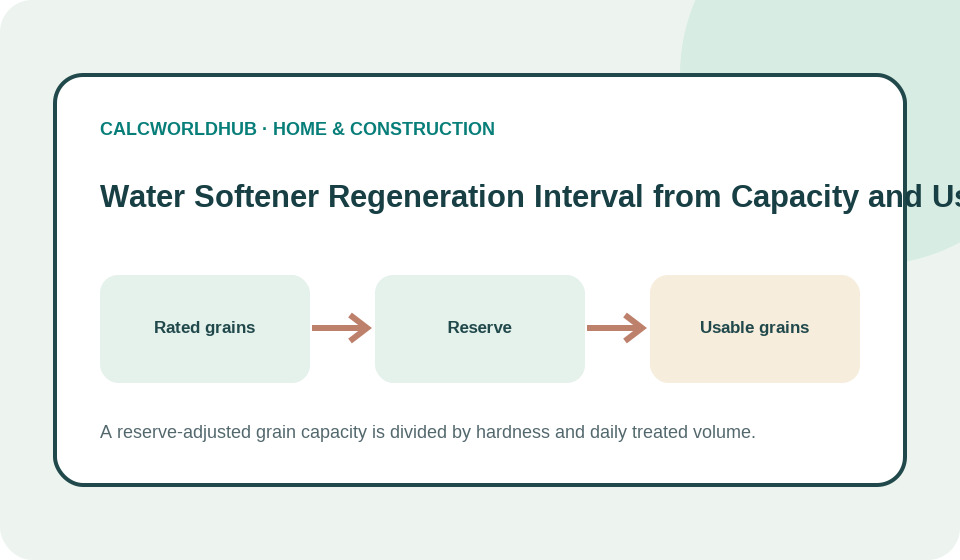
First calculate usable capacity = rated service capacity × (1 − reserve percent ÷ 100). Then divide usable grains by hardness in grains per US gallon to estimate treated gallons per run. Grains cancel, leaving gallons. Finally divide gallons per run by daily softened-water use to estimate days. This sequence keeps a capacity reserve distinct from an assumption about how much water is treated each day.
The calculator's reserve is a simple percentage held back from the entered capacity. It does not calculate salt dose, brine efficiency, resin condition, iron loading, leakage, or the control valve's programming. A manufacturer's stated capacity may vary with the selected salt dose and operating settings. Treat the result as an arithmetic comparison and use the manual and water test to set the actual unit.
What can move the interval
Higher hardness consumes capacity faster for the same treated volume. Higher daily use also shortens the estimated time in days, while a larger reserve lowers the capacity counted before the modeled regeneration point. A small change in any of these inputs can change the interval, so use realistic household averages and make clear whether seasonal or occasional uses are included.
The tool requires positive hardness and daily treated-water use; capacity may be zero and the reserve ranges from zero to 100%. At 100% reserve, the estimated usable capacity is zero, so the interval is zero. That edge result follows the arithmetic and is not a recommended setting. The calculator does not decide a safe or efficient reserve for a specific softener.
Interpret an estimate alongside the control valve
A metered valve may initiate regeneration from measured water use, while other controls can use time schedules or additional safeguards. The calculator has no field for the valve type or its day override, so its estimate need not match the displayed countdown. Observe the installed unit's manual and settings; do not delay regeneration solely because a simplified estimate predicts more days remain.
A reliable comparison needs consistent units and a representative demand period. If hardness varies or iron and manganese are present, a single hardness value may not describe the load on the resin. Penn State's water-treatment resources discuss additional water-quality issues; have a qualified water professional interpret difficult results rather than using this interval as a diagnosis.
Worked examples
Each example applies the reserve to rated capacity before converting grains of capacity into treated gallons and days.
A 30,000-grain unit treating 90 gallons per day
Inputs: Service capacity = 30,000 grains; hardness = 20 grains/US gal; daily treated use = 90 US gal/day; reserve = 10%.
Calculation: Usable capacity = 30,000 × (1 − 0.10) = 27,000 grains; treated water = 27,000 ÷ 20 = 1,350 US gal; interval = 1,350 ÷ 90 = 15.0 days.
The model estimates 1,350 US gallons per run and 15.0 days at the entered daily use, before considering the valve's other settings.
A smaller capacity with a higher hardness
Inputs: Service capacity = 32,000 grains; hardness = 28 grains/US gal; daily treated use = 80 US gal/day; reserve = 12.5%.
Calculation: Usable capacity = 32,000 × (1 − 0.125) = 28,000 grains; treated water = 28,000 ÷ 28 = 1,000 US gal; interval = 1,000 ÷ 80 = 12.5 days.
The estimate is 1,000 treated gallons and 12.5 days. The higher hardness and smaller entered service capacity both contribute to the shorter calculated run than the first example.
