
Understand drawdown between switch points
The result describes the water volume a pressure tank can release as system pressure falls from cut-out to cut-in. It can help compare a nominal tank with a stated pressure-switch range. It is not the pump’s flow rate, the total volume in the tank, or a measure of how much water a well can sustainably produce.
Use tank volume and pressure settings
Enter the tank’s nominal volume in gallons, the air precharge, pump cut-in, and cut-out settings in psi, and atmospheric pressure in psi. Use gauge-pressure readings for the three system settings if that is how the fields are defined. The atmospheric input converts them to absolute pressure for the ideal gas calculation; the default may approximate local sea-level pressure but varies with elevation and weather.
Why absolute pressure appears in the relation
With a fixed amount of air and approximately constant temperature, Boyle’s law relates pressure and volume. The model estimates drawdown as tank volume × absolute precharge pressure × (1/absolute cut-in pressure − 1/absolute cut-out pressure). The parentheses describe the change in compressed-air volume between the two switch points.
Calculate the usable volume
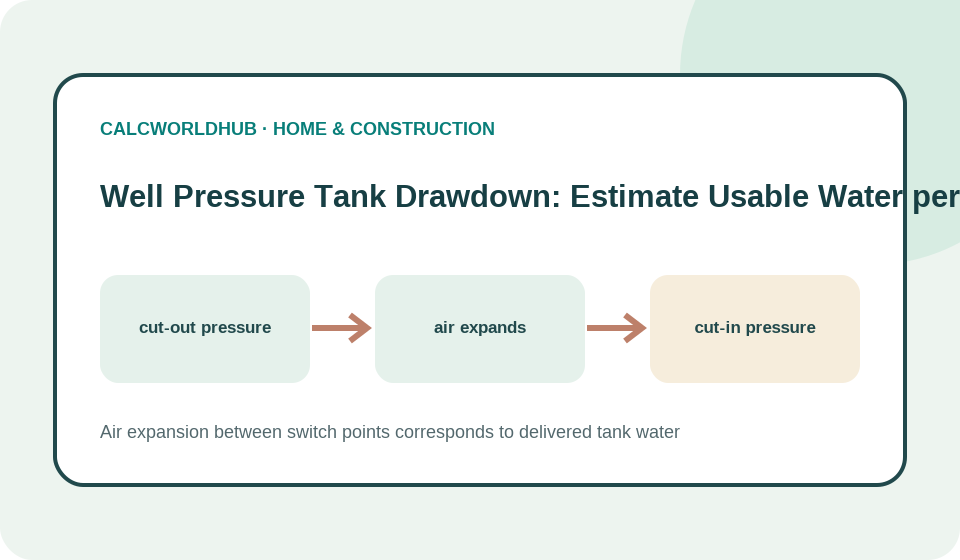
Because the air pressure is higher at cut-out, the compressed air occupies less volume then. As water leaves and pressure drops to cut-in, the air expands and occupies more of the tank; that increase is the water volume delivered. Gauge pressure alone cannot be substituted into the inverse-pressure terms because zero gauge pressure is not zero absolute pressure.
Check precharge against the system
Many diaphragm-tank manufacturers specify precharge near two psi below the pump cut-in setting when the water side is drained, but the exact procedure and value depend on the tank and system. Verify the manual and measure precharge with the system isolated and drained as instructed. A precharge that is too high or low can alter useful drawdown and cycling behavior.
Gauge readings are relative to the surrounding atmosphere, but the gas-law relationship uses absolute pressure. Adding atmospheric pressure to each gauge setting preserves the ratios in the model. Never mix an absolute-pressure value with gauge inputs or omit the atmospheric adjustment; doing so changes the predicted air-volume change and therefore the drawdown estimate.
Worked examples
The examples convert each gauge setting to absolute pressure before applying the inverse-pressure difference.
A 44-gallon tank with a 30/50 psi switch
Inputs: Tank volume = 44 gal; precharge = 28 psig; cut-in = 30 psig; cut-out = 50 psig; atmosphere = 14.7 psi.
Calculation: Absolute pressures = 42.7, 44.7, and 64.7 psia. Drawdown = 44 × 42.7 × (1/44.7 − 1/64.7) = 12.99268 gal = 49.18264 L.
The ideal drawdown estimate is about 13.0 gallons, not 44 gallons of usable water.
A larger tank over a 40/60 psi switch range
Inputs: Tank volume = 62 gal; precharge = 38 psig; cut-in = 40 psig; cut-out = 60 psig; atmosphere = 14.7 psi.
Calculation: Absolute pressures = 52.7, 54.7, and 74.7 psia. Drawdown = 62 × 52.7 × (1/54.7 − 1/74.7) = 15.992795 gal = 60.539315 L.
The ideal estimate is about 16.0 gallons between these switch points.

The ideal model is not a pump test
The ideal relation assumes a known tank volume, intact diaphragm, stable temperature, and the stated pressure range. Real tanks have a usable-volume rating, connection and bladder effects, pressure-gauge error, and installation-specific constraints. A failing bladder, waterlogged tank, restricted pipe, or inaccurate switch setting requires inspection, not just a new calculation.
The calculator does not recommend a tank size, pump capacity, or switch setting. Compare its estimate with the manufacturer’s drawdown chart for the exact tank model and pressure range. If the pump cycles rapidly or the measured pressures differ from the settings, have the system checked by a qualified well-service professional.