How to use this calculator
Estimate usable water between pump cut-in and cut-out from tank size and air precharge pressure.
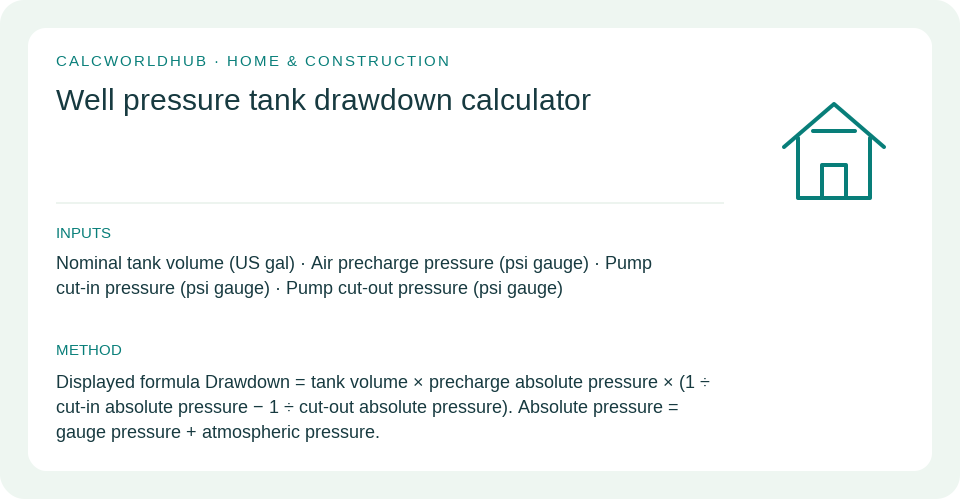
- Enter Nominal tank volume (US gal), Air precharge pressure (psi gauge), Pump cut-in pressure (psi gauge), Pump cut-out pressure (psi gauge), then complete the remaining labeled fields. Match the units shown beside each field and review the result together with the assumptions below.
- Read the worked example below to check the expected input format and result.
- Compare another scenario by changing one input at a time. Use Reset to return to the starting values.
How this calculation works
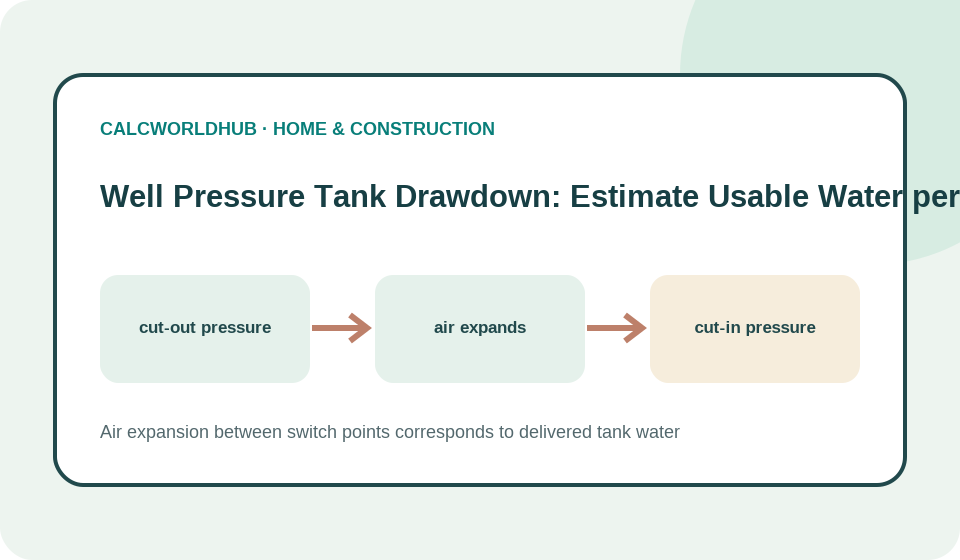
A bladder pressure tank stores water by compressing air. This calculator applies Boyle’s law to the tank gas volume at the pump’s cut-in and cut-out pressures, using absolute pressure in the calculation. The difference is the approximate water delivered between switch cycles.
Inputs and units
tankGallons— Nominal tank volume (US gal)- Tank’s labeled total volume, not its usable water drawdown.
prechargePsi— Air precharge pressure (psi gauge)- Pressure measured with the tank empty of water, per manufacturer procedure.
cutInPsi— Pump cut-in pressure (psi gauge)- Pressure at which the pressure switch starts the pump.
cutOutPsi— Pump cut-out pressure (psi gauge)- Pressure at which the switch stops the pump.
atmosphericPsi— Atmospheric pressure (psi)- Local atmospheric pressure; 14.7 psi approximates sea-level standard pressure.
Formula
Drawdown = tank volume × precharge absolute pressure × (1 ÷ cut-in absolute pressure − 1 ÷ cut-out absolute pressure). Absolute pressure = gauge pressure + atmospheric pressure.
Method
Enter the tank’s nominal volume and all three gauge pressures in the same pressure unit. Atmospheric pressure must use the same unit; the default 14.7 psi is a sea-level approximation. Precharge should be below cut-in.
Worked example
For a 44 US-gallon tank with 28 psi precharge, 30 psi cut-in, 50 psi cut-out, and 14.7 psi atmospheric pressure, the ideal-gas estimate is about 12.99 gallons. Gauge pressures are converted to absolute pressure before applying Boyle’s law.
Assumptions and limits
The ideal-gas estimate assumes a sealed bladder tank, fixed tank volume, and approximately isothermal compression. Actual drawdown depends on tank model, local atmospheric pressure, switch calibration, and precharge procedure. Follow the tank manufacturer’s instructions before changing precharge.
Frequently asked questions
Why does the calculation add atmospheric pressure?
Boyle’s law uses absolute pressure. Gauge readings are relative to local air pressure, so the same atmospheric pressure is added to each gauge value.
Should precharge be higher than cut-in?
For typical bladder pressure tanks, manufacturers specify precharge slightly below switch cut-in. Follow the instructions for your exact tank and switch.
Is nominal tank volume the same as drawdown?
No. Only part of the tank volume is delivered between the switch’s cut-in and cut-out pressures.
How do I use the Well pressure tank drawdown calculator?
Enter Nominal tank volume (US gal), Air precharge pressure (psi gauge), Pump cut-in pressure (psi gauge), Pump cut-out pressure (psi gauge), then complete the remaining labeled fields. Match the units shown beside each field and review the result together with the assumptions below.
What is a worked example of Well pressure tank drawdown?
For a 44 US-gallon tank with 28 psi precharge, 30 psi cut-in, 50 psi cut-out, and 14.7 psi atmospheric pressure, the ideal-gas estimate is about 12.99 gallons. Gauge pressures are converted to absolute pressure before applying Boyle’s law.
Reference: Amtrol well-tank support and precharge guidance. See our calculation methodology.