How to use this calculator
Estimate gauge pressure created by a vertical water head, before pipe friction or flow effects.
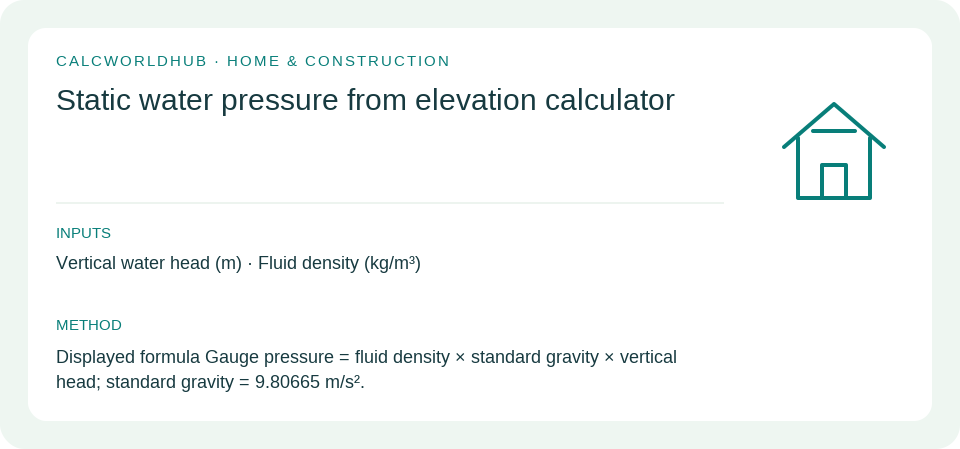
- Enter Vertical water head (m), Fluid density (kg/m³). Match the units shown beside each field and review the result together with the assumptions below.
- Read the worked example below to check the expected input format and result.
- Compare another scenario by changing one input at a time. Use Reset to return to the starting values.
How this calculation works
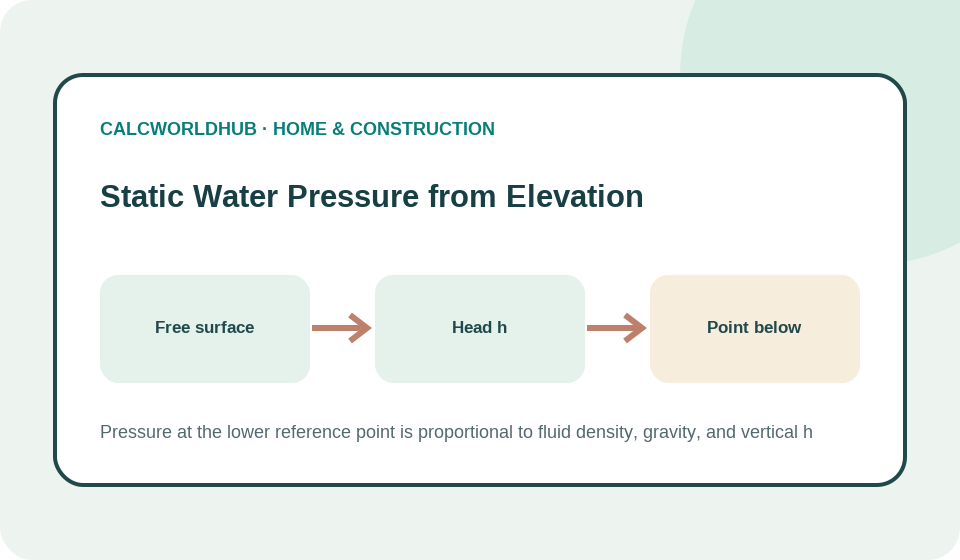
A stationary water column creates pressure that increases with its vertical height above the point being considered. This calculator estimates the hydrostatic pressure difference from elevation head and an entered fluid density.
Inputs and units
head— Vertical water head (m)- Height difference between the free surface and the point where pressure is estimated.
density— Fluid density (kg/m³)- Use a density appropriate to the fluid and temperature; 1,000 kg/m³ is a common water estimate.
Formula
Gauge pressure = fluid density × standard gravity × vertical head; standard gravity = 9.80665 m/s².
Method
Enter the vertical head in metres and the fluid density in kilograms per cubic metre. The calculator multiplies density, standard gravity, and head, then converts pascals to kilopascals, bar, and psi.
Worked example
A 10 m water head at 1,000 kg/m³ gives 1,000 × 9.80665 × 10 = 98,066.5 Pa, or 98.0665 kPa (about 14.22 psi).
Assumptions and limits
This is static gauge pressure from elevation alone. It excludes pump pressure, pipe friction, fittings, velocity, water hammer, temperature-dependent density changes, and pressure-regulator effects.
Frequently asked questions
Does every 10 metres of water create about 1 bar?
At the conventional density entered here, 10 m produces about 0.981 bar of static gauge pressure. Actual density and measurement conditions affect the result.
Is this the pressure at a flowing tap?
Not necessarily. Flow, pipe size, elevation changes, fittings, pumps, and regulators can change the pressure at a tap.
What is gauge pressure?
Gauge pressure is pressure above the surrounding atmospheric pressure. The result here is an elevation-based pressure difference, not absolute pressure.
How do I use the Static water pressure from elevation calculator?
Enter Vertical water head (m), Fluid density (kg/m³). Match the units shown beside each field and review the result together with the assumptions below.
What is a worked example of Static water pressure from elevation?
A 10 m water head at 1,000 kg/m³ gives 1,000 × 9.80665 × 10 = 98,066.5 Pa, or 98.0665 kPa (about 14.22 psi).
Read our calculation methodology.