How to use this calculator
Estimate pump flow at the tested operating condition by combining basin drawdown volume, pump run time, and continuing inflow.
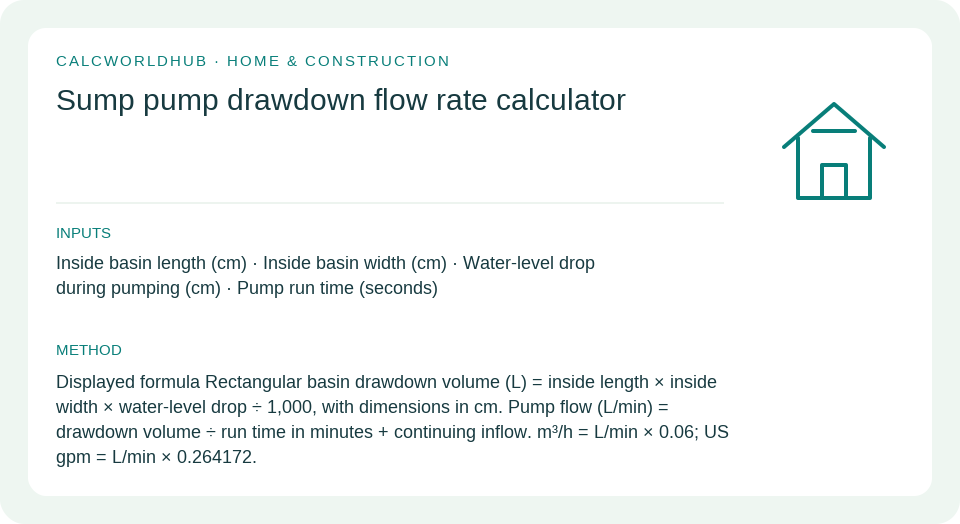
- Enter Inside basin length (cm), Inside basin width (cm), Water-level drop during pumping (cm), Pump run time (seconds), then complete the remaining labeled fields. Match the units shown beside each field and review the result together with the assumptions below.
- Read the worked example below to check the expected input format and result.
- Compare another scenario by changing one input at a time. Use Reset to return to the starting values.
How this calculation works
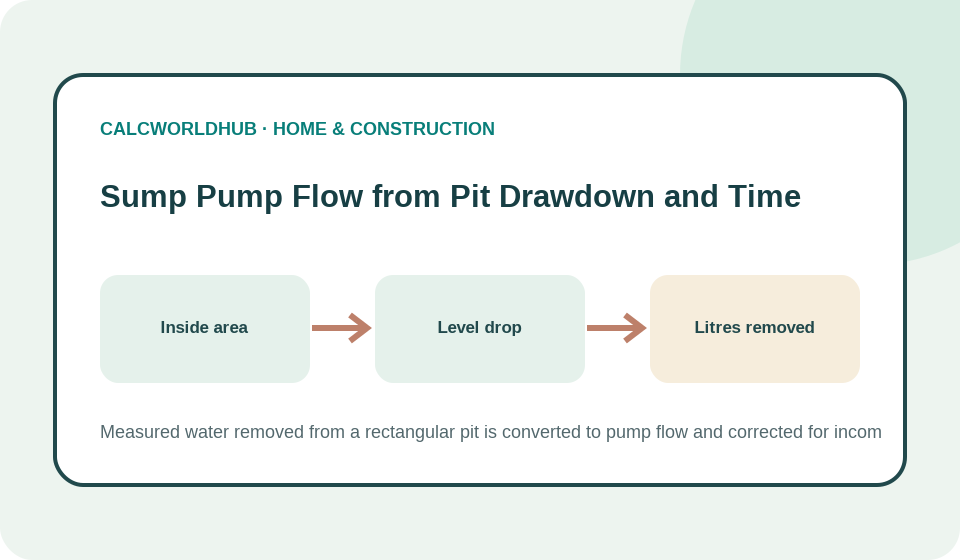
A drawdown test estimates actual discharge from the volume removed during a timed pump run. Because water may continue entering the basin while the pump runs, add the measured inflow rate to the basin-volume decrease per unit time. The result is an observed flow estimate at that test condition, not a pump-curve rating.
Inputs and units
insideLengthCm— Inside basin length (cm)- Internal length of a rectangular basin, measured at the water surface.
insideWidthCm— Inside basin width (cm)- Internal width of the rectangular basin.
drawdownCm— Water-level drop during pumping (cm)- Difference between the starting and ending water level while the pump runs.
runSeconds— Pump run time (seconds)- Elapsed time over which the drawdown was measured.
inflowLpm— Continuing inflow during test (L/min)- Water entering the basin while the pump runs; measure separately if possible.
Formula
Rectangular basin drawdown volume (L) = inside length × inside width × water-level drop ÷ 1,000, with dimensions in cm. Pump flow (L/min) = drawdown volume ÷ run time in minutes + continuing inflow. m³/h = L/min × 0.06; US gpm = L/min × 0.264172.
Method
Measure the basin’s inside rectangular footprint, the water-level decrease during pump operation, and the run time. Enter any separately measured continuous inflow in litres per minute. The test estimate adds that inflow back to the stored volume removed during pumping.
Worked example
A 45 × 35 cm basin drops 20 cm in 60 seconds, removing 31.5 L. The drawdown portion is 31.5 L/min; adding a measured inflow of 5 L/min gives an estimated pump flow of 36.5 L/min (about 9.64 US gpm) at that test condition. The same flow is about 2.19 m³/h, and the basin drawdown removed 31.5 L.
Assumptions and limits
This uses a rectangular, constant-area basin and assumes the water-level change and inflow estimate represent the same test interval. Irregular basins, sloped walls, inaccurate inflow measurement, changing system head, or air entrainment affect the result. Compare it with the pump manufacturer’s curve at the actual total dynamic head and follow electrical and water-safety procedures.
Frequently asked questions
Why should continuing inflow be added?
The observed basin-volume decrease is pump discharge minus water entering during the run. Adding a measured inflow estimates the pump’s total discharge.
Can I use a circular basin?
Not directly with this rectangular-footprint formula. For a circular basin, calculate its water volume separately or use its manufacturer dimensions and a suitable geometric method.
Will this equal the pump’s advertised maximum flow?
Not necessarily. Pump flow changes with total dynamic head, pipe losses, check valves, and system conditions; use the manufacturer’s curve for the operating head.
How do I use the Sump pump drawdown flow rate calculator?
Enter Inside basin length (cm), Inside basin width (cm), Water-level drop during pumping (cm), Pump run time (seconds), then complete the remaining labeled fields. Match the units shown beside each field and review the result together with the assumptions below.
What is a worked example of Sump pump drawdown flow rate?
A 45 × 35 cm basin drops 20 cm in 60 seconds, removing 31.5 L. The drawdown portion is 31.5 L/min; adding a measured inflow of 5 L/min gives an estimated pump flow of 36.5 L/min (about 9.64 US gpm) at that test condition. The same flow is about 2.19 m³/h, and the basin drawdown removed 31.5 L.
Reference: Rural Community Assistance Partnership drawdown test. See our calculation methodology.