
Measure the test, not just the pump nameplate
The calculator needs the pit's inside length and width in centimetres, the water-level drop in centimetres, pump run time in seconds, and continuing inflow in litres per minute. Measure internal dimensions at the level where the water moves. These inputs describe one test interval; use a timer and record the starting and ending levels while the pump is actually discharging.
A rectangular, constant-area basin is assumed. If the pit has tapered walls, shelves, a rounded shape, or large obstructions, length × width × depth may not represent its water volume. The calculation also assumes the measured level drop and inflow correspond to the same interval. A poor inflow estimate can materially change the final flow because it is added to the drawdown rate.
Why inflow is added back
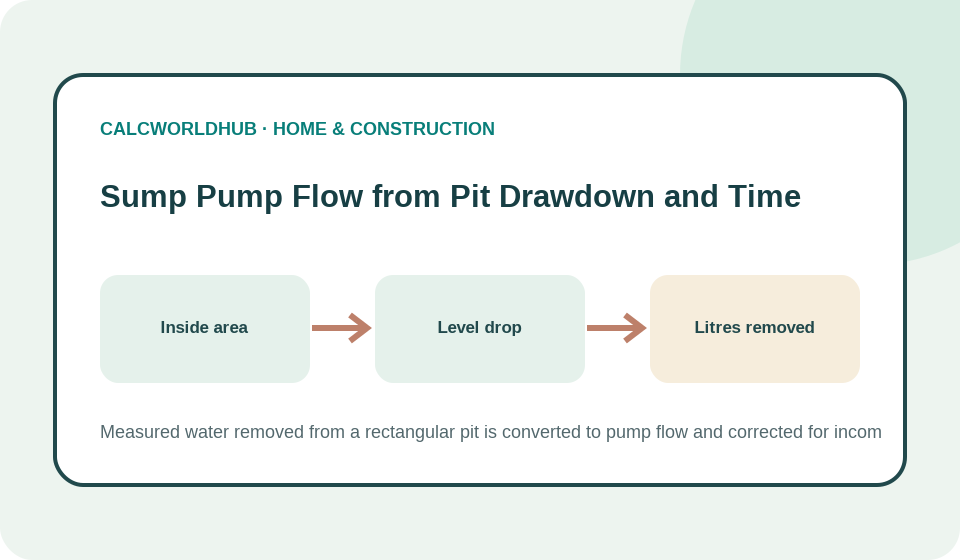
While the pump runs, some water that leaves the pit is replaced by incoming water. The fall in the water level therefore measures net drawdown, not all water delivered by the pump. First calculate drawdown volume = inside length × inside width × drop ÷ 1,000 to get litres. Divide that volume by run time in minutes, then add continuing inflow in litres per minute to estimate the pump's rate during the test.
For example, if a pit loses 30 litres during a one-minute run while 6 litres per minute continue entering, the estimated pump flow is 36 L/min. Omitting the inflow would understate pump delivery by 6 L/min. Conversely, adding an inflow rate that was not measured during that same interval can overstate it. The model cannot separate measurement error from true pump behavior.
Convert units only after the test calculation
The result is displayed in litres per minute, US gallons per minute, and cubic metres per hour. The calculator uses 1 L/min × 0.264172 for US gal/min and 1 L/min × 0.06 for m³/h. Keep the units explicit: US gallons are not Imperial gallons, and a flow expressed per hour should not be compared directly with a per-minute number.
The run-time input is in seconds, so the internal conversion divides seconds by 60 before calculating litres per minute. Use elapsed time for the period in which the observed drawdown occurred rather than the entire time between pump cycles. The calculator allows a zero water-level drop and zero inflow, but basin dimensions and run time must be positive for the rate calculation.
Compare against a pump curve at the actual head
A field estimate can help explain what a system is doing, but it does not certify that a pump meets a design duty. Zoeller's pump-curve guidance shows why flow must be read with the head the pump works against. Pipe diameter, lift, fittings, check valves, discharge routing, and other resistance affect the operating point. Use the manufacturer's curve and the installation conditions for selection or troubleshooting.
Repeat the measurement if the water level oscillates, the pump cycles before a stable interval, or inflow changes with rainfall. Keep hands and measuring equipment clear of electrical components and moving parts; follow the pump manufacturer's safety instructions. A sump test is not a substitute for checking a failed float switch, blocked intake, stuck check valve, or other mechanical fault.
Worked examples
Both examples add continuing inflow after converting the measured drawdown volume into a per-minute rate.
A 60 by 40 cm pit drops 15 cm in 45 seconds
Inputs: Inside length = 60 cm; inside width = 40 cm; drawdown = 15 cm; run time = 45 s; inflow = 7 L/min.
Calculation: Drawdown = 60 × 40 × 15 ÷ 1,000 = 36 L; time = 45 ÷ 60 = 0.75 min; flow = 36 ÷ 0.75 + 7 = 55 L/min = 14.53 US gal/min = 3.3 m³/h.
The estimated pump flow at this test condition is 55 L/min. The basin level fell by 36 L net while an estimated 7 L/min continued entering.
A narrower drop over an 80-second run
Inputs: Inside length = 50 cm; inside width = 40 cm; drawdown = 12 cm; run time = 80 s; inflow = 4 L/min.
Calculation: Drawdown = 50 × 40 × 12 ÷ 1,000 = 24 L; time = 80 ÷ 60 ≈ 1.3333 min; flow = 24 ÷ (80 ÷ 60) + 4 = 22 L/min = 5.81 US gal/min = 1.32 m³/h.
The estimated test flow is 22 L/min. The runtime uses the full 80-second interval before rounding its displayed outputs.
