Arithmetic sequence sum calculator
Sum a finite sequence whose terms increase or decrease by one constant difference.
inputs.
Calculator
How to use this calculator
Calculate the sum of a finite arithmetic sequence from its first term, common difference, and term count.
- Enter First term a₁, Common difference d, Number of terms n. Match the units shown beside each field and review the result together with the assumptions below.
- Read the worked example below to check the expected input format and result.
- Compare another scenario by changing one input at a time. Use Reset to return to the starting values.
Add a finite arithmetic sequence from its first term and common difference
An arithmetic sequence changes by the same amount from one term to the next. This calculator sums a specified positive number of terms, including sequences with a negative or zero common difference.
Inputs and units
- First term a₁: The starting value of the sequence.
- Common difference d: The fixed amount added to each term to get the next one.
- Number of terms n: A positive whole-number count of terms to include.
Formula and method
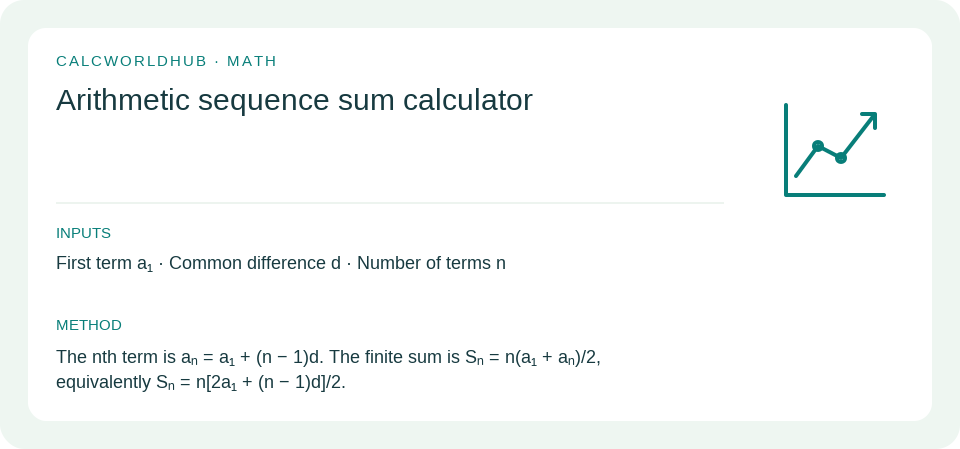
The nth term is aₙ = a₁ + (n − 1)d. The finite sum is Sₙ = n(a₁ + aₙ)/2, equivalently Sₙ = n[2a₁ + (n − 1)d]/2.
Worked example
For a₁ = 3, d = 4, and n = 8, the terms are 3, 7, 11, 15, 19, 23, 27, and 31. Their sum is 8 × (3 + 31)/2 = 136.
Interpreting the result
The result is the total of the first eight terms in this example. A negative difference creates a decreasing sequence; a zero difference repeats the first term n times.
Assumptions and limits
The count must be a positive integer. The calculation assumes a constant difference and sums only the number of terms entered; it does not infer a pattern from observed data.
Method references
Frequently asked questions
Can the common difference be negative?
Yes. A negative difference means each term is smaller than the previous term; the same finite-sum formula applies.
How do I use the Arithmetic sequence sum calculator?
Enter First term a₁, Common difference d, Number of terms n. Match the units shown beside each field and review the result together with the assumptions below.
What is a worked example of Arithmetic sequence sum?
For a₁ = 3, d = 4, and n = 8, the terms are 3, 7, 11, 15, 19, 23, 27, and 31. Their sum is 8 × (3 + 31)/2 = 136.
What does the Arithmetic sequence sum calculator calculate?
Calculate the sum of a finite arithmetic sequence from its first term, common difference, and term count.
What assumptions apply to Arithmetic sequence sum?
The count must be a positive integer. The calculation assumes a constant difference and sums only the number of terms entered; it does not infer a pattern from observed data.
Good calculators show their work.
CalcWorldHub is built around clear inputs and visible assumptions. Results are estimates for planning; check official sources or your provider’s terms when exact figures matter.