Finite geometric series sum calculator
Sum a finite geometric sequence using its first term and ratio. Enter your numbers below to see the result and method.
inputs.
Related calculators and articles
Compare methods and explore more free tools in math.
How to use this calculator
Free Finite geometric series sum calculator. Sum a finite geometric sequence using its first term and ratio. Review the formula and assumptions.
- Enter First term a₁, Common ratio r, Term count n. Match the units shown beside each field and review the result together with the assumptions below.
- Read the worked example below to check the expected input format and result.
- Compare another scenario by changing one input at a time. Use Reset to return to the starting values.
How a finite geometric series is summed
Each term is obtained by multiplying the previous term by the same common ratio. This calculator adds exactly n terms, starting with a₁ and including the first term.
Inputs and units
- First term a₁: The starting value of the sequence. The sum has the same unit as this value.
- Common ratio r: The dimensionless multiplier from one term to the next. It may be positive, zero, or negative.
- Term count n: A positive whole number counting a₁ as term 1.
Formula and method
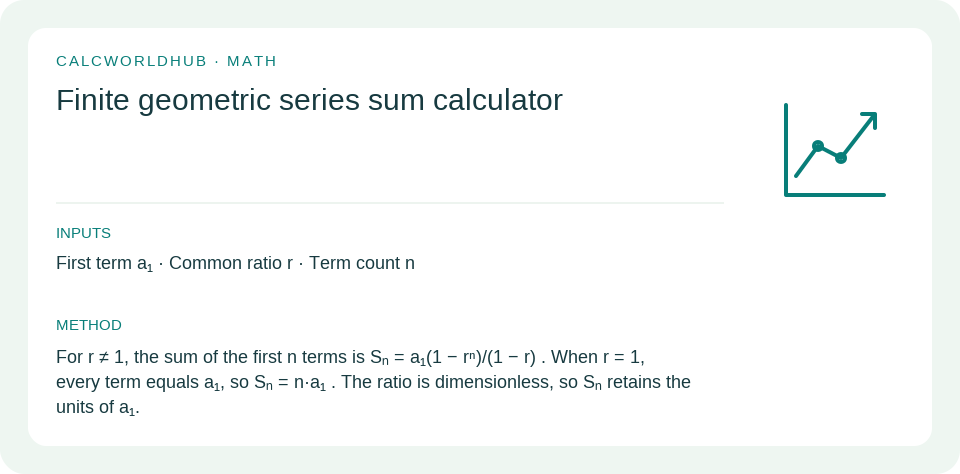
For r ≠ 1, the sum of the first n terms is Sₙ = a₁(1 − rⁿ)/(1 − r). When r = 1, every term equals a₁, so Sₙ = n·a₁. The ratio is dimensionless, so Sₙ retains the units of a₁.
Worked example
For a₁ = 3 units, r = 2, and n = 8, the terms are 3 + 6 + 12 + 24 + 48 + 96 + 192 + 384. Their sum is 765 units. The closed form gives 3(1 − 2⁸)/(1 − 2) = 765.
Interpreting the result
The result is the total of exactly n terms, not the sum of an infinite series. A negative ratio alternates term signs. When |r| is below 1, later terms shrink in magnitude; when |r| exceeds 1, later terms grow and can dominate the total.
Assumptions and limits
The model assumes one unchanged ratio between every consecutive term and a finite positive whole-number term count. Values must remain within JavaScript’s finite numeric range; very large ratios or term counts can overflow and are reported as invalid. Near r = 1, the implementation uses a stable exponential form to reduce cancellation; at r = 1 it uses the exact limit.
Frequently asked questions
What happens when the common ratio is 1?
All n terms equal the first term, so the sum is n times a₁. This is the limit of the geometric-sum formula whose denominator would otherwise be zero.
Can the common ratio be negative?
Yes. A negative ratio alternates the signs of successive terms; the term count must still be a positive whole number.
What does the term count include?
It includes the first term a₁. For example, n = 1 returns a₁.
What unit does the sum use?
The ratio has no unit, so the sum uses the same unit as the first term.
How do I use the Finite geometric series sum calculator?
Enter First term a₁, Common ratio r, Term count n. Match the units shown beside each field and review the result together with the assumptions below.
Related calculators
- Geometric sequence term — calculate one selected term from a₁ and r.
- Arithmetic series sum — sum a finite sequence with a constant difference instead of a constant ratio.
Source
The finite-sum formula and the special condition r ≠ 1 follow OpenStax, Geometric Sequences.
Read the calculation methodology and privacy policy.