Arithmetic series sum calculator
Add an arithmetic sequence from first term, common difference, and term count. Enter your numbers below to see the result and method.
inputs.
Related calculators and articles
Compare methods and explore more free tools in math.
How to use this calculator
Free Arithmetic series sum calculator. Add an arithmetic sequence from first term, common difference, and term count. Review the formula and assumptions.
- Enter First term a₁, Common difference d, Number of terms n. Match the units shown beside each field and review the result together with the assumptions below.
- Read the worked example below to check the expected input format and result.
- Compare another scenario by changing one input at a time. Use Reset to return to the starting values.
How the arithmetic series sum works
An arithmetic series adds a finite sequence whose neighboring terms differ by a constant amount. This calculator uses the first term a₁, common difference d, and positive whole-number term count n.
Formula and worked example
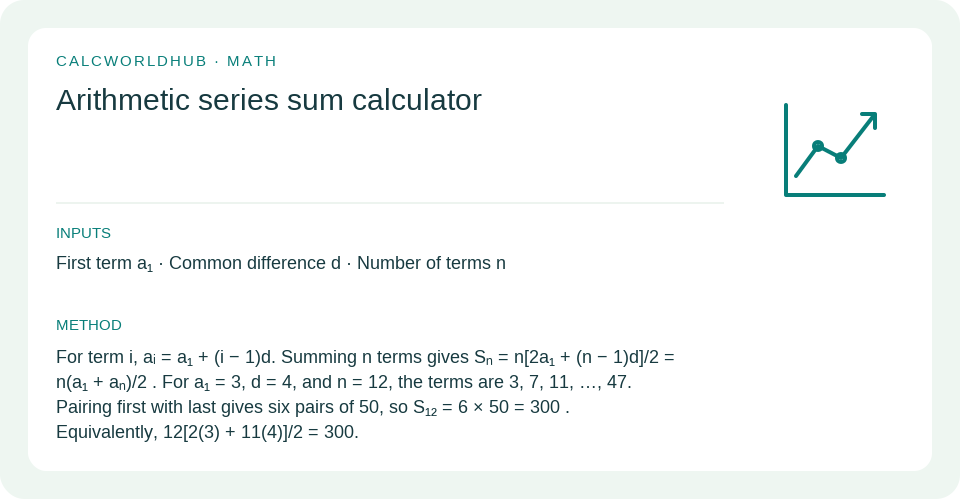
For term i, aᵢ = a₁ + (i − 1)d. Summing n terms gives Sₙ = n[2a₁ + (n − 1)d]/2 = n(a₁ + aₙ)/2.
For a₁ = 3, d = 4, and n = 12, the terms are 3, 7, 11, …, 47. Pairing first with last gives six pairs of 50, so S₁₂ = 6 × 50 = 300. Equivalently, 12[2(3) + 11(4)]/2 = 300.
What to enter
- First term a₁: the value at position 1, in the unit used for every term.
- Common difference d: the constant change from one term to the next, in the same unit as a₁.
- Number of terms n: a positive whole-number count; the final position included in the sum.
Interpreting the result
The sum has the same unit as each term. A negative d means the sequence decreases; the resulting total may be negative, zero, or positive depending on the inputs. The calculator evaluates the finite arithmetic model and rounds only the displayed result.
Assumptions and limits
The sequence must have one constant difference and contain exactly n terms beginning at a₁. Signed finite a₁ and d values are valid; n = 0, fractional n, and negative n do not describe a finite term count for this calculation.
Frequently asked questions
What does the common difference d mean?
It is the fixed amount added to each term to get the next one. With a₁ = 3 and d = 4, the terms are 3, 7, 11, and so on.
Why must n be a positive whole number?
n counts terms in a finite sequence, so it must be an integer of at least 1. With n = 1, the sum is just a₁.
Can the first term or common difference be negative or zero?
Yes. The formula works for signed terms and differences. If d = 0, every term equals a₁ and the sum is n·a₁.
How do I use the Arithmetic series sum calculator?
Enter First term a₁, Common difference d, Number of terms n. Match the units shown beside each field and review the result together with the assumptions below.
What is a worked example of Arithmetic series sum?
For term i, aᵢ = a₁ + (i − 1)d. Summing n terms gives Sₙ = n[2a₁ + (n − 1)d]/2 = n(a₁ + aₙ)/2 . For a₁ = 3, d = 4, and n = 12, the terms are 3, 7, 11, …, 47. Pairing first with last gives six pairs of 50, so S₁₂ = 6 × 50 = 300 . Equivalently, 12[2(3) + 11(4)]/2 = 300.
Formula reference: OpenStax, Arithmetic Sequences. Read the calculation methodology.